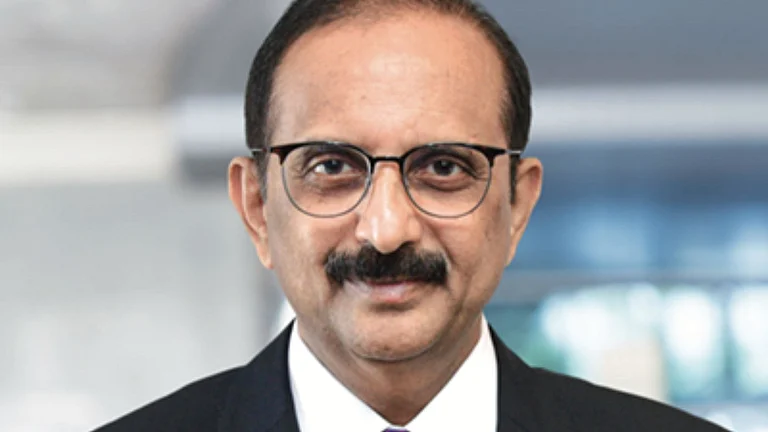
India has an immense opportunity to take lead in diffusion of technology that reaches millions, Wadhwani Foundation CEO and board member Ajay Kela has said.
Diffusion means building national-scale use cases of technology that reach end-users.
Speaking to PTI during an interview recently, Kela further said the coming years will see acceleration in deep-tech startups, while SMEs will be the biggest job creators.

1 September 2026
Get the latest issue of Outlook Business

"The benefits of AI will all come in the application layer which touches the end population. And some of the foundation models are already open source. A lot of them will become even small models and India is building some of those which other countries may not do.
"But where India needs to spend their primary energy... is diffusion of these technologies. India has an opportunity there to lead. India can lead because that's where we have done well all along in the IT segment as well," he said.
On jobs and concerns of loss of employment due to AI, Kela pointed at SMEs and deep-tech startups and said they will be major drivers of employment in the coming years.
Drug discovery, molecular discovery will accelerate deep-tech startups in the coming days and these will be game-changing, he said.
Recently, Wadhwani Foundation announced a strategic roadmap to create 2.5 million jobs in India and enable 6 million placements via training by 2030.
Advertisement
"From micro-entrepreneurs to $20-30 million businesses where big players don't really support and help... we come in, to help them accelerate their growth. Our goal is to see if we can help them incrementally grow 10-15%, which will effectively add another 5-10% of the jobs that they would not have added," he said.
Kela said in the past few years, one major shift has been how the focus has shifted from four-year degree programmes to upskilling.
"There are many such jobs where you don't need to go through four years of rigour and 5,000 hours of training... I can take an 18-year-old or a 40-year-old displaced worker and through 500-1,000 hours of training get them ready for mid-skill entry-level jobs," Kela said.
Advertisement
Digital marketing, data visualisation, home healthcare worker, dental hygienist, the entire BPO industry are some such examples, he said.
The Wadhwani Foundation CEO hailed the AI Impact Summit held in New Delhi last month and said it drew attention from around the world.
"For any government organisation, to hold a 5-day event with endless panels is a very hard task, especially on the first day when there were 300,000-400,000 people coming in," he said.



However, he added that the key objective should be to reach the end user.
"Where India needs to spend their primary energy -- and it even tried to do that at the AI summit -- is diffusion of all these technologies," Kela said.
The Wadhwani Foundation has joined hands with IIT Bombay to set up a Wadhwani Hub for Biosciences, Bioengineering, Health and Medicine and the Wadhwani Innovation and Translation Centre (WITC) to promote research and innovation.
The centre, which will be inaugurated later this year, will come up at a cost of ₹300 crore, of which the foundation's contribution is ₹100 crore.