
India's private sector capital expenditure rose 67 per cent to Rs 7.7 lakh crore in September 2025 from Rs 4.6 lakh crore a year ago, CII said on Sunday, as it unveiled a five-point industry action agenda amid the West Asia crisis and beyond, comprising a phased drawdown of the central excise cut on petrol and diesel.
The Confederation of Indian Industry (CII) termed the surge in private capex as the most decisive evidence yet of a powerful and broad-based revival in the country's investment cycle.
"The Rs 10 per litre central excise cut on petrol and diesel, taken at significant cost to the exchequer, should be progressively rolled back in tranches over six to nine months as crude prices stabilise," argued CII.

1 September 2026
Get the latest issue of Outlook Business

Its five-point agenda also pitches for a 45-day MSME payment guarantee; supply-chain ring-fencing with deeper import substitution; and a front-loading of private capex coupled with voluntary price restraint and a stepped-up internship intake; among others.
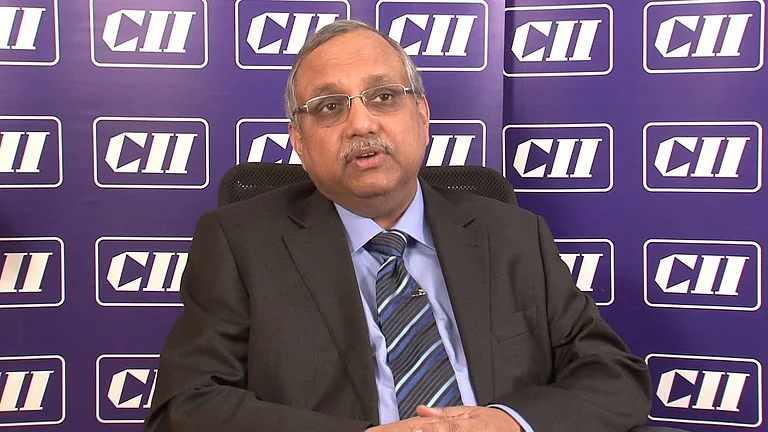
CII's analysis of nearly 1,200 companies, drawn from the CMIE Prowess database, shows that private sector investment, measured as the annual change in net fixed assets and capital work in progress, rose to Rs 7.7 lakh crore in September 2025, a 67 per cent jump over Rs 4.6 lakh crore a year earlier, it stated.
Advertisement
Manufacturing led the way, accounting for Rs 3.8 lakh crore or nearly half of total private capex, with metals, automobiles and chemicals at the forefront. Services contributed Rs 3.1 lakh crore, or about 40 per cent, driven by trading, communications and IT/ITeS.
Complementary indicators reinforce the trend.
Capacity utilisation of manufacturing firms rose to 75.6 per cent in Q3FY26 from 74.3 per cent in the previous quarter, while new order books grew 10.3 per cent year-on-year. Bank credit growth has rebounded sharply, averaging close to 14 per cent in the second half of FY26 against around 10 per cent in the first half.


Advertisement
"Buoyed by this strengthening cycle, CII has appealed to industry to step forward and shoulder its share of the national burden during the ongoing period of global stress, CII Director General Chandrajit Banerjee said.
CII's five-point agenda also suggests its member companies to commit to a 3 to 5 per cent reduction in fuel and power consumption over the next two quarters through process optimisation, efficient logistics, fleet electrification and accelerated renewable power purchase agreements.
Besides, it proposes that larger member corporates could commit to a voluntary 45-day MSME payment guarantee, backed by aggressive use of the TReDS platform and supply-chain finance, to ease working capital pressure on small enterprises during this volatile period.
Indian supply chains will be ring-fenced through diversified sourcing, strategic inventory buffers and tie-ups with alternative geographies, alongside deeper domestic value addition in components, specialty chemicals and capital goods, said CII.