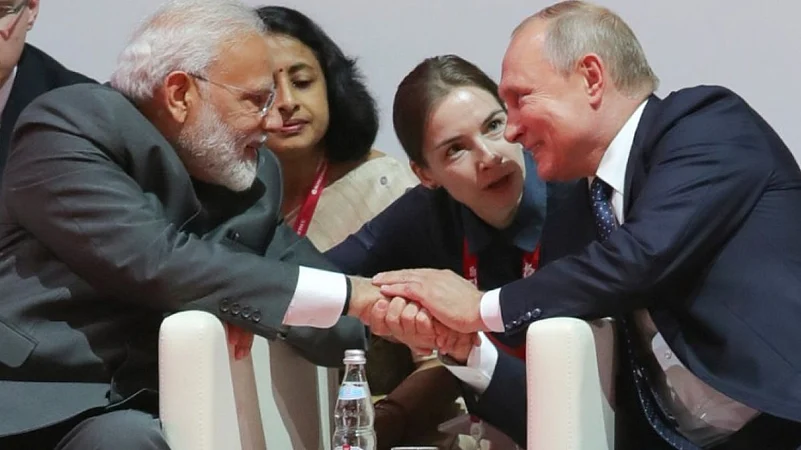

Putin’s visit to New Delhi comes at a critical geopolitical moment as India faces mounting pressure from the US and Western allies.
Defence cooperation remains the core of India–Russia ties, with expected discussions on S-400 and S-500 missile systems, and Su-57 jets, and the RELOS logistics pact.
The real priority for India is rebalancing economic relations and securing sustainable trade, payment mechanisms and energy supply despite sanctions, logistics challenges and declining exports.
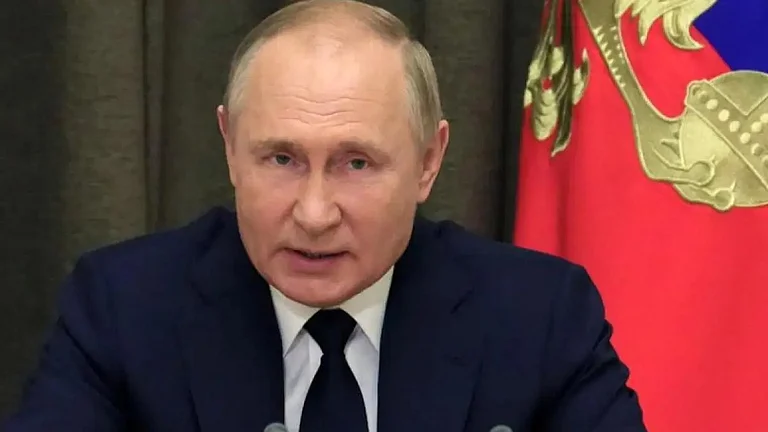
New Delhi is ready to welcome Russian President Vladimir Putin after four long years at the India–Russia Summit, commencing on December 4. Putin’s two-day trip marks a crucial juncture in power politics as pressure from the US and other Western allies mounts on India, while it cannot let go of its long-standing ally. The India–Russia Summit provides a much-needed platform to reshape and reinvent its economic ties with the decades-old friend, which are now below potential and rather “skewed”, as written by C. Raja Mohan, professor at the Motwani-Jadeja Institute of American Studies, Jindal Global University.
India–Russia Best Friend Forever Narrative
The relationship between Moscow and New Delhi can be traced back to the Cold War era, and New Delhi has considered Moscow its “best friend forever”, even amid rising global pressures, sanctions, and outright criticism of New Delhi’s stance on the Kremlin’s invasion of Kyiv in 2022. However, the depth of the ties has narrowed and diluted over the years, with little government-to-government engagement, a report from The Indian Express said. According to Raja Mohan, the ongoing ties that New Delhi is able to maintain with Moscow are largely due to Putin’s personal commitment rather than structural Russian interest.
Advertisement
The war between Russia and Ukraine has emerged as a serious challenge for Indian foreign policy, with New Delhi bearing the brunt of navigating a delicate balancing act in its relations with Russia and the West, the Observer Research Foundation wrote in a note. It further highlighted how the “Sanctioning Russia Act of 2025” proposes to impose 500% duties on countries that “knowingly” purchase or transfer Russian energy, uranium, or petrochemical products. The attempt to pressure Putin into a ceasefire in the ongoing war has rippled into the Indian economy, particularly its dependence on energy imports.
Advertisement
What’s On The Table?
1. The Usual Main Course
Moscow and New Delhi are expected to discuss and boost defence ties. On Monday, the Russian Parliament’s lower house, the State Duma, ratified the Reciprocal Exchange of Logistic Support (RELOS) Agreement, allowing mutual logistical support for military operations, exercises, and humanitarian aid. According to a report by Business Standard, the expected topics on defence between Russia’s defence minister and his Indian counterpart will include several deals, such as India’s additional procurement of S-400 surface-to-air missile (SAM) systems, potential contracts for the purchase and joint production of S-500 systems and the Su-57 fifth-generation fighter jets.
Moscow has remained New Delhi’s largest arms supplier since the 1960s. There are two major drivers of India–Russia’s long-standing defence ties: first, Moscow’s willingness to share technologies and localise production; second, the provision of military hardware following the US embargo in 1965, which led to solidification between the two countries.

1 September 2026
Get the latest issue of Outlook Business

Further, the erstwhile USSR strengthened the Indian Air Force by exporting 200 Su-7 fighter-bombers in 1967. In the 1980s, the Soviet Union enhanced its efforts to grow closer with India with advanced weapons and technologies, and one significant moment came when the USSR leased a nuclear-powered submarine to India in 1987. Following the “lost decade” in the 2000s, a number of deals helped re-establish India–Russia ties. Weapons and equipment provided by Moscow included aircraft, helicopters, battle tanks, missiles, frigates, an aircraft carrier and submarines, reports said. According to the Business Standard article, the upcoming summit is a key platform to remain a defence partner to Moscow, even with a decreasing share of the Indian arms market.
2. The Dessert
As C. Raja Mohan notes, what India right now needs is not just a defence pact with Russia, but rather deepening economic ties with sustainable commercial and trade relations. Raja Mohan highlights that without an economic foundation, New Delhi’s promotion of “multipolarity” with Moscow will remain shallow. According to reports, India’s export growth to Russia slowed owing to sanctions pressure, disruption in supply-chain logistics, and market access, although merchandise trade with Moscow has expanded sharply. According to the latest government data, total trade between India and Russia rose to $68.7 billion in FY25 from $8.73 billion in FY22. However, reports suggest that exporters expect exports to Russia to fall going ahead amid economic sanctions by the European Union and the US. Furthermore, logistics challenges, including inadequate container load and currency fluctuation, especially in the ruble, persist.
What Can India Do?
The European Union is India’s largest trading partner after the US, which has now joined the bandwagon with the US to impose sanctions on Russia. India has been actively engaging in bilateral trade agreements with the EU, the UK, and the US, while also strengthening ties with other regions including Chile and New Zealand.
Raja Mohan says India must navigate a way to enhance ties with all three major players — the EU, the US, and Russia. He suggests India must start by correcting its Russia policy, which is heavily dependent on defence and nuclear cooperation and must now pivot to commerce, technology, and scientific partnership.
“For India, the challenge is strategic balance — protecting autonomy while navigating pressure from Washington and dependence on Moscow,” a report by the Global Trade Research Initiative said.
Putin’s Visit — Likely Outcomes
The report suggests two likely outcomes. The most possible outcome is a cautious strengthening of existing relations between India and Russia, securing firm defence deliveries, maintenance contracts, and technology upgrades. A long-term energy commitment from Russia and a formalised new payment framework may also result in a stabilised relationship, albeit mounting Western pressures.
Second, a more ideal alternative would involve a deeper strategic relationship with joint production of defence equipment, Indian investment in Russian oil and gas projects, and expansion of nuclear cooperation beyond existing deals. Connectivity initiatives, such as the Chennai–Vladivostok corridor or nodes of the International North-South Transport Corridor, could also gain momentum.
“Putin’s visit is not a nostalgic return to Cold War diplomacy. It is a negotiation over risk, supply chains, and economic insulation. A modest outcome will secure oil and defence; an ambitious one will reshape regional economics. The visit is ultimately not about choosing sides — but about managing dependence in a fractured world,” Ajay Srivastava of GTRI notes.