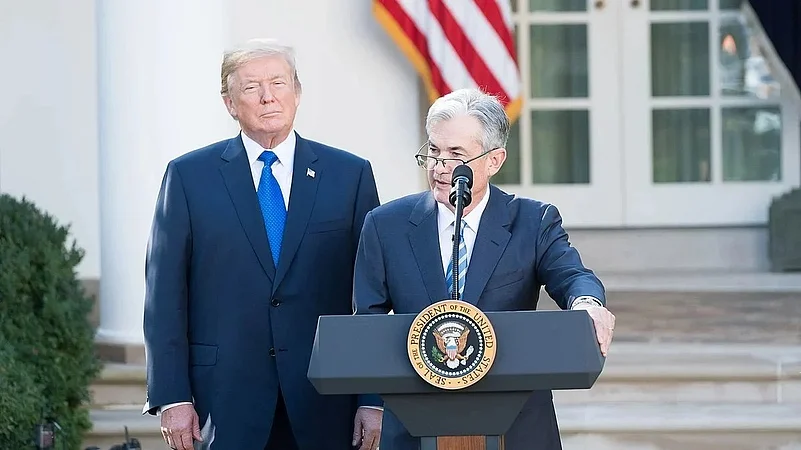

Trump says he has chosen the next US Federal Reserve chair, with Kevin Hassett emerging as the leading contender.
Hassett is seen as aligned with Trump’s push for aggressive rate cuts, though analysts warn of challenges in uniting the Fed’s rate-setting committee.
Markets are watching both the December 9–10 FOMC meeting and Trump’s upcoming announcement.
US President Donald Trump said Sunday that he has decided on his choice for the next Federal Reserve chair, after making clear that he expects his nominee to deliver interest-rate cuts—unlike the current Fed chair Jerome Powell, whom Trump has repeatedly criticised for not reducing benchmark lending rates. “I know who I am going to pick, yeah,” Trump told reporters on Air Force One on his way back to Washington, without naming his choice. “We’ll be announcing it.”
Bloomberg reported, citing sources, that White House National Economic Council Director Kevin Hassett, Trump’s chief economic adviser, is likely to be the candidate succeeding Powell, whose tenure ends in May 2026.

1 September 2026
Get the latest issue of Outlook Business

Earlier Sunday, speaking on a programme, Hassett declined to address whether he considers himself Powell’s successor and called the report a “rumour”. However, he highlighted the positive market reaction to the speculation.
“We had a great Treasury auction, interest rates went down, and I think that the American people could expect President Trump to pick somebody who’s going to help them have cheaper car loans and easier access to mortgages at lower rates,” Hassett said on CBS. “That’s what we saw in the market response to the rumour about me.”
Advertisement
According to reports, Hassett is the likely choice as Trump trusts him and sees him as aligned with his push for more aggressive rate cuts. Hassett said he would accept the role if asked, though analysts warn he may struggle to unite the Fed’s rate-setting committee and could be more vulnerable to political pressure. US Treasury Secretary Scott Bessent said last week that Trump is likely to announce his nominee before December 25. Trump’s nominee will require Senate confirmation as chair and may be appointed to a 14-year Fed governor term beginning in February, if the selection is an outsider. Hassett has decades of experience in Republican economic policymaking, having served as economic adviser to George W. Bush, John McCain, and Mitt Romney.
Advertisement

Who Are the Other Frontrunners?
The other two leading contenders are former Fed governor Kevin Warsh and current board member Christopher Waller. Other finalists include Fed governor Michelle Bowman and BlackRock’s Rick Rieder.
Warsh is known for his hawkish stance, and his prior tenure at the central bank would represent a sharp directional shift, Mint reported. He served in the White House under President George W. Bush before being appointed to the Federal Reserve Board in 2006. His tenure covered the critical period of the 2008 financial crisis, during which he was a central figure in the response.
Waller, currently on the Federal Reserve Board, is seen as offering continuity and institutional steadiness. Bowman, appointed by Trump in 2018 and reappointed in 2020, has held senior roles across federal agencies.
Rick Rieder is the chief investment officer for global fixed income at BlackRock, overseeing nearly $2.4 trillion in assets. He began his career at Lehman Brothers before joining BlackRock.
Why the Fed Chair Appointment Matters
The appointment of the US Federal Reserve chair is one of the most consequential economic policy decisions, directing interest-rate strategy, shaping responses to inflation, and serving as the central figure of US monetary policy. Fed decisions move global markets instantly, influence credit availability, and affect the economic outlook for households, businesses, and governments.
The choice of Powell’s successor is especially critical as tensions have grown between the White House and the US central bank regarding decisions of the Federal Open Market Committee (FOMC) and their impact on the economy. Trump has repeatedly called for rate cuts, while the FOMC has maintained status quo on benchmark lending rates through most of 2025, reducing the Fed Funds target range only twice—by 25 basis points each in September and October.
The FOMC is scheduled to meet for its final policy review of the year on December 9–10, amid signs of a softening labour market, easing price pressures, and delayed government data due to the shutdown. According to the CME FedWatch Tool, traders see an 87.6% probability of a 25-basis-point cut, with the remainder expecting a hold.
How US FOMC Outcomes Impact India
The US Federal Reserve’s policy decisions have significant effects on Indian financial markets, particularly government bonds and foreign exchange. When interest rates are reduced—whether the US federal funds rate or India’s repo rate—it becomes cheaper to borrow, encouraging businesses to expand and households to spend.
When the Fed cuts rates, the interest-rate differential between India and the US widens, making India and other emerging markets more attractive for carry trades. Lower yields in the US debt market may also trigger stronger foreign inflows into emerging-market equities. Fed moves ripple into India through capital flows, the rupee, and monetary-policy space.
When the Fed cuts rates, US Treasury yields fall, pushing global investors toward higher-yielding emerging markets like India. This typically strengthens the rupee, boosts bond prices, and increases foreign equity inflows. It also gives the RBI more room to cut rates without risking capital flight.
When the Fed hikes rates, the dollar strengthens and capital tends to move away from emerging markets. This can pressure the rupee, push domestic bond yields higher, and limit the RBI’s ability to reduce the repo rate—sometimes forcing it to remain on hold or turn hawkish to maintain stability.



India’s markets will track both the December FOMC outcome and the identity of Powell’s successor, who will oversee the next phase of US monetary policy.