
The RBI's Monetary Policy Committee unanimously decided to keep the benchmark repo rate unchanged at 5.25% and retain its neutral policy stance.
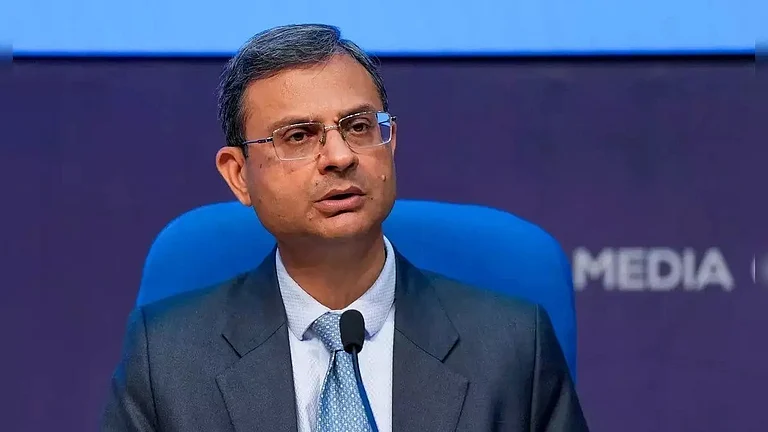
Governor Sanjay Malhotra said the global economic outlook remains uncertain due to elevated energy prices and supply-chain disruptions arising from the West Asia crisis.
The RBI noted that central banks worldwide are becoming more cautious, with some expected to shift towards tighter monetary policy amid rising global risks.
The Reserve Bank of India's Monetary Policy Committee (MPC) on Friday kept the benchmark repo rate unchanged at 5.25% and retained its neutral policy stance. The decision was unanimous, with RBI Governor Sanjay Malhotra stating that the global economic outlook remains clouded by elevated energy prices and supply-chain disruptions arising from the ongoing crisis in West Asia.
He added that, against this backdrop, monetary policy has become more cautious across the world, with several central banks likely to pivot towards policy tightening.

1 October 2026
Get the latest issue of Outlook Business

"The committee noted that the global environment has deteriorated since the last policy meeting, with the conflict continuing amid a fragile truce," Malhotra said. "The adverse implications of the prolonged disruption in supply chains and elevated energy prices are reflected in the moderation of growth and the increase in inflation projections from the April policy."
He added that the rate-setting panel believes there are considerable risks to both baseline inflation and growth due to uncertainty surrounding the duration of the conflict and the possibility of further escalation.
Advertisement
The spillover effects, along with forecasts of a sub-normal southwest monsoon and El Niño conditions, pose additional risks to economic growth.
Despite higher-than-expected inflation projections, the RBI reiterated that it would continue with a "wait-and-watch" approach before making any changes to policy rates.
Growth and Inflation Projections
The RBI has projected real GDP growth for FY27 at 6.6%, down from the 6.9% forecast in the April policy review. Growth is expected to moderate to 6.3% in the quarter ending September before recovering to 6.8% in the January-March quarter.
"Prolonged global supply-chain disruptions, volatility in global financial markets, and weather-related shocks continue to pose downside risks to the domestic growth outlook," the RBI said in a statement.
Advertisement
Acknowledging the impact of elevated global energy prices on raw material costs and economic activity, the RBI projected CPI inflation for FY27 at 5.1%. Inflation is expected to rise to as high as 5.9% in the quarter ending December before easing thereafter.
Core inflation is projected at 4.7% for FY27. Despite the upward revision, inflation is expected to remain within the RBI's inflation-targeting framework. The central bank's inflation target is 4%, with a tolerance band of ±2%.
"These forecasts are subject to upside risks arising from global supply-chain disruptions, global commodity price shocks, uncertainty regarding the spatial and temporal distribution of the southwest monsoon, and El Niño conditions. Adequate stocks of foodgrains and satisfactory reservoir levels, however, provide some comfort," the RBI said in its statement.
Financial Market Conditions
Speaking on financial market conditions and liquidity, Malhotra said that, according to the latest data, credit from all sources grew 15.4% year-on-year in FY26, compared with 12.1% a year earlier.
He added that bank credit growth remained robust, although market-based funding had become more expensive. The financial health of Scheduled Commercial Banks (SCBs) also remained strong in terms of capital adequacy, liquidity, asset quality, and profitability, though some moderation in profitability has been observed.
The external sector remains comfortable, he said, although the rapidly evolving geopolitical situation warrants caution and poses upside risks to the current account deficit.
Malhotra noted that the services trade surplus and remittance inflows are expected to provide some cushion against external vulnerabilities. However, net foreign portfolio investment (FPI) flows into India recorded outflows of $13.7 billion, primarily from the equity market.



As of May 29, India's foreign exchange reserves stood at $683.3 billion, which is sufficient to cover around 11 months of imports and the country's external debt obligations.