US President Donald Trump has nominated Kevin Warsh to succeed Federal Reserve Chair Jerome Powell.
Warsh’s appointment is expected to ease tensions between the White House and the US central bank during Trump’s second term.
Warsh was a member of the Board of Governors of the Federal Reserve System between 2006 and 2011.
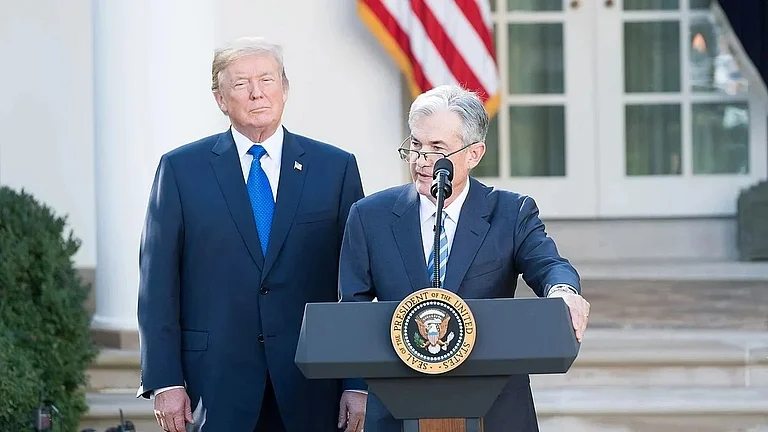
US President Donald Trump on Friday said he has nominated Hoover Institution’s Kevin Warsh to succeed Federal Reserve Chair Jerome Powell, ending months of speculation that had put global investors and financial markets under a cloud of uncertainty. Warsh’s appointment is expected to bring an end to the White House’s public feud with the US central bank since Trump returned to office for a second term in January.
“I am pleased to announce that I am nominating Kevin Warsh to be the Chairman of the Board of Governors of the Federal Reserve System. Kevin currently serves as the Shepard Family Distinguished Visiting Fellow in Economics at the Hoover Institution, and as a lecturer at the Stanford Graduate School of Business,” Trump wrote on his Truth Social page.
1 August 2026
Get the latest issue of Outlook Business

“I have known Kevin for a long period of time, and have no doubt that he will go down as one of the great Fed chairmen, maybe the best. On top of everything else, he is ‘central casting’, and he will never let you down,” the US president added.


Advertisement
What We Know About Kevin Warsh
Warsh was a member of the Board of Governors of the Federal Reserve System between 2006 and 2011. He currently serves as a distinguished visiting fellow at Stanford University’s Hoover Institution and as a lecturer at its Graduate School of Business. In addition, he advises several companies, including serving on the board of directors of United Parcel Service.
Born in Albany, New York, Warsh completed his undergraduate studies at Stanford University in 1992, earning an honours degree in public policy with a focus on economics and statistics. He later attended Harvard Law School, where his academic work centred on the interaction of law, economics and regulatory policy, graduating in 1995.
Advertisement
He began his professional career at Morgan Stanley & Co. in New York, joining the firm’s mergers and acquisitions division. In February 2002, Warsh left his role as vice president and executive director at Morgan Stanley to enter public service under President George W. Bush. He was appointed special assistant to the president for economic policy and executive secretary of the National Economic Council, advising senior officials on capital flows, securities markets, banking and insurance. He also served on the President’s Working Group on Financial Markets.
President Bush nominated Warsh to the Federal Reserve Board in 2006. During his tenure, he represented the Board at the Group of Twenty (G20) and acted as an envoy to both emerging and advanced economies in Asia. He also served as administrative governor, overseeing the Board’s operations, staffing and finances.
Road to Appointment Still Rocky
According to US media reports, while Warsh’s nomination concludes a crowded selection process that at one point included 11 contenders, his appointment still faces hurdles. Republican Senator Thom Tillis has said he will block any Fed appointments until a Justice Department investigation involving current Chair Jerome Powell is resolved.
Earlier this month, Powell was subpoenaed over a construction project at the Federal Reserve building. In a rare public rebuke, he described the move as a “pretext” aimed at pressuring the Fed to comply with Trump’s demands to loosen monetary policy.
Uncertainty also surrounds Powell’s future at the borad of the central bank. While Fed chairs have typically stepped down from the Board after losing the top role, Powell still has two years remaining as a governor and could choose to stay on as a check on political interference.