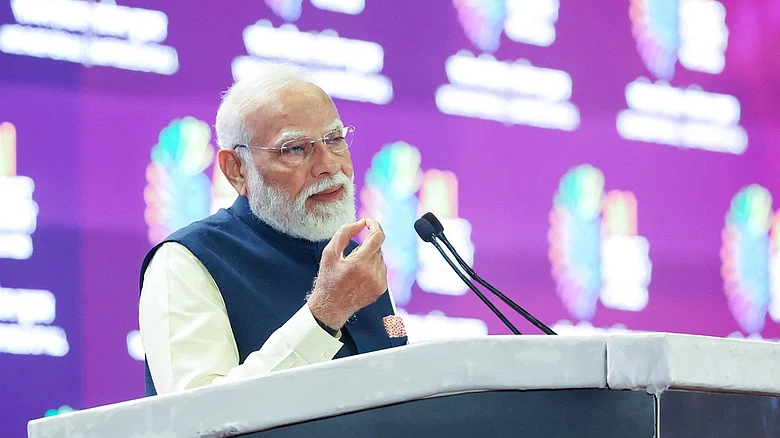
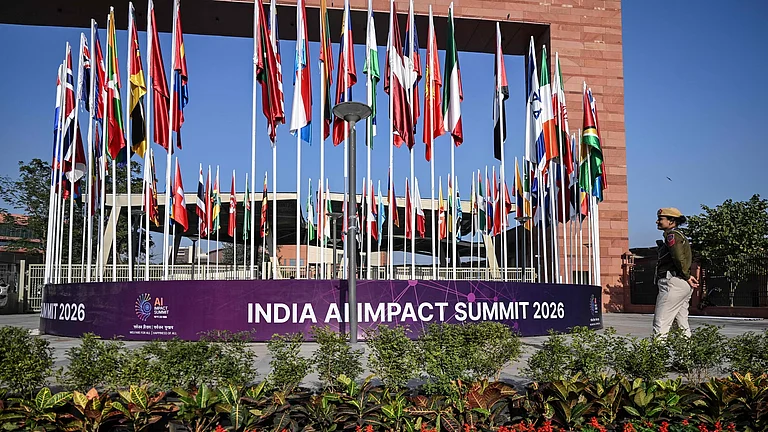
Prime Minister Narendra Modi on Thursday outlined India's 'MANAV' vision for artificial intelligence at India AI Impact Summit 2026. The mission lays out a human-centric framework for the responsible use of AI. Modi presented the mission while addressing global leaders at the summit in New Delhi today.
He said it would guide the development of AI "for the welfare of humanity in the AI-based world of the 21st century". Modi positioned India as a natural hub for this transformation and highlighted the country's diversity. demography, and democracy to underscore his stance.
At the expo, the Prime Minister argued that AI models capable of succeeding at India’s scale and complexity could be deployed globally, owing to its young population.

1 October 2026
Get the latest issue of Outlook Business

"We must democratise AI. It must become a tool for inclusion and empowerment, particularly for the Global South," Modi told the global leaders and technology giants.
What Is 'MANAV' Vision?
Modi explained the 'MANAV' vision for AI during the expo, saying the word's literal meaning is "human". In simple words, it an acronym for five guiding pillars, including 'moral and ethical systems', 'national sovereignty', 'accountable governance', accessivle and inclusive technology' and 'valid legitimate systems'.
“Manav means human, and the MANAV Vision says M — moral and ethical systems: AI should be based on ethical guidance. A — accountable governance means transparent rules and robust oversight; N — national sovereignty means whose data, his right; A — accessible and inclusive means AI should be a multiplier, not a monopoly; V — valid and legitimate means AI should be lawful and verifiable," he said.
Advertisement
Modi added that this vision will become an important link for the welfare of humanity in the AI-based world of the 21st century.
He called for using AI for public good rather than as a competitive weapon and urged the need to safeguard trust in the digital age. He invited innovators and creators to design and develop in India.
However, he acknowledged the limitations and uncertainty surrounding the social and economic impact of AI in an evolving world. “Our future is like a new opportunity. This is the time for humans and intelligent systems to work together — an era where humans and intelligent systems co-create and collaborate,” he added.
Advertisement
Modi on AI Impact
In his address, PM Modi also compared the current AI revolution to historic turning points the reshaped civilisation and accelerated the pace of development. He mapped humanity's journey from the harnessing of fire to the advent of writing and wireless communication, while describing AI as the next defining leap in that long arc of transformation.
“What we are witnessing today is only the beginning of AI’s impact,” he said, adding that the speed and scale of change driven by AI are unprecedented. Unlike earlier technological shifts that took years to spread, AI advancements are expanding rapidly across sectors and geographies," he said.
"AI has transformative power. If it is left without a path ahead it will cause disruption. If it goes the right path, it will help in the solution process," Modi added.
PM Modi welcomed global leaders on Thursday, including United Nations Secretary-General António Guterres and International Monetary Fund Managing Director Kristalina Georgieva.


The AI Impact Summit, concluding on Friday, has hosted over 500 global tech leaders, including Google’s Sundar Pichai and OpenAI’s Sam Altman, 150 academics and researchers, and 400 chief technology officers, vice presidents, and philanthropists.