Draft India–EU FTA extends mutual Most Favoured Nation treatment for five years.
European Union and India to align standards, ease customs and support digital trade.
Agreement covers a €180bn trade relationship and a 2-billion-people free-trade zone.
Tariffs to be cut on 96.6% of trade value, boosting access to EU’s 450mn-consumer market.
A draft of the proposed trade agreement between India and the European Union, released on Friday, has revealed that both parties intend to extend Most Favoured Nation (MFN) status to one another once the pact comes into force. The arrangement would bar either side from offering more favourable tariff terms to third countries for a period of five years.
According to the draft text published by the commerce and industry ministry, the two parties have committed to refraining from imposing new import or export restrictions beyond what World Trade Organisation rules permit, and have agreed to strengthen cooperation on digital commerce under the proposed free trade agreement (FTA). News agency Reuters was the first to report this.

1 October 2026
Get the latest issue of Outlook Business

To facilitate smoother trade flows, New Delhi and Brussels intend to bring food safety and plant health standards into line with WTO requirements, whilst also simplifying certification and audit processes. The text further outlines plans for improved customs cooperation and swifter clearance of goods, with these commitments becoming legally binding upon ratification.
Advertisement
One year after the agreement takes effect, both parties will begin exchanging annual import data to track how the deal is being implemented and how tariff preferences are being used. They have also agreed to ensure that appeal procedures for customs decisions — covering imports, exports and goods in transit — are fair, transparent and accessible.
On the digital front, India and the EU have pledged to remove unwarranted obstacles to online trade and to foster an open and secure digital environment. The draft acknowledges privacy as a fundamental right whilst preserving each side's sovereign authority over personal data protection and the cross-border transfer of data. The text also supports paperless trading and the legal recognition of electronic contracts, signatures and authentication methods.
Advertisement
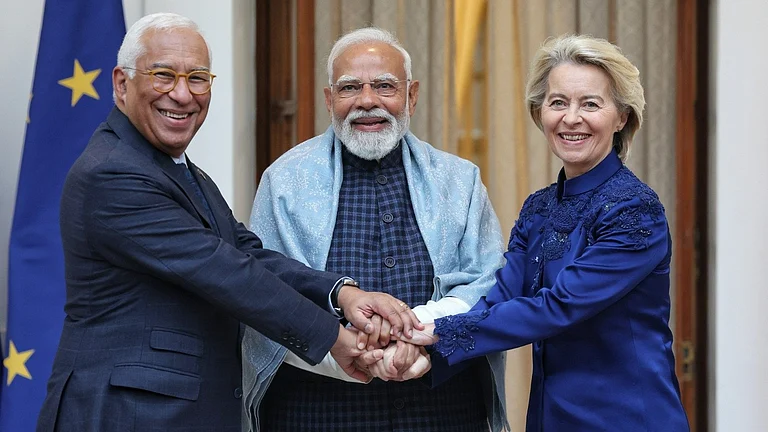
India-EU Trade Deal
The two economies reached the long-awaited agreement a month ago, ending 18-year negotiations and linking two of the world’s largest democratic markets. Together, India and the European Union account for about 25% of global GDP and nearly one-third of global trade.
It also creates one of the world’s largest free trade zones, covering close to 2 billion people by integrating India’s population of around 1.4 billion with the 27 countries of the European Union.
The EU and India currently trade over €180bn worth of goods and services annually. For India, the deal provides duty-free access to a market of 450 million European consumers, particularly benefiting labour-intensive sectors like textiles, leather, and gems and jewellery.
The deal is not expected to take effect for roughly a year, pending ratification through the relevant legislative processes. Once in force, it is projected to double EU exports to India by 2032, with tariffs eliminated or reduced on goods accounting for 96.6% of trade by value. European businesses stand to save around $4.7 billion in import duties as a result.

Certain sensitive agricultural products — including soya, beef, sugar, rice and dairy — have been deliberately excluded from the agreement's scope, as both sides acknowledged.