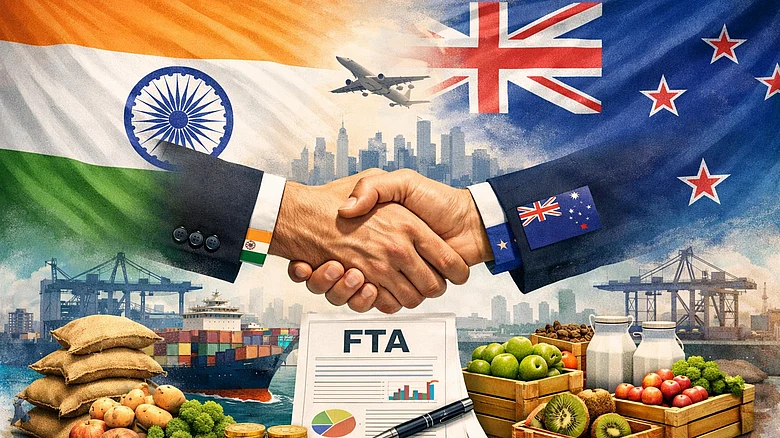

Under the India-New Zealand FTA, 100% of Indian exports will receive duty-free access to New Zealand, while 57% of New Zealand's exports to India will become tariff-free from day one, with further tariff reductions phased in over time.
The agreement expands cooperation in services, agriculture, MSMEs, investment and skilled mobility, including opportunities for Indian students, professionals and businesses.
The two countries aim to double bilateral trade to $5 billion, building on merchandise trade of $1.16 billion in FY2026 and strengthening economic ties across the Indo-Pacific.
Prime Minister Narendra Modi's visit to New Zealand, during his three-nation visit, will mark a significant milestone in bilateral ties, coming months after the two countries signed a landmark Free Trade Agreement (FTA) that is expected to reshape trade, investment and mobility between the two economies.
The visit will accelerate the momentum between the two nations after New Zealand Prime Minister Christopher Luxon announced that more than half of New Zealand's exports to India will become tariff-free from day one under the agreement.

1 October 2026
Get the latest issue of Outlook Business

"New Zealand businesses are set to boom with our India Trade Deal. 57% of everything we export to India will be tariff free from day one," Luxon said in a post on X.
The FTA, signed on April 27, 2026, is among India's fastest-concluded trade agreements, with negotiations beginning in March 2025 and concluding within nine months. The pact covers trade in goods, services, agriculture, investment, skilled mobility and technical cooperation, while strengthening New Zealand's role as India's gateway to Oceania and the Pacific region.
Advertisement
Why the FTA Matters
The agreement is expected to double bilateral trade to $5 billion over the next five years, opening new opportunities for exporters, manufacturers, MSMEs and service providers in both countries.
For Indian exporters, the biggest gain is complete duty-free access to the New Zealand market across 8,284 tariff lines, making products from pharmaceuticals to engineering goods more competitive. Meanwhile, India will gradually liberalise access across 70.03% of its tariff lines, while protecting sensitive sectors such as dairy, selected agricultural products and strategic industries.
A New Phase in Bilateral Trade
Although trade between the two countries remains relatively modest, it has expanded steadily over the past few years.
Advertisement
Merchandise trade stood at $1.16 billion in FY2026, recording an 8% compound annual growth rate (CAGR) between FY2022 and FY2026 despite easing from the FY2025 peak. India exported goods worth $566 million while imports from New Zealand rose to $589 million, resulting in a $23 million trade deficit, according to data by Rubics Data Sciences.
The report notes that despite this moderation, bilateral trade remains well above historical levels, suggesting considerable untapped potential that the FTA could unlock through improved market access and lower trade barriers.
What's India Exporting?
India's export basket is becoming increasingly diversified and value-driven. Pharmaceuticals remain the country's largest export category, while passenger vehicles and refined petroleum products have emerged as fast-growing segments. Engineering goods, chemicals, machinery, electronics, textiles, leather and footwear are also expected to benefit significantly from duty-free access under the FTA.
The report highlights that India's exports are gradually shifting from a fragmented basket towards higher-value and strategically competitive sectors, strengthening its position in the New Zealand market.
What Does India Import From New Zealand?
India's imports are increasingly concentrated in industrial raw materials that support domestic manufacturing. Wood logs, ferrous scrap, coal, aluminium scrap and raw wool account for a growing share of imports, reflecting rising demand from India's construction, steel recycling and industrial sectors.
Beyond Goods: Investment and Mobility
The FTA extends well beyond merchandise trade. New Zealand has committed to invest $20 billion in India over the next 15 years, reinforcing long-term economic cooperation. The agreement also creates new mobility opportunities for Indian students and professionals.
Indian students will be allowed to work up to 20 hours a week while studying and will gain access to extended post-study work visas of up to four years, depending on their qualifications.
Additionally, 5,000 skilled visas will be issued annually for Indian professionals in sectors such as IT, healthcare and education, while 1,000 young Indians will be eligible for a working holiday programme.
Services, Agriculture and MSMEs
The agreement also opens New Zealand's services market across 118 sectors and extends most-favoured nation treatment in 139 sectors, making it the country's most comprehensive services commitment to date.
It also includes cooperation in AYUSH, tourism, audiovisual industries, sports and traditional knowledge.
For agriculture and MSMEs, the FTA establishes frameworks to improve farm productivity, promote mutual recognition of organic products and help small businesses integrate into global value chains through better market access and institutional support.

The India-New Zealand FTA represents more than a tariff-cutting exercise. It is designed to deepen economic integration through trade, investment, services, mobility and technology cooperation.
With New Zealand offering full duty-free access to Indian exports and both countries expanding cooperation across manufacturing, agriculture, education and skilled mobility, the agreement lays the foundation for a broader strategic partnership. As Prime Minister Modi visits New Zealand, the focus is likely to shift from concluding the deal to translating its provisions into higher trade, greater investment and stronger people-to-people ties.