
India is actively courting greater foreign direct investment from South Korea, aiming to diversify and deepen capital flows beyond traditional sources amid global supply-chain shifts.
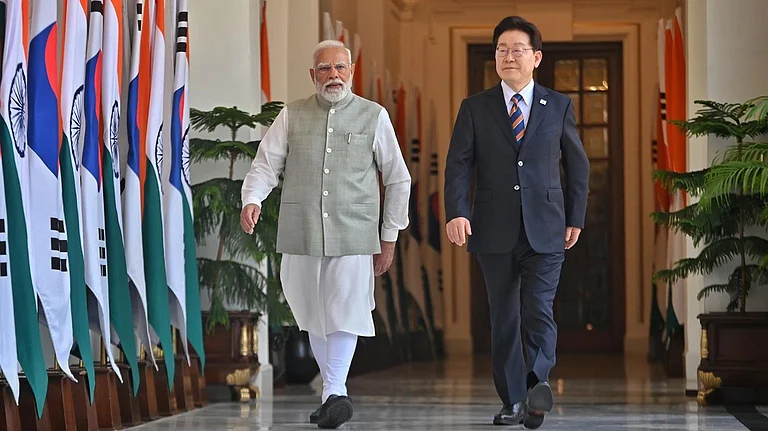
Discussions between Prime Minister Modi and South Korean President Lee Jae-myung highlighted expanding Korean investment from core manufacturing into semiconductors, shipbuilding, energy and advanced mobility sectors.
Both nations are targeting to nearly double annual bilateral trade to around $50 billion by 2030, while exploring venture capital and innovation funds to boost tech and startup collaboration.
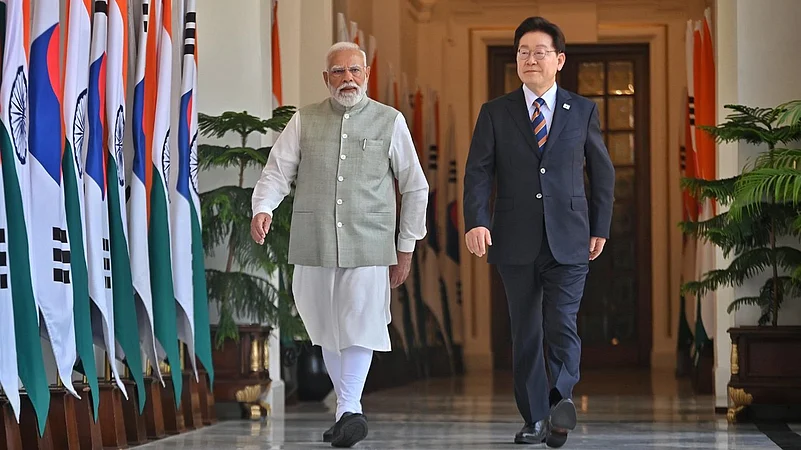
India is stepping up its efforts to draw greater foreign direct investment from South Korea, with Prime Minister Narendra Modi's meeting with visiting South Korean President Lee Jae Myung on April 20 serving as the latest signal of that intent. The summit in New Delhi went beyond diplomatic formality. It was a structured attempt to position India as a preferred investment base for Korean conglomerates at a time when global supply chains are being reorganised, according to multiple reports.
South Korea is already a significant investor in India, ranking among its 13th to 15th largest sources of FDI. Between April 2000 and March 2025, Korean companies have invested over $6.69 billion in India, driven largely by the bilateral Comprehensive Economic Partnership Agreement (CEPA). The bulk of this capital has flowed into automobiles, electronics and steel, with Samsung, Hyundai and LG as the most prominent players. Total bilateral trade currently stands between $25 billion and $28 billion, with both sides targeting $50 billion by 2030.
1 September 2026
Get the latest issue of Outlook Business

Beyond the Factory Floor
While manufacturing has anchored Korean investment in India so far, the Modi-Lee discussions pointed to a more ambitious agenda. The two leaders indicated that future Korean capital is expected to move into semiconductors, shipbuilding, energy systems and advanced mobility, the sectors aligned with India's industrial ambitions.


Advertisement
A dedicated India-Korea startup and innovation investment fund was among the key proposals discussed. Unlike earlier phases of Korean investment that focused on large-scale manufacturing plants, this initiative is aimed at channelling Korean venture capital into early-stage Indian companies working in artificial intelligence, semiconductor design, electric mobility software and industrial automation.
On the established conglomerate side, LG Group's ongoing expansion in electronics and consumer manufacturing was cited as evidence of growing confidence in India as a long-term production base. The discussions also pointed to potential expansion by other Korean manufacturers in electronics and components, with India keen to deepen value chains rather than remain a final assembly destination.
Advertisement
"We will realise new opportunities for cooperation in every field, from chips to ships, talent to technology, environment to energy, and together we will ensure the progress and prosperity of both countries," Modi said.
Shipbuilding as a Strategic Bet
Shipbuilding emerged as a particularly significant pillar of the investment agenda. India is exploring deeper cooperation with HD Hyundai, one of the world's leading shipbuilding groups, to build domestic shipyard capacity and a maritime manufacturing ecosystem. The discussions covered co-investment in shipbuilding infrastructure, port-linked industrial clusters and vessel manufacturing within India, not merely procurement.
The numbers underline why this matters. India's share of global shipbuilding has fallen from 0.15% in 2014 to just 0.06% in 2024. South Korea, which held the second-largest share in global shipbuilding in 2024 after China, brings both scale and expertise that India is looking to tap.
Trade Deficit Complication
The investment push comes alongside a trade imbalance that has grown harder to ignore. India's trade deficit with South Korea widened after the CEPA came into force in 2010. After FY22, Indian exports to Korea declined, with petroleum products, aluminium and steel among the most affected categories. India is now pushing for a renegotiation of the bilateral trade agreement, a backdrop that adds complexity to the broader effort to deepen economic ties.
As part of the visit, senior executives from major Korean conglomerates also met Prime Minister Modi directly, a format that has become a fixture of India's investment diplomacy, allowing companies to identify opportunities and engage without bureaucratic delays.