Against the backdrop of a rapidly deteriorating security environment in West Asia and its cascading impact on global maritime stability, Indian Navy Chief Admiral Dinesh K Tripathi cautioned that geographic distance no longer insulates nations from the consequences of conflict.
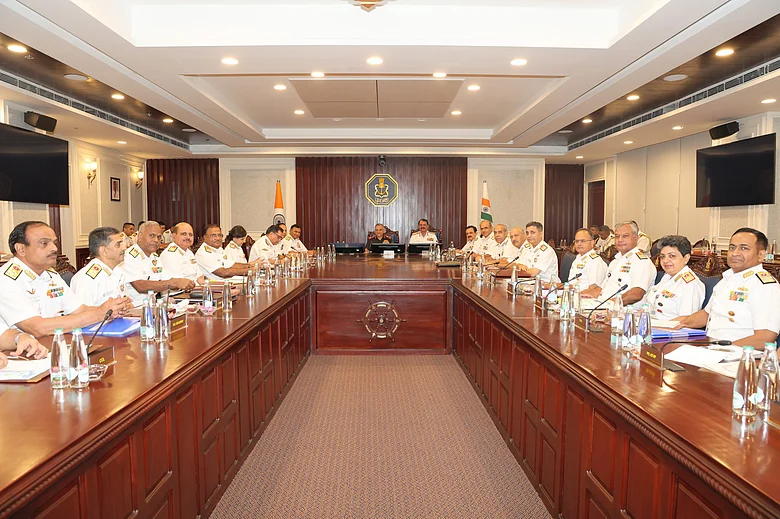
His comments came on the first day of the three-day Navy Commanders' Conference that began on April 14 in New Delhi.
At this crucial conference, the Navy Chief "addressed and interacted with the Naval Commanders on matters pertaining to changing geo-political orders, and urged the Navy to plan for rapidly evolving character of war, including economic and technological factors."

1 October 2026
Get the latest issue of Outlook Business

Drawing attention towards the continued instability in West Asia and its linked disruptions to the maritime traffic, Admiral Tripathi said "security is interconnected, persistent, and unforgiving - where distance from conflict does not equate to distance from its consequences."




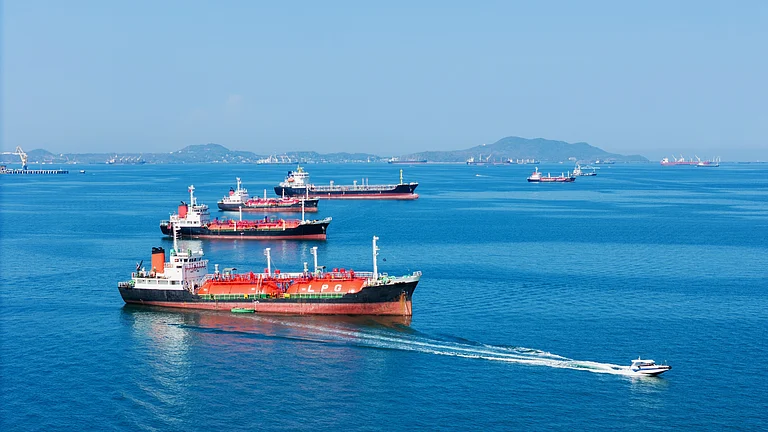
His remarks come amid the fallout of failed peace talks in Islamabad last week, reports of a possible second round of negotiations in the coming days and escalating concerns over the blockade of the Strait of Hormuz by the United States, which has caused global supply disruptions in the energy sector, leading to shooting up of oil and energy prices.
Advertisement

Notably, the conference also comes in the wake of heightened instability in the maritime domain following the sinking of the Iranian naval vessel IRIS Dena last month, an incident that has further intensified tensions in the region and raised concerns over the safety of commercial shipping routes.
It is worthy to note that an American Submarine torpedoed and sank the IRIS Dena in the international waters in the Indian Ocean as the later was returning from the joint naval exercises in India.
Advertisement
Speaking of the global power dynamic which is witnessing a turbulent phase, the Navy Chief said that "in a span of five years, we have moved from a competition continuum to a conflict continuum."
He highlighted the salient impacts of the ongoing conflict, "both economic and military", as well as the visible shaping of conflict perception through "narrative warfare, and not just operational outcomes alone."
He also underscored the growing complexity of maritime security, driven by concurrent conflicts, the rise in capabilities of adversaries, and the increasing role of non-state actors.
The Navy Chief highlighted the force’s progress in capability augmentation, noting full utilisation of the allocated budget, the conclusion of over 90 capital contracts, and the continued induction of indigenously designed platforms.
More than 15 platforms are scheduled for delivery this year, reflecting a sustained push towards self-reliance, he said.
He highlighted a significant rise in operational deployments over the past decade, with Indian naval assets maintaining a sustained presence in critical waters, including the Persian Gulf, to ensure the safe transit of merchant vessels and reassure Indian seafarers.
Chief of Defence Staff Anil Chauhan also addressed the gathering, urging commanders to adapt to the rapidly evolving character of warfare, where economic and technological factors are increasingly shaping outcomes.
With geopolitical tensions continuing to escalate, the conference in the next two days is expected to further deliberate on strategies to secure India’s maritime interests while responding effectively to emerging threats in an increasingly contested global order.