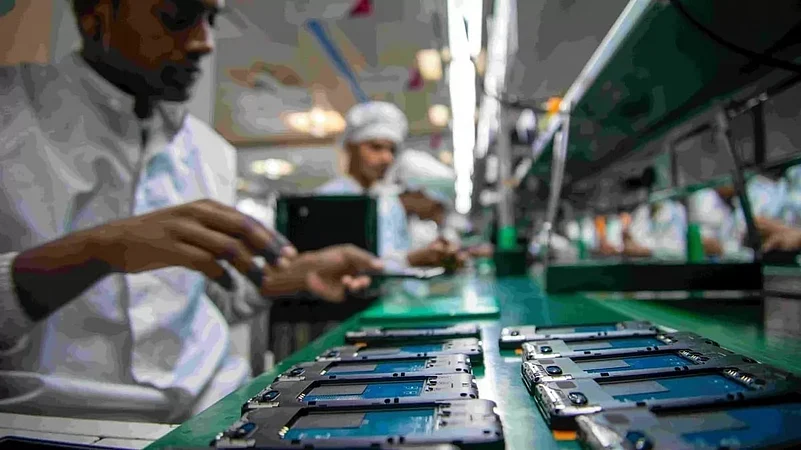
Prime Minister Narendra Modi's government is preparing a fresh push to reduce India's dependence on imports, with plans to expand domestic manufacturing across key sectors as geopolitical tensions and supply chain disruptions expose vulnerabilities in the economy, Bloomberg reported.
According to officials familiar with the matter, the Prime Minister's Office has directed ministries to identify products where imports can be replaced by locally manufactured alternatives.
As per the report, the government is evaluating incentives, including subsidies and production support, to encourage domestic manufacturing, though discussions are still underway and no final decisions have been taken.

1 September 2026
Get the latest issue of Outlook Business

Over 100 Products Under Review
The Ministry of Commerce and Industry is drawing up a list of more than 100 products where local production can be scaled up. These include electronics, semiconductors, chemicals, automobiles, machinery, fertilisers and critical pharmaceutical ingredients.
The initiative comes as India seeks to strengthen supply chains, reduce pressure on the rupee and narrow its trade deficit.
In the financial year ended March, the country imported goods worth nearly $775 billion, with almost one-fifth of those imports coming from China.
Principal Secretary to the Prime Minister and Former RBI Governor Shaktikanta Das is leading a task force preparing an import-substitution roadmap, with members of the Prime Minister's Economic Advisory Council also involved in the exercise.
Incentives for Domestic Manufacturing
The government is considering extending manufacturing incentives to both private and foreign investors willing to establish production facilities in India. State-owned enterprises may also be encouraged to expand capacity through joint ventures.
Advertisement
In a related move, the Union Cabinet recently approved ₹1.9 trillion in additional financial support for semiconductor and smartphone manufacturing. It also cleared measures aimed at boosting domestic fertiliser production following supply disruptions linked to the Strait of Hormuz.
Officials are also examining changes to export promotion schemes, including the Advance Authorisation programme, to encourage exporters to source more machinery and intermediate goods from domestic manufacturers.

Long-Term Strategy
While officials acknowledge that imports such as crude oil, gold and critical minerals cannot be replaced in the near term, the government sees scope to reduce dependence on products including fertilisers, edible oils and pulses through domestic production and agricultural reforms.
Advertisement
Some sectors, however, will require a longer transition. Intermediate products used in electric vehicle manufacturing, for instance, remain heavily dependent on Chinese supply chains.
The broader objective is to build manufacturing capacity, preserve foreign exchange reserves and position India as a stronger alternative to China in global supply chains.



Officials believe that India's expanding network of free trade agreements and continued policy support for manufacturing could help attract fresh investment while making the economy more resilient to future geopolitical shocks.