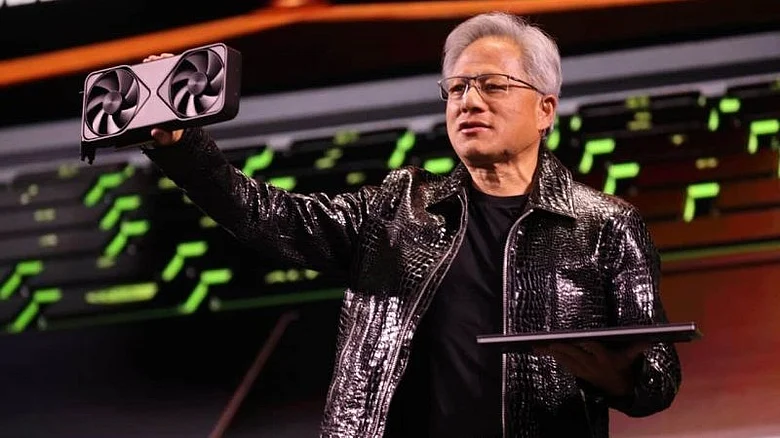

Nvidia CEO Jensen Huang announced partnerships with Japanese firms Fanuc and Yaskawa Electric in Tokyo.
The collaboration aims to integrate advanced artificial intelligence capabilities into next-generation industrial robotics.
Huang met with top Japanese supply chain executives, including the CEOs of Kioxia and Tokyo Electron.
Nvidia has partnered with prominent Japanese companies, including Fanuc and Yaskawa Electric, to accelerate the development of next-generation robotics and artificial intelligence, Reuters reported.
The partnership was announced on Thursday, July 16, 2026, during a high-profile visit to Tokyo by Nvidia CEO Jensen Huang. The collaboration aims to integrate advanced AI capabilities into industrial robotics, transforming how factories and automation systems operate globally.

1 October 2026
Get the latest issue of Outlook Business

"With AI, robots will become smart, easily adaptable and accessible," Huang said at a media event in Tokyo on Thursday, highlighting the transformative potential of the technology.

Huang's Rock Star Status
On Wednesday, Huang visited an event hosted by gaming firm Sega Sammy in the Akihabara electronics district before dining at a traditional Japanese "izakaya" pub. His presence drew significant attention from local onlookers and tech enthusiasts alike. He also met with top supply chain executives to strengthen industry ties.
Huang was pictured on Wednesday night alongside leading Japanese supply chain executives, including the CEOs of chipmaker Kioxia and semiconductor equipment manufacturer Tokyo Electron. The Nvidia chief has achieved rock-star status in Taiwan and his public appearances have sparked immense interest in Japan, which boasts several of the world's leading companies in the chipmaking supply chain.
Advertisement
"I think he's the most influential man on Earth," Chang Hui-Yu, a 57-year-old Taiwanese tourist speaking outside the Sega event, told Reuters.
"It was my first time seeing Jensen Huang in person and I was so excited," said Brian Yang, a 37-year-old Taiwanese resident of Tokyo.
Global AI Boom Context
Global investors are currently assessing the durability and strength of the ongoing AI investment cycle. On Wednesday, Dutch chipmaking equipment manufacturer ASML raised its sales forecast and pledged to expand its production capacity to meet soaring demand.
Meanwhile, TSMC, the world's leading contract chipmaker, posted a 77% surge in net profit in Q2. The tech giant exceeded market projections, hitting a record amid rising demand for AI processing hardware worldwide.
Advertisement
Taiwan Semiconductor Manufacturing (TSMC), a supplier to companies like NVIDIA and Apple, experienced a surge in its April-June net profit to around $21 billion.