




Cabinet allocated ₹1.27 lakh crore to expand India's commitment to semiconductor design and manufacturing
The government plans to support intellectual property (IP) creation, semiconductor designs and system-level products
The approval comes after the first phase of the India Semiconductor Mission recorded investments exceeding ₹1.64 lakh crore
The Union Cabinet on Wednesday approved the second phase of the India Semiconductor Mission (ISM 2.0), allocating ₹1.27 lakh crore to expand the country's semiconductor design and manufacturing ecosystem and provide long-term policy support to the sector.
"Cabinet has approved ISM 2.0 with a total outlay of ₹1.27 lakh crore," Union Electronics and IT Minister Ashwini Vaishnaw announced the decision after the Cabinet meeting.

1 October 2026
Get the latest issue of Outlook Business

Semicon 2.0 has been designed around six focus areas to build a comprehensive semiconductor ecosystem.


The programme will expand support for chip design, building on the progress made under the first phase, where 105 start-ups have already begun developing semiconductor products.
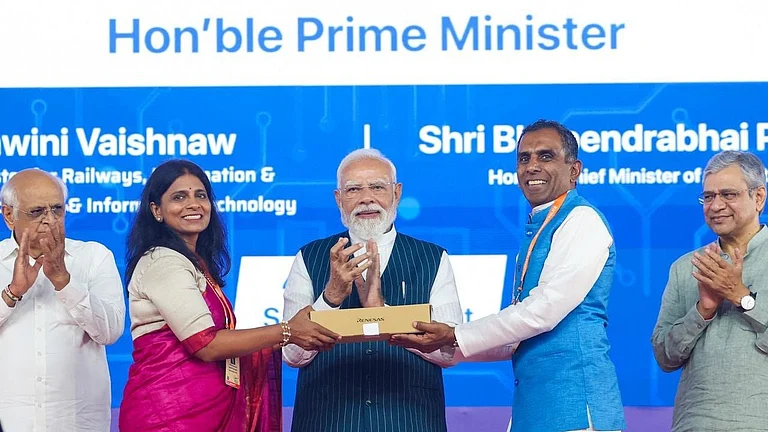
The government plans to support intellectual property (IP) creation, semiconductor designs and system-level products with the objective of strengthening India's position in global chip design.
Another major focus is the development of machines, materials, speciality chemicals and industrial gases required for semiconductor manufacturing. The government said incentives will be extended to companies engaged in manufacturing these critical inputs to reduce import dependence and strengthen domestic capabilities.
Advertisement
The scheme also seeks to attract additional investments in silicon fabs, compound semiconductor facilities, discrete component fabs and display fabs, while further expanding India's Assembly, Testing, Marking and Packaging (ATMP) and Outsourced Semiconductor Assembly and Test (OSAT) ecosystem.
The mission will also support advanced semiconductor research, including work on next-generation technology nodes, and expand industry-linked talent development programmes. According to the government, around 68,000 students across 315 universities have already received training in advanced chip design using Electronic Design Automation (EDA) tools.

Builds On Progress Under ISM 1.0
The approval comes after the first phase of the India Semiconductor Mission recorded investments exceeding ₹1.64 lakh crore, with 12 manufacturing projects receiving approval, according to the government.
Advertisement
These include one silicon fabrication unit, one silicon carbide fab, an integrated gallium nitride Micro LED display facility and nine semiconductor packaging units.
Three companies — Micron, Kaynes and CG Semi — have already commenced commercial production, while another unit is expected to begin operations in 2026.









