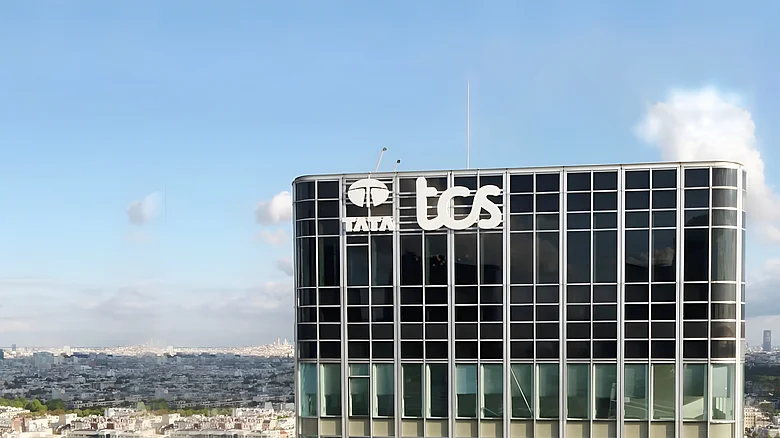

TCS added 9,279 employees in Q1 FY27, its strongest quarterly net hiring in four years, while saying AI is creating new roles rather than eliminating jobs.
The company reported $2.6 billion in annualised AI services revenue and said AI is delivering productivity gains while supporting demand for new skills.
TCS expects demand to improve gradually in FY27, supported by rising AI adoption, though geopolitical and macroeconomic uncertainties remain key risks.
Tata Consultancy Services (TCS) added 9,279 employees on a net basis during the June quarter, its strongest quarterly workforce expansion in four years, as the country's largest software exporter challenged the growing view that artificial intelligence (AI) will lead to widespread white-collar job losses.
The company's total headcount rose to 593,000, a sequential increase of 1.6% and the highest quarterly net addition since the second quarter of FY23. Despite the hiring rebound, TCS' workforce remained 3.1% lower year-on-year, reflecting the restructuring undertaken during the previous fiscal year.

1 October 2026
Get the latest issue of Outlook Business

The sharp increase in hiring comes at a time when the global technology industry is debating whether generative AI will significantly reduce demand for software engineers and other knowledge workers.




TCS Says AI Will Change Roles, Not Eliminate Jobs
Speaking during the company's post-results analyst call, Chief Executive Officer and Managing Director K. Krithivasan rejected the view that AI would result in a sharp decline in white-collar employment.
Advertisement
"We do not believe that there would be a drastic reduction in employment. There will be people doing different things," Krithivasan said.
He added that software engineers would increasingly require new capabilities such as prompt engineering, model training, testing and AI lifecycle management.
"We don't agree with the view that overall white-collar employment will go down," he said.
Explaining the company's hiring strategy, Krithivasan said TCS continues to recruit proactively to ensure it has sufficient talent available for future demand.
"Our hiring is based on we do proactively, we want to have more top talent available in the organization," he said, adding that recruitment is driven by both market opportunities and client engagement requirements.
Advertisement
The company also reported a voluntary attrition rate of 13.6%, down 10 basis points sequentially. During the quarter, employees completed 14.6 million learning hours and acquired more than 1.3 million competencies, while TCS onboarded around 14,000 campus graduates, with a continued focus on AI-native and digital skills.

AI Business Scales As Productivity Improves
TCS said its AI services business continued to expand, with annualised AI services revenue reaching $2.6 billion, up 13.6% during the quarter.
Growth was supported by several large deals, including an $800 million contract with Swedish bearings manufacturer SKF and another agreement with a Europe-headquartered Fortune Global 50 company.
The company said it continues to invest in AI capabilities, partnerships and talent, including collaborations with Anthropic and Mistral AI, to support client demand for AI-led transformation, application modernisation and cybersecurity.
Management said AI is currently delivering 10-15% productivity gains across client engagements. However, it argued that these efficiencies are largely being absorbed through additional client work rather than resulting in meaningful reductions in technology jobs. The company acknowledged that some AI-driven productivity benefits are being passed on to clients during contract renewals, although incremental work has so far offset much of the revenue impact.
Financial metrics also reflected improved productivity. Revenue per employee increased 6.5% year-on-year, exceeding both 5.9% growth in cost per employee and the company's overall 2.7% revenue growth. EBIT per employee rose 14% year-on-year and 1.1% sequentially.
Management Sees Demand Improving In FY27
The hiring rebound marks a sharp turnaround from FY26, when TCS reduced its workforce by 23,460 employees, or 3.9%, as part of a broader restructuring programme.
Looking ahead, management expressed cautious optimism about demand in the second quarter of FY27, particularly across the manufacturing, life sciences, BFSI and technology services segments.
The company said it expects client spending to gradually recover as AI adoption accelerates and macroeconomic conditions improve. At the same time, it cautioned that geopolitical uncertainty, inflationary pressures, delayed manufacturing decisions and weakness in discretionary sectors such as retail and airlines continue to weigh on demand.
Management added that it expects the consumer business to recover as geopolitical sentiment improves.