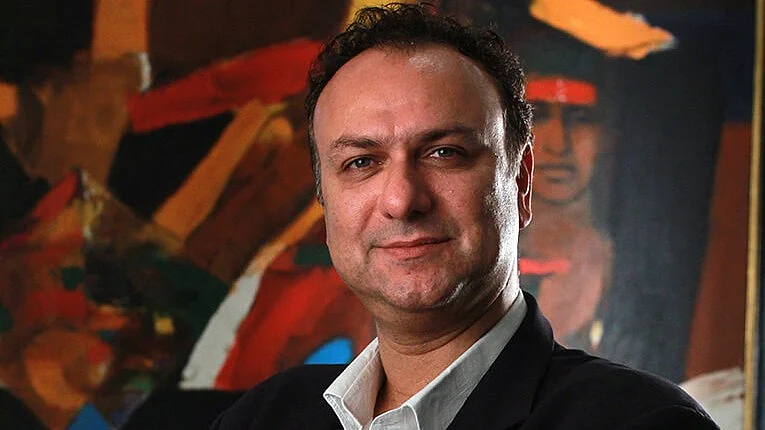

Shapoor Mistry reiterates call for Tata Sons IPO, calling it a “necessary evolution”.
Mistry claims listing the Tata Group's holding company is in the broader public interest.
The statement comes ahead of an expected RBI decision on Tata Sons’ listing mandate.
Amid growing rift among key board members of the Tata Trusts, Shapoor Mistry, chairman of the Shapoorji Pallonji Group has reiterated his demand for a public listing of the holding company of the salt-to-software conglomerate Tata Sons. In a statement on Friday, he described Tata Sons listing as “not merely a regulatory compliance but a necessary evolution.”
His remarks also comes amid reports that the Reserve Bank of India (RBI) is likely to soon take a call on Tata Sons’ listing mandate.

1 October 2026
Get the latest issue of Outlook Business

“The listing of Tata Sons is fundamentally in the public interest. A publicly listed holding company strengthens board accountability, broadens the investor base, and secures long-term value for all stakeholders. Besides, a listing will unlock value for millions of retail shareholders, create a more defined and robust dividend stream for the Tata Trusts, and expand the social and philanthropic impact that benefits the poorest sections of our country,” Mistry said.


The Shapoorji Pallonji Group, which holds just over 18% stake in Tata Sons, has been demanding a listing since the RBI first categorised the holding firm as an upper-layer non-banking financial company (NBFC) in 2022. As per the mandate, the company was supposed to list by September 2025.
Advertisement
However, Tata Sons, which is controlled by a group of charitable trusts, pushed back. It mandated chairman N Chandrasekaran to keep the company private and has since asked the regulator to allow it to surrender its upper-layer CIC licence. It has significantly reduced the group’s debt to support its case with the regulator.
In its latest list of NBFCs in January 2025, the central bank said that “inclusion of Tata Sons Private Limited in the list of NBFC-UL is without prejudice to the outcome of its application for de-registration, which is under examination.”
On Wednesday, without naming Tata Sons, RBI Governor Sanjay Malhotra noted that a revised framework for classification of NBFCs would be released soon.
Advertisement
In his statement, Mistry also noted that conversations with Tata Sons’ leadership regarding a potential divestment of its shareholding are “constructive” and expected to “come to an amicable resolution at the earliest.”
Last year, Chandrasekaran initiated talks with the SP Group to provide liquidity for its shareholding.
The SP group’s stakes of Tata Sons has been pledged as collateral to raise debt via private credit firms.

Diverging views among Tata trustees
Mistry’s comments also come amid a growing rift among key trustees of the Tata Trusts. Vice-chairman Venu Srinivasan and Vijay Singh have publicly disagreed with chairman Noel Tata. The disagreement started over their membership of the Bai Hirabai Jamsetji Tata Navsari Charitable Institution.
The public trust’s deed requires its trustees to be of the Parsi Zoroastrian faith and to have permanent residence in Mumbai.
The rift emerged after Mehli Mistry, a former Tata Trusts board member, moved the Mumbai Charity Commission, challenging the membership of Srinivasan and Singh.
It was earlier reported that, following this petition, Tata Trusts CEO Siddharth Sharma asked Srinivasan and Singh to resign.
While Srinivasan stepped down from the Bai Hirabai Jamsetji Tata Navsari Charitable Institution, Singh continues to remain a trustee.
Meanwhile, both trustees have told the media that they support a public listing of Tata Sons.
On Friday, the SP Group chairman said that a public listing would not only fulfil “regulatory compliance” but also “reinforce corporate governance, deepen transparency and accountability.”
“These form the very foundation of the Tata Group. To date, no clear, evidence-based case has been presented to explain how a public listing would materially damage the interests of the trusts or reduce their ability to serve beneficiaries,” he said.
Outlook Business had earlier reported that a listing could lead to a weakening of Tata Trusts’ special veto rights over Tata Sons under Article 121A of the company’s Articles of Association.