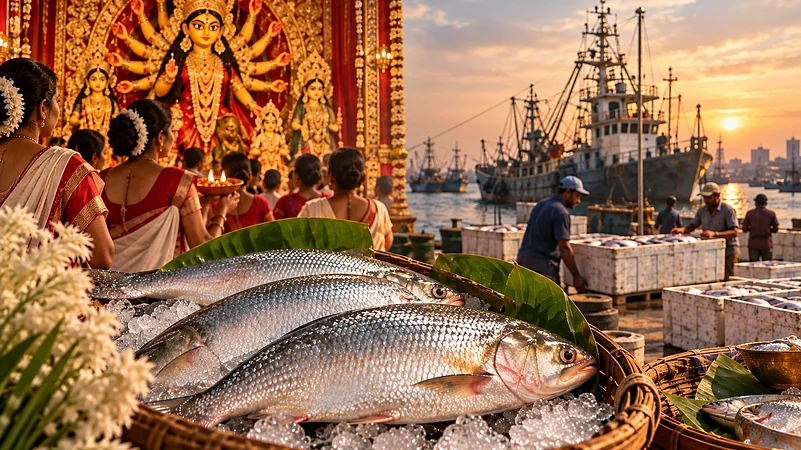

India has exported 500 tonnes of Hilsa to Bangladesh, reversing the traditional trade flow ahead of the Durga Puja season.
Gujarat has emerged as an unexpected Hilsa hub, with the state’s production reaching a four-year high of 14,587.72 metric tonnes in 2025–26.
Bangladesh’s domestic supply shortage has driven the unusual trade reversal, with roe-rich Hilsa from Gujarat helping meet festive demand.
For generations, Hilsa has been a culinary favourite in eastern India, particularly among Bengalis, where the fish holds a special place in traditional cuisine.
Generations have seen this valuable fish move in one direction—from the rivers of Bangladesh towards the north and west into the markets of West Bengal, where it has always been the main feature of festive meals and a symbol of cultural nostalgia.

1 September 2026
Get the latest issue of Outlook Business

Yet in a surprising turn of events, India has recently sent 500 tonnes of hilsa to Bangladesh, with an additional 150 to 200 tonnes expected, as the reports state.

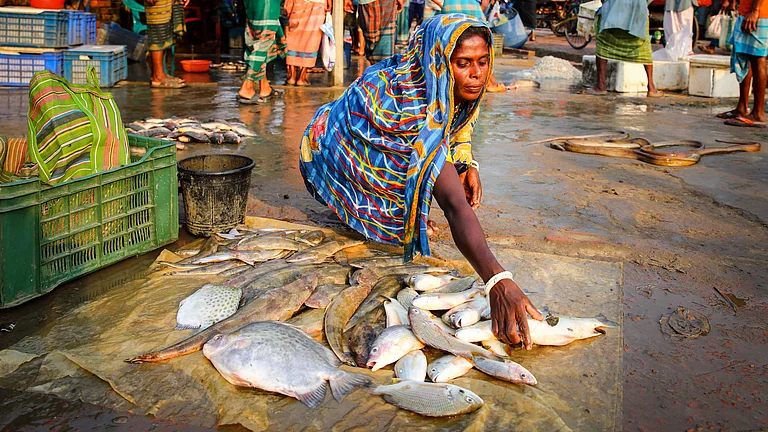

Since there had been an unforeseen shortage of domestic production in the rivers of Bangladesh, traders on the other side of the border had no choice but to look elsewhere and turn to India in order to make up the difference.
The most surprising development in this cross-border trade reversal doesn't simply lie in the fact that India is now exporting a fish which it has customarily imported, but in the fact that Gujarat has become the export centre for this silver fish.
Advertisement
Gujarat’s Unexpected Marine Might
On the western coast the hilsa have been moving out of the ports and wholesale markets of Gujarat—having been steamed, packed, and shipped via routes such as Bharuch.
One might be surprised to find that a state, which has traditionally been known for the vegetarian leanings of a majority of its population, functions as a fishing hub.
Gujarat, with a coastline that extends over 1,600 kilometres and makes up about 20% of India's total coastline, ranks second in the country for marine fish production and produces more than 7 lakh metric tonnes of marine fish each year.
Advertisement
The country's exports of marine and sea food have developed into a commercial sector worth several thousand crores, thanks to state and central infrastructure policies, the subsidy of fuel (for example the reduction of VAT on diesel), modern cold-chain logistics, and the presence of busy fishing harbours such as Veraval.
Although domestic consumption among the Gujarati population is largely vegetarian, the state's entrepreneurial attitude and its deep-sea trawling fleets have turned its coast into a huge commercial channel for global seafood markets.
The Ecological Shift
The hilsa appearing on the western coast of India is due to geographical factors and changes in natural habitats. This species is anadromous and has historically been known to swim up rivers from marine areas in order to spawn.
Although the Bay of Bengal and its extensive network of rivers used to be the famous origin of the hilsa, environmental degradation has changed the situation.
For many years the migration routes and breeding areas of the hilsa along the eastern coastline and in Bangladesh have been seriously blocked by severe siltation, the narrowing of river depths, industrial pollution from thermal power stations, and temperature rises associated with climate change.
As the navigability of the traditional eastern rivers has declined and the plankton food supply has diminished, the hilsa populations have started to move into deep-ocean areas and other estuarine zones and have established a noticeable presence in the western rivers such as the Narmada and the Tapti in Gujarat.
The data shows that Gujarat's Hilsa production reached 14,587.72 metric tonnes in 2025–26, which is its highest level in four years.
In the 2022–23 period the state's catch of Hilsa was 14,198.98 tonnes, but it then dropped sharply to 8,209.48 tonnes in 2023–24 and increased slightly to 8,535.75 tonnes in 2024–25.
This hilsa from the western coast has a particular biological feature: a very high egg content. Although this meant that it was less desirable in the traditional Indian home markets which prefer fish that is leaner and oilier, it proved to be a success all over the subcontinent.
In places in Bangladesh such as Chattogram and Sylhet the roe-filled hilsa is highly desired with the valuable eggs being separated out for special processing and then re-exported all over the world, while the rest of the fish is turned into salted and dried specialities.
The Shadow Over Durga Puja
The fact that this trade reversal has such great psychological and cultural significance should be noted, since it is occurring just before Durga Puja. For millions in West Bengal and among the wider diaspora, the celebration of Durga Puja cannot be imagined without the culinary aspect of hilsa.
The situation in Bangladesh, which is facing a severe shortage in domestic production, is further complicated by the fact that it has been importing hundreds of tonnes of hilsa with a high roe content from Gujarat, thereby leaving the traditional festive supply chain in a state of uncertainty.
The hilsa from Bangladesh—this variety is regarded as the finest in terms of flavour—is imported around the time of Durga Puja; but this marks the first instance of hilsa being exported to Bangladesh, the fish in question being mainly the roe-filled hilsa from Gujarat, as the reports quote SA Maqsood, secretary of the Fish Importers’ Association in West Bengal.
Hence a country famous for its vegetarian beliefs is now taking a key role in satisfying an overseas demand for the most extreme non-vegetarian dish, reversing decades of established culinary patterns at the very moment when the festive drums start to beat.