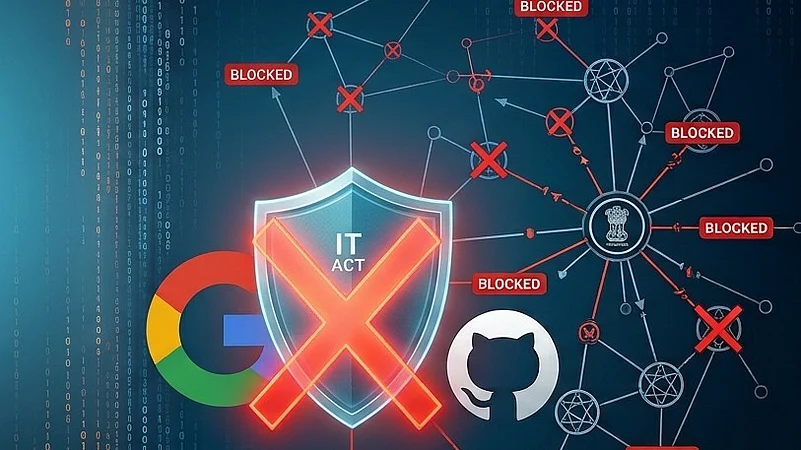
The government has widened its ongoing crackdown on offline messaging applications, directing Google to remove Bitchat, Briar and Bridgefy from the Play Store, according to an order reviewed by Moneycontrol. These apps allow users to message each other without an internet or mobile network connection.
The Indian Cyber Crime Coordination Centre (I4C), which functions under the Ministry of Home Affairs, issued the notice to Google on July 23, giving the company three hours to disable access to the three apps. As of July 29, all three remain available on the Play Store.
On the same day, I4C had sent a separate notice to GitHub, asking it to take down repositories linked to Bitchat, the Bluetooth messaging application built by Twitter co-founder Jack Dorsey. The repositories named include Bitchat's core codebase and its Android build. GitHub has not acted on this notice either, leaving the app's source code accessible on the platform.

1 September 2026
Get the latest issue of Outlook Business

The order to GitHub came during student protests at Jantar Mantar in New Delhi, led by the Cockroach Janata Party (CJP), where demonstrators had reportedly turned to Bluetooth-based apps to stay in touch after mobile internet services were suspended in parts of the city. Dorsey posted screenshots of the I4C notice on X at the time.



I4C invoked Section 79(3)(b) of the Information Technology Act, 2000, along with Rule 3(1)(d) of the IT Intermediary Guidelines and Digital Media Ethics Code Rules, 2021, to justify the three-hour deadline given to GitHub.
What The Notices Say
In its communication to Google, I4C described Bitchat, Briar and Bridgefy as decentralised communication platforms that allow peer-to-peer messaging over Bluetooth mesh networks, without needing internet connectivity or mobile networks.
Advertisement
Such applications "can be misused to evade lawful surveillance, facilitate anonymous coordination, and circumvent lawful restrictions imposed by competent authorities during situations involving public disorder, riots, terrorism, organized crime, or internet shutdowns," the notice said.
It added that intelligence inputs indicate these platforms could be exploited for "coordinating unlawful assemblies, violent protests, dissemination of misinformation, radicalisation, criminal conspiracies, and other activities prejudicial to the sovereignty and integrity of India, defence of India, security of the State, public order, and for facilitating the commission of cognizable offences."
The notice to GitHub carried similar language, stating that Bitchat's design "significantly impedes lawful interception, attribution, and investigation by law enforcement agencies" because it works independently of mobile networks, internet access or centralised servers.
Advertisement
Bridgefy is a Bluetooth-based mesh messaging application that gained prominence during the 2019 Hong Kong protests. Briar is an open-source messaging platform that can operate over Bluetooth, Wi-Fi or the Tor network when internet connectivity is unavailable.
Protests And Internet Shutdowns
The action came amid heightened scrutiny of such communication tools following the CJP-led protests in Delhi, which were called off after 36 days on July 25, following the resignation of education minister Dharmendra Pradhan.
Mobile internet services around Jantar Mantar were suspended several times during the protests, which led demonstrators to rely on applications that allow communication without mobile or internet infrastructure.
Experts cited by Moneycontrol said the government's attempt to block Bitchat, Briar and Bridgefy is unlikely to be straightforward, since all three are built on decentralised, open-source architectures rather than centralised servers.
Removing an app from the Play Store, or taking down its source code repository on GitHub, may make it harder for new users to discover or install the app. However, it does not disable copies that are already installed on users' devices, meaning existing users of Bitchat, Briar and Bridgefy could continue using the apps regardless of the takedown notices.