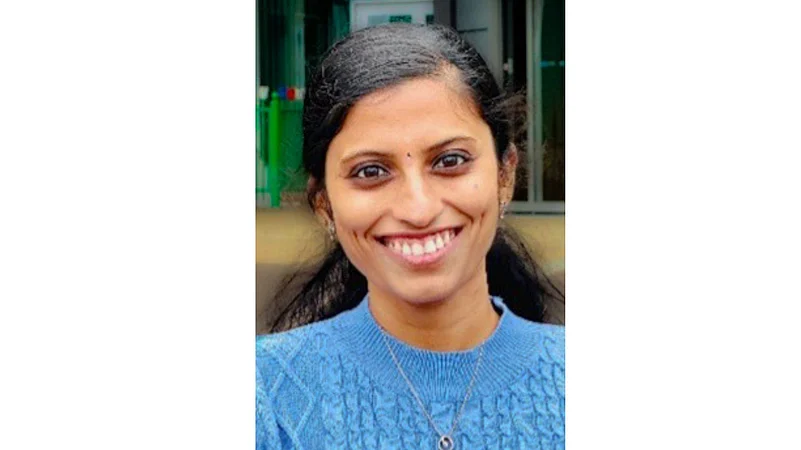

Swati Sudhakar rose from a small Tamil Nadu village to become a pioneering researcher in nanomedicine at IIT Madras
Her work focuses on developing nanomaterials to improve cancer treatment, drug delivery, and medical therapies
She emphasizes that educating girls and supporting their ambitions is essential for scientific and societal progress
Swati Sudhakar, Assistant Professor in the Department of Applied Mechanics and Biomedical Engineering at Indian Institute of Technology Madras, comes from a small village in Tamil Nadu but is now working at the forefront of cutting-edge medical research.
Her work focuses on developing advanced nanomaterials for cancer treatment, wound healing, and other medical therapies. She is also exploring the emerging field of space nanotherapeutics and nanomedicine, studying how extremely tiny materials known as nanoparticles can deliver medicines more effectively, particularly in space conditions and advanced medical applications.

1 September 2026
Get the latest issue of Outlook Business

Sudhakar believes empowering girls through education is key to societal progress, emphasizing that investing in a daughter’s education ultimately helps build a stronger future for everyone.
How has your journey as a woman in tech been, and what challenges did you overcome in breaking stereotypes in a male-dominated field?
I come from a small village in Bodinayakkanur, Tamil Nadu. My father is a sales officer, and my mother is a homemaker. Like many families, my parents believed that after completing my B.Tech, I should get married.
Even though I was a gold medalist in both my bachelor’s and master’s degrees, pursuing higher education was not easy.
Convincing my parents to allow me to pursue my master’s degree was a major challenge. I had secured Rank 2 in the central entrance examination for biotechnology and gained admission to Anna University, yet there was hesitation at home. My father, in particular, was concerned about marriage and social expectations.
During my master’s, I completed an internship at IIT Madras and published quality research papers. Later, I received an opportunity to pursue a PhD abroad. This was another difficult phase, as no one in my family had ever gone overseas for higher studies. There was strong social pressure, and concerns about safety, distance, and marriage made it even harder to convince my family.
Despite these challenges, I pursued my PhD in Germany. I later completed my postdoctoral research in London and eventually returned to India to contribute to the scientific ecosystem here.
Even today, while institutions like IIT Madras have improved significantly, the gender ratio in science and technology remains unequal. Women still face subtle and systemic barriers in many academic spaces.
My research focuses on space nanotherapeutics and nanomedicine, an emerging field with very few researchers worldwide. We are among the pioneers in this area, which brings both challenges and responsibilities. Navigating this journey as a woman in science has required resilience, persistence, and strong self-belief.
Through every stage, I learned that breaking stereotypes is not a one-time achievement but a continuous process; one that requires courage, support, and a commitment to one’s passion.
Advertisement
How did your interest in this field begin, and how would you explain your work in simple terms to someone without a science background?
My background is in biotechnology and nanomaterials, and my interest in this field grew from wanting to solve real-world healthcare problems. Let me explain it in simple terms using cancer as an example. When a patient is given chemotherapy or other strong medicines, the drugs do not only attack cancer cells. They also affect healthy cells, which leads to severe side effects.
Another major challenge, especially in rural and remote areas, is medicine storage. Many medicines require refrigeration and special transportation, which is not always easily available.
These problems made me ask important questions: How can we reduce harmful side effects? Can we store medicines safely at room temperature? And can we deliver drugs more effectively inside the body?
In my lab, we developed nano-archeosomes; extremely small, specially designed particles that act like carriers. They transport medicines directly into targeted cells, especially diseased ones. This improves treatment effectiveness while minimizing damage to healthy cells. At the same time, these nanomaterials help preserve medicines for longer periods without the need for refrigeration.
Our research focuses on developing advanced nanomaterials for applications such as cancer treatment, wound healing, and other medical therapies. Through this work, we aim to make healthcare more efficient, affordable, and accessible particularly for people in underserved communities.
Advertisement
Did you pursue this line of research during your time in Germany and London, and what key differences did you observe between the research culture abroad and in India?
Yes, my research journey in Germany and London was closely connected to my current work.
In Germany, I specialized in synthesizing nanoparticles and studied how proteins interact with them using advanced biophysical tools. This phase focused mainly on fundamental research, helping me build a strong scientific foundation. In London, I continued working on advanced and applied aspects of nanomaterials and biotechnology.
At present, Indian Institute of Technology Madras offers world-class facilities and has been improving continuously in terms of infrastructure and research support.
One of the major differences I observed between research abroad and in India is funding. In countries like Germany and cities such as London, research funding is significantly higher. Researchers receive better salaries, and students are exposed to cutting-edge training from an early stage. As a result, the overall research ecosystem is more mature, and many talented students still prefer going abroad.
Access to advanced equipment and modern techniques is also more widespread in these countries, which accelerates innovation and high-quality research.
Despite these advantages, I chose to return to India because I wanted to contribute to my country’s scientific growth. With more researchers returning from abroad, the research environment here is steadily improving. For instance, I introduced advanced techniques such as optical tweezers and super-resolution imaging at IIT Madras.
I strongly believe that if we can provide better financial support and competitive salaries for PhD students and postdoctoral researchers, we can retain more talented minds in India. This will help strengthen our research ecosystem and make the country more self-reliant in science and technology.
How do you see today’s young women differing from your generation, and what changes or solutions do you believe can help them succeed further?
From my interactions in rural areas, I feel that, unfortunately, there has not been as much change as we would hope for. Girls in small towns and villages continue to face many of the same challenges that my generation experienced, especially restrictions related to higher education, career choices, and early marriage.
In premier institutions like the IITs, students today are more informed, confident, and exposed to global opportunities. However, in many state colleges and rural regions, deep-rooted social barriers still exist. While students are eager to learn and grow, parental hesitation remains a major obstacle. This is why educating parents is just as important as educating students.
Many young women are motivated and capable, but they are often not given the freedom to pursue their ambitions. If my parents had not eventually supported my decision to study abroad, I would not be where I am today.
I entered academia at the age of 27, and today I lead pioneering research. In my lab, I currently mentor around 10 PhD students and postdoctoral researchers. This journey was possible only because I was given the opportunity to study and grow.
My strongest message to parents is this: investing in a daughter’s education is investing in the future. When girls are allowed to learn, explore, and build careers, they not only transform their own lives but also contribute meaningfully to society.