
RDI Fund targets Technology Readiness Levels (TRL) 4–6 projects, bridging prototype-to-market innovation gap.
Fund supports technology acquisition, providing debt and equity financing to entities.
Second-level managers and statutory boards like TDB, BIRAC will implement investments.
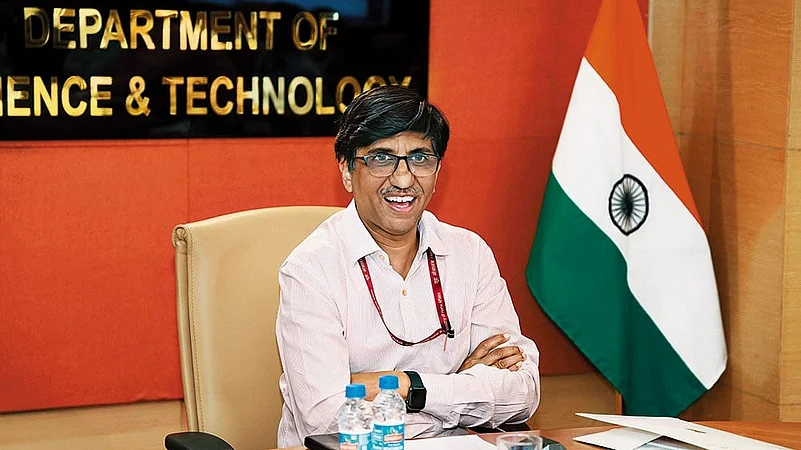
As the Research & Development Innovation (RDI) Fund moves into the implementation phase, the Department of Science and Technology (DST) has begun industry consultations to fine-tune its rollout. Addressing startups, innovators and industry representatives at an RDI Outreach event, DST Secretary Prof Abhay Karandikar said the fund will support projects at Technology Readiness Levels (TRL) 4 to 6, helping bridge the gap between lab-scale prototypes and market-ready products.
“The RDI seeks to finance the transformation of technologies from advanced prototype stages to commercially viable products as this stage considered as ‘valley of death’. The fund will not support basic research from Technology Readiness Level (TRL) 1 to TRL 3; those stages are supported through other mechanisms under DST and the ANRF," he said.

1 September 2026
Get the latest issue of Outlook Business

Prof Karandikar also said the fund would support the acquisition of technologies by eligible entities.
“If an entity chooses not to develop a technology entirely from scratch, but instead acquires intellectual property and builds its R&D capabilities on top of it, such acquisition can be supported as part of the overall project,” he added.
Advertisement
DST Secretary Prof. Abhay Karandikar, along with Jitendra Singh, Minister of State (Independent Charge) for Science and Technology, also clarified to startups that those seeking financial assistance at the early stages can tap other government schemes, such as the Anusandhan National Research Foundation (ANRF).

According to the RDI fund mechanism, this fund will first identify second-level fund managers, and these fund managers may include Alternative Investment Funds, Development Financial Institutions (DFIs), NBFCs or Designated Focus Organisations (DFOs).
These second-level fund managers will then invest in corporates and start-ups, collectively referred to as “eligible technology entities".
Advertisement
DST Secretary also highlighted that funding support will be limited to a maximum of 50% of the total project cost.
“The loans are tailored for innovation and will largely be unsecured. A portion of the loan may be convertible into equity and the interest rates will be kept low. Equity assessment and valuation will be carried out by professional investment committees constituted by the second-level fund managers; the first-level entity will not interfere in these decisions,” he added.

Prof Karandikar also informed that It has also been decided that statutory organisations under DST, such as the Technology Development Board (TDB) and the Biotechnology Industry Research Assistance Council (BIRAC), can be onboarded through a nomination process and by creating dedicated professional investment committees within these organisations.
These committees will be empowered to provide both debt and equity financing to the start-ups, innovators and other industry players. According to him, TDB and BIRAC are expected to be fully onboarded within the current month, and by January, they should be in a position to directly invest in corporates and start-ups.
The Research & Development Innovation (RDI) Fund was launched by Prime Minister Narendra Modi on November 3, 2025, during the Emerging Science, Technology and Innovation event. At the launch, the scheme guidelines were unveiled and applications were invited for the appointment of second-level fund managers.