India has 1.79mn start-ups and 60% are from Tier II, III cities.
RDI Fund finances up to 50% project cost for TRL 4+ innovations.
Fund provides unsecured loans and equity, with IP fully retained by innovators.
It is only a misconception that most start-ups come from Delhi and Bengaluru, said Science and Technology Minister Jitendra Singh in New Delhi. While these cities have stronger infrastructure, a growing number of start-ups are emerging from Tier II and Tier III cities as well.
“India today has around 1.79mn start-ups, and nearly 60% of them are from Tier II and Tier III cities. Innovation is no longer confined to Bengaluru or a handful of metros. Aspirations are rising across the country,” he said.

1 September 2026
Get the latest issue of Outlook Business

Singh was speaking at the RDI Fund Outreach event for start-ups, corporates, industry and fund managers at an event held in Delhi. For context, the Research, Development & Innovation (RDI) Scheme, was approved by the Union Cabinet on July 1, 2025. The total outlay for the same is ₹1 lakh crore over six years.
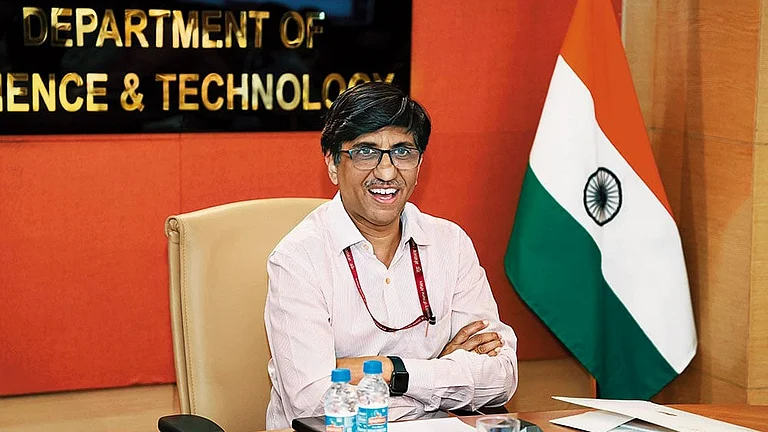
Speaking about how the scheme, he said, “We are only enabling you to start. After that, we expect you to take over in a big way and become an asset for all of us, for the nation and for society. This initiative is not charity. It is not benevolence. It is driven by cooperation and a clear global strategy.”
Advertisement
The RDI fund will finance up to 50% of a project’s approved cost for high-impact research, development and innovation projects that are at Technology Readiness Level (TRL) 4 or above. TRL 4 is basically a technology that moves beyond basic lab concepts into more realistic testing
The scheme will be run through second-level fund managers, such as Alternate Investment Funds, development finance institutions, NBFCs, focused research organisations or other entities approved by the Empowered Group of Secretaries.
While clarifying that the government will not take ownership of start-ups’ intellectual property, Abhay Karandikar, Secretary, Department of Science and Technology, said that any intellectual property created under the scheme must be owned in India and will remain with the innovators.
Advertisement

The funding will mainly be provided as unsecured, long-term loans at lower-than-market interest rates, awarded through a competitive process across India. “The second first-of-its-kind feature is that this is an unsecured loan, offered at an interest rate of less than 3%. Have you heard anywhere in the world of unsecured loans being given at such low interest rates, sometimes close to zero? There is no demand for collateral, no guarantees and no undertakings. This reduces stress significantly. This shows the level of trust and thought that has gone into designing this ecosystem,” added Singh.
In some cases, especially for start-ups, the fund may also offer equity support.
The aim of the fund is to “boost large-scale private sector investment in R&D”. This comes at a time when the overall investment in the deeptech sector has been increasing in the country and it is expected to be $30bn by 2030, as per a Redseer report. It further says, “India is emerging as the only trusted, low-cost scale hub outside China. Its deeptech base, i.e., $9–12bn as of FY2025, is being pulled forward by spending in India's defence deeptech and global robotics.”