

OpenAI and Anthropic CEOs sparked "AI Cold War" rumors by avoiding a hand-clasp
Anthropic’s enterprise market share surged to 40% in 2025, surpassing OpenAI’s lead
OpenAI is countering with a massive Tata Group collaboration, deploying ChatGPT Enterprise to employees
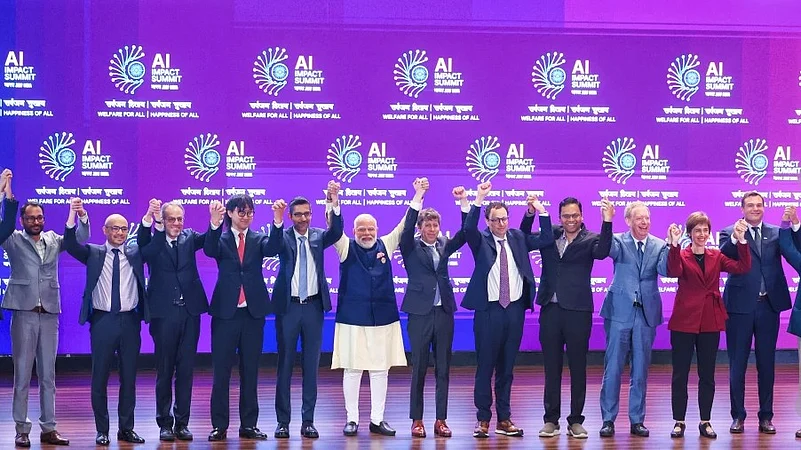
When Prime Minister Narendra Modi lifted the hands of tech leaders on stage at the India AI Impact Summit, it drew attention to an awkward moment between the CEOs of OpenAI and Anthropic.
Once colleagues, Sam Altman and Dario Amodei did not hold each other’s hands. Instead, they raised their fists while other leaders stood hand-in-hand.
3 February 2026
Get the latest issue of Outlook Business

When asked about the moment, Altman told Moneycontrol that he was “sort of confused” when Modi grabbed his hand and raised it, adding that he wasn’t sure what they were supposed to do.


While the incident may have simply been a misunderstanding, the rivalry between the two founders has long been known. This is why the moment attracted so much public attention.
Anthropic’s Jibe at OpenAI
Just weeks before the summit, Anthropic aired a Super Bowl advertisement that indirectly criticised OpenAI’s plans to introduce advertising into ChatGPT.
The ad’s tagline read: “Ads are coming to AI. But not to Claude.”
Altman responded publicly, calling the campaign “funny” but “clearly dishonest,” highlighting the growing public rivalry between the two companies.
Colleagues to Contemporaries
After leaving Google Brain in 2016, Amodei joined OpenAI as a team lead focused on AI safety. Over time, he rose to become Vice President of Research and played a key role in early large language model development that helped lay the foundation for the GPT series.
However, internal disagreements gradually emerged within the team over strategy, commercialisation and the balance between rapid development and safety.
These tensions eventually led Amodei and several senior researchers to quit around 2020 end to the start of 2021.
In February 2021, Amodei founded Anthropic along with a group of former OpenAI researchers, including his sister Daniela Amodei. The company positioned itself as a safety-focused alternative, emphasising careful and responsible AI development.
Who Owns the Market?
Today, OpenAI and Anthropic are among the world’s leading companies developing advanced general-purpose AI models, making them direct competitors. However, their approaches and market positions are evolving differently.
OpenAI had a clear first-mover advantage and held a dominant, near-monopoly-level market share for a long period. But as new AI startups entered the space, its lead began to shrink.
According to a CNBCTV‑18 report, OpenAI’s market share fell sharply from 75% in October to 61% in November 2025, the largest monthly decline it had ever recorded.
At the same time, Anthropic has been strengthening its position, particularly in the enterprise segment.
A report by Menlo Ventures found that by late 2025, Anthropic had become the leading player in the enterprise LLM market, with its share rising to about 40%, surpassing OpenAI.
This growth has been driven largely by Anthropic’s strong performance in coding tasks, where it holds a 54% share, and its success in high-stakes enterprise use cases.
Overall, Anthropic has tripled its enterprise market share from 12% in 2023 to around 40% in 2025, highlighting its rapid rise as a major competitor.
Ideological Rivalry: OpenAI vs Anthropic
OpenAI focuses on rapid scaling and widespread deployment, believing that real-world use helps improve and align AI systems faster. This approach has helped ChatGPT reach hundreds of millions of users and expand into voice, multimodal features, and AI agents.
Contrastingly, Anthropic was founded with a stronger emphasis on safety and controlled deployment. Its AI assistant Claude is positioned as more reliable and predictable, especially for enterprise use cases such as legal, financial, and coding work.
In terms of pricing, OpenAI positions itself higher, especially for its most advanced models, but it offers a wider tier range including free, Plus, Teams and Enterprise.
However, Anthropic has aggressively priced Claude models to be competitive or cheaper per token, especially for enterprise API use and offers extremely large context windows as a differentiator.
Fight for Indian Space
On February 16, Anthropic announced that it will open a new office in Bengaluru and has already formed several partnerships across the enterprise, education, and agriculture sectors in India. The company said these partnerships will continue to expand in the coming months and years as it strengthens its presence in the country.
Just a few days later, OpenAI also revealed plans to open new offices in Bengaluru and Mumbai by the end of 2026. The company stated this expansion as part of its “OpenAI for India” initiative, which aims to increase access to AI, support sovereign AI capabilities, and accelerate enterprise and workforce transformation across India.
Separately, Anthropic announced a strategic partnership with Infosys on February 17. The Claude-maker said the collaboration aims to develop and deliver advanced enterprise AI solutions for industries such as telecommunications, financial services, manufacturing, and software development.
Simultaneously, OpenAI also announced major partnerships in India. The company announced it is set to become the first customer of Tata Consultancy Services’ data centre business under a broader strategic partnership.
In addition, OpenAI and the Tata Group also announced an enterprise collaboration to accelerate AI adoption at scale. Tata Group plans to roll out ChatGPT Enterprise to its workforce over the next few years, starting with hundreds of thousands of TCS employees. This would make it one of the largest enterprise AI deployments in the world. TCS also plans to use OpenAI’s Codex tools to standardize AI-driven software development across its teams.