


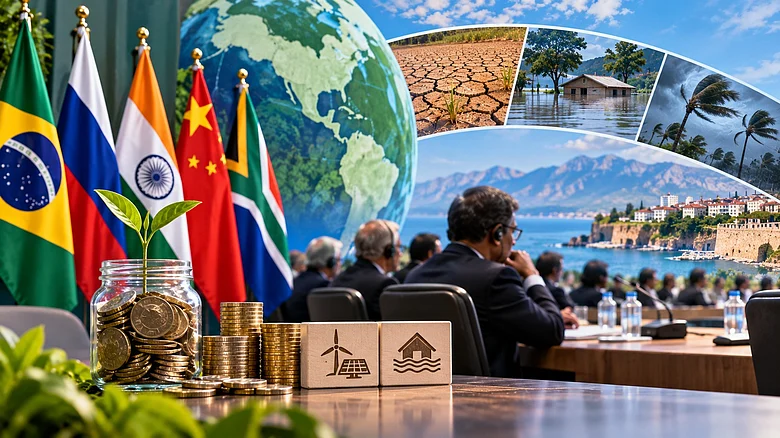

BRICS arrives at COP31 with a larger membership and a common position on climate finance.
The bloc is pushing for more predictable, concessional finance for developing countries, but its own financial institutions remain modest in scale.
Its biggest influence may lie in shaping the rules around adaptation finance, debt and multilateral climate funding.
When BRICS leaders met in New Delhi on September 12 and 13, the climate-finance language in their declaration sounded familiar. Developed countries, it said, “shall provide additional, adequate, predictable, accessible financial resources” for adaptation. Unilateral carbon border measures were opposed. High debt burdens were named as a constraint on climate investment. None of this was new. What has changed is the setting in which it will be heard.
As COP31 got underway in Antalya, Turkiye (November 9-20), climate finance is likely to be its most contested question. BRICS arrives with a larger membership, a common position and its own development bank. It does not arrive with the money that would change the arithmetic. The bloc may strengthen the Global South’s hand in the negotiations. Whether it changes the game is a different question.

1 November 2026
Get the latest issue of Outlook Business

Climate Finance Under Pressure
At COP29 in Baku, developed countries agreed to mobilise at least $300 billion a year by 2035, within a broader aspiration of $1.3 trillion a year from all sources. Since then, the financing outlook has become more uncertain.
Advertisement
According to OECD data, public climate finance attributable to developed countries fell from $104.3 billion in 2023 to $101.6 billion in 2024, even as total finance provided and mobilised rose from $132.8 billion to $136.7 billion. Official development assistance fell by 23.1% in 2025, the largest single-year drop recorded. Cuts to development budgets have raised questions about the availability of future concessional finance. For countries that depend on grant-based and concessional finance, particularly for adaptation, these numbers matter more than any headline goal.
What Delhi Put On The Table
Read against this backdrop, the New Delhi Declaration is less a new agenda than a restatement of the Global South’s core positions. BRICS environment ministers called for fulfillment of the ‘New Collective Quantified Goal’ (NCQG) commitments and reiterated the COP30 decision to triple adaptation finance by 2035. The leaders asked that adaptation finance be grant-based and concessional. They welcomed Brazil’s Tropical Forest Forever Facility and supported a larger role for the New Development Bank.
Advertisement
These positions will be tested early in Antalya. At the preparatory sessions at Bonn, Germany in June, the G77 and China expressed “deep disappointment” that the climate-finance work programme agreed at COP30 was missing from the draft agenda. Developing countries want that work to focus on Article 9.1 of the Paris Agreement, which places the obligation to provide finance on developed countries. Developed countries want to look beyond it, towards private capital and a broader base of contributors.
A coordinated BRICS can make that argument harder to set aside. It cannot, by itself, resolve it.

The Limits Of An Alternative
The New Development Bank is often presented as evidence that BRICS can build its own financial architecture. Since 2015, the bank has approved about $42.9 billion across 139 projects, and local-currency financing accounted for nearly 30% of its active portfolio at the end of 2025, reducing borrowers’ exposure to exchange-rate fluctuations.
But the scale is modest. Its cumulative approvals cover development and infrastructure projects, not climate finance alone, and remain small compared with the annual $300 billion climate-finance goal. Approvals are also not the same as disbursements. Its lending is largely on market-linked terms. For countries already constrained by debt, a loan is not a substitute for a grant.
This distinction matters for investment. Renewable energy projects may attract commercial lenders, but flood protection, water security and other adaptation measures often generate little direct revenue. They depend more heavily on public and concessional finance.
There is also a less comfortable question. The argument to widen the donor base is directed, in large part, at economies that now sit inside BRICS, including China and major oil and gas exporters. The bloc’s insistence on Article 9.1 is consistent with the Paris Agreement. But it also raises questions about whether emerging economic powers should contribute more voluntarily, even without equivalent legal obligations.

What BRICS Can Change
That does not make the bloc irrelevant. Its weight may matter most on questions of rules rather than resources: how adaptation finance is tracked, whether carbon border measures are tested against trade law, how multilateral development banks lend, and whether debt is treated as a climate issue. These are areas where a coordinated position from economies that account for a large share of global emissions carries real weight.
The divergences within the bloc are also real. Its members include some of the world’s most climate-vulnerable populations as well as some of its largest fossil-fuel exporters. A common position on finance is easier to reach than a common position on what that finance should achieve.
Over the coming weeks, three things will show whether Delhi has made a difference in Antalya: whether the finance work programme reaches the agenda, whether the tripling of adaptation finance acquires a credible delivery path, and whether BRICS members speak with one voice when the question of contributors is raised. BRICS may not change the climate-finance game. But it may change who gets to set its rules.



Disclaimer: Bhargabi Ghosh is Associate Director, Strategic Communications and Public Policy Advisory, at the Policy and Development Advisory Group. The views expressed are personal.