


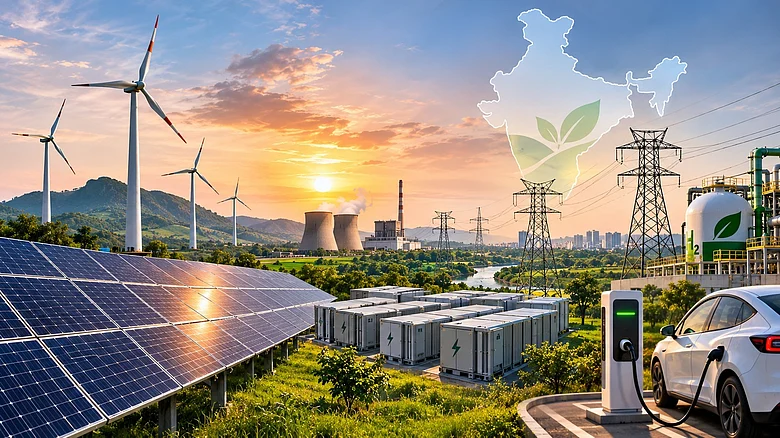

India’s electricity demand could rise more than tenfold by 2070 as transport, industry and other sectors electrify.
Renewables could provide up to 80% of power generation, but storage, transmission and grid flexibility will be critical.
The transition could require around $8 trillion in generation and storage investment, alongside major spending on transmission and distribution.
India’s shift toward cleaner energy is frequently quantified in gigawatts: the quantum of solar and wind power that has been set up, the pace at which Renewable Energy (RE) goals are being achieved, and the extent to which coal power can be phased out. These metrics are significant indicators of advancement but, they fail to capture the entire picture. As India’s economy grows and electricity is utilized in transportation, industry, buildings, data centres and agriculture, the larger challenge will be to ensure that clean electricity is accessible when and where it is needed and the manner in which it is needed.
The nation must transition its electricity generation systems to reduce carbon emissions while also meeting the energy needs of its developing economy. Decarbonization must extend beyond simply boosting generation capacity while a framework must be established where generation, storage, transmission, and demand are interconnected. An examination of India’s electricity transition toward 2070 through power system modelling highlights the challenges and opportunities associated with this endeavour.

1 November 2026
Get the latest issue of Outlook Business

Aligning Demand Patterns, System Requirements
Electricity demand is projected to increase from 1,848 TWh in FY26 to around 19,362 TWh by 2070 under the Net Zero Scenario. This growth will be driven by the electrification of industry, transport, buildings and agriculture, alongside emerging demand from green hydrogen production. This transition also presents an opportunity to improve energy efficiency, support domestic technology development and reduce dependence on imported fossil fuels. Realising these benefits will, however, require renewable energy expansion to be supported by adequate storage, transmission infrastructure and system flexibility to ensure a reliable and cost-effective electricity supply system. Consequently, power system planning must account for changes in the timing and location of demand, alongside planning for meeting the anticipated growth in overall electricity consumption.
Advertisement
The presence of competitive tariff rates, as well as other supportive policies and enhanced transmission capacity, has helped to accelerate RE deployment in India. Solar and wind will continue to play important roles in India's power sector. According to TERI’s estimate, variable renewables might account for up to 80% of power output by 2070, assuming the Net Zero scenario. However, a renewable system would provide a different operational issue than a standard power system since solar energy would be produced primarily during the day, while electricity demand would continue into the evening and night hours.
The central question is therefore no longer simply how much renewable capacity India can install. It is how effectively the electricity system can absorb, store, transmit and deliver the resulting generation.
Advertisement
Energy storage systems (ESS) will be critical to this transformation process. The Net Zero Scenario requires major development of battery energy storage systems, as well as the utilization of pumped storage and hydroelectric power. ESS can store extra electricity generated by renewables and provide power when there is insufficient power generation or the generation tariff is high. However, storage should not be seen as a replacement for all other system resources. Nuclear power plants, hydroelectric facilities, flexible generation during the transition, and improved transmission infrastructure will all remain important. Their utility will be determined by evolving system requirements and the availability of substitutes. The key policy implication is that India must plan for system flexibility alongside renewable energy capacity expansion to ensure reliable and cost-effective integration of renewables.

Leveraging Demand-Side Flexibility
Electricity demand can also contribute to system balancing. Industrial consumers may shift suitable loads to periods of high renewable generation, while managed EV charging can align electricity consumption with solar availability. Green hydrogen production, where operationally feasible, can similarly adjust its electricity use in consonance with renewable availability. Commercial loads, distributed batteries and energy management systems can further support peak management and reduce pressure on the grid. Realizing this goal will need more than just using technology. Regulators and utilities should establish suitable incentives and measurements to solicit customer willingness for providing verified flexibility. Resource adequacy plans should transform stated flexibility requirements into actionable procurement strategies that are periodically reassessed when demand patterns and renewable penetration change. These solutions have the potential to alleviate pressure on peak-demand infrastructure, increase renewable use, and make the overall transition more cost-effective.

Matching Vision With Actionable Plans
India can have it both ways when it comes to growth, reliable electricity, and emissions reduction. The immediate priority should be to translate long-term visions into actionable plans. This includes assuring plan flexibility, developing demand response technologies, expediting grid modernization, and ensuring that infrastructure service delivery aligns with power sector changes. The transition from conventional generation must be carefully sequenced to ensure that adequate firm capacity and flexibility remain available as the generation mix evolves.
The scale of the transition has significant financing implications. The study estimates cumulative investment in generation and storage at approximately USD 8 trillion with further additional investment required in transmission & distribution, underscoring the need for timely capital mobilisation, investment-ready projects and coordinated infrastructure development.
India's electricity transition will ultimately be judged not by installed renewable capacity alone, but by whether the power system can deliver reliable, affordable and clean electricity to households and businesses. The path to 2070 will require more than a change in the generation mix. It will require a change in how the entire electricity system is planned and operated.




Disclaimer: A K Saxena is senior director at TERI, while Ishaan C Saxena and Mohit K Meena are research associates in the same organization. The views expressed are personal.