


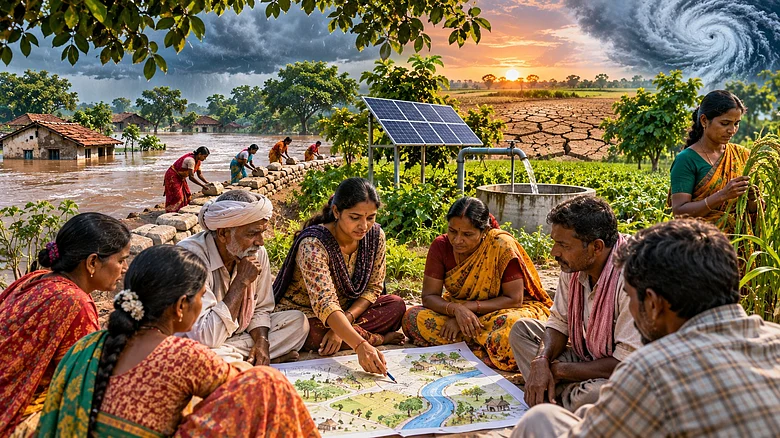

Communities across India are using local knowledge and grassroots institutions to adapt to climate shocks.
Indigenous seeds, local solutions and community networks are strengthening resilience.
Patient, flexible climate finance can help scale this “human infrastructure” of resilience.
In the year 2022, following a flood in Golaghat district in Assam, community members from a village were consulted by Farm2Food Foundation about rebuilding a road destroyed in the floods. When the plan was taken to them, they rejected it for a practical reason.
“The village is vulnerable to frequent floods and a tar road would make it difficult for the water to flow through. If it is destroyed again, we won’t have the resources to rebuild it,” said a community member. Villagers suggested using traditional materials (mud and bricks) as these were locally available and easy to replace. They knew they could not avoid future floods, but wanted to prepare in a way that would allow them to bounce back.

1 November 2026
Get the latest issue of Outlook Business

For decades, much of the human relationship with nature has been shaped by an impulse to control it. We have built embankments to hold back rivers, roads designed to withstand floods, drainage systems to move water away, and technologies that promise to insulate us from heat, drought and other climatic shocks. Development, in this context, has often meant making nature more predictable and less disruptive. Climate change is now exposing the limits of this approach.
India has witnessed a steady intensification of extreme weather events, from droughts and floods to cyclones and heatwaves. We experienced extreme weather events on 99% of the days in the first nine months of 2025, with heat and cold waves, intense rains, floods, landslides, and storms affecting communities across the country. To build resilience, India has put in place policies and adaptation plans, energy-transition strategies, climate finance mechanisms, scientific institutions, early-warning technologies and investments in physical infrastructure. Businesses, philanthropic institutions and development organizations are investing in climate adaptation and resilience. Amid these efforts, a silent yet powerful infrastructure often remains overlooked and underfunded: the grassroots infrastructure.
Advertisement
Building Resilience Through Grassroots Infrastructure
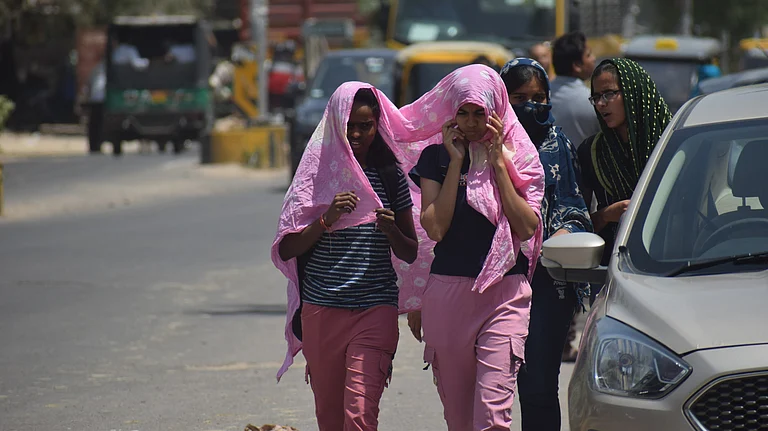
Most climate narratives still revolve around scientific concepts such as greenhouse gas emissions, carbon footprints, and global warming. Yet climate change is experienced differently in everyday life: localities inundated by floods, farmers facing water scarcity and crop loss, indigenous communities losing local food species, and gig workers falling sick in extreme heat. Communities are not merely passive victims of climate change but are also developing strategies to cope with its impact.
Across India, a robust human infrastructure of resilience already exists, embedded in people, relationships, knowledge and institutions supported by thousands of grassroots organizations working alongside them.
Advertisement
Grassroots organizations strengthen these local systems and connect them to public resources. For instance, Agragamee works alongside tribal communities in Odisha to strengthen women’s collectives, farmer groups and local institutions as foundations of resilience. By combining community mobilization with climate-smart agriculture, indigenous seeds and sustainable livelihoods, it helps communities draw on their own knowledge and resources to respond to a changing climate.
Second is local intelligence and indigenous knowledge. Communities through generations have developed detailed understandings of soil, water, crops, forests, and weather cycles. Sahaja Samrudha in Karnataka works with farmers to conserve indigenous seeds and traditional farming knowledge. These initiatives demonstrate how local knowledge has been strengthening food and climate resilience.
Third are local and indigenous frugal solutions. Communities develop responses using locally available resources and ecological knowledge. Jaljeevika works with fishing and farming communities across eight states in India to develop locally appropriate, low-cost solutions for water and livelihood security.
Leveraging The Community Infrastructure
The first step is to recognize that this infrastructure exists. A women’s collective that can mobilize during a crisis, a farmer who can read changing weather patterns, or a community network that can coordinate a response may not appear on an infrastructure balance sheet but can determine whether a road survives a flood, or a water system continues to function during a drought. This means measuring resilience differently, through outcomes such as stronger local institutions, greater agency, diversified livelihoods, social networks, community leadership, etc.
Climate finance and philanthropy are structured around visible, time-bound interventions, while building relationships, strengthening institutions and nurturing community leadership is slower and harder to attribute. A water pump can provide access to water; the collective capacity to maintain it, govern its use and adapt it during a drought determines whether it continues to serve the community. Resilience therefore needs patient, flexible and longer-term capital, alongside meaningful participation by communities in identifying problems, determining priorities and shaping responses.
This is where grassroots organizations are playing critical connecting roles in articulating what the communities are experiencing, in documenting and strengthening local solutions, in building collective capacity, and in creating spaces for people to participate in decisions that affect them. At the same time, they translate these experiences for policymakers, funders, researchers and other institutions. Grassroots organizations approach climate change as an intersectional challenge, recognizing how it compounds existing psycho-socio-economic vulnerabilities. This enables responses that address not only climate shocks, but also the underlying conditions shaping how communities experience and recover from them. For grassroot organizations led by community members, there is no alternative; they must adapt, survive, and grow through the extreme climate crisis.



India will need better roads, efficient water systems, cleaner energy, robust scientific data and new technologies to fight the climate crisis. But whether these investments create lasting resilience will depend, in part, on the human infrastructure that surrounds them — the knowledge, relationships, care systems, local institutions and collective agency that allow communities to respond to shocks and adapt over time. And herein lies the great opportunity for private and public philanthropy to come together to nourish these infrastructures.
Disclaimer: Ankita Bhatkhande is a writer, researcher and communications professional working at the intersection of social and ecological issues, while Deep Jyoti Sonu Brahma is an Ashoka Fellow, with 20 years of experience working on youth leadership and food systems across vulnerable communities in Northeast India. Views expressed are personal.