Study links renewable energy mineral mining to rising global deforestation risks worldwide.
Unrecorded mining sites significantly increase forest loss and carbon emissions estimates globally.
Experts warn clean energy expansion must avoid biodiversity hotspots through better planning.
Increasing push for expanding renewable energy capacities could be an “underlying driver of intensified deforestation”, according to a study published in the journal Nature Communications on December 21, 2025.
The report further stated that 66.20% of deforestation in mining areas occurred in regions where minerals were extracted between 2001 and 2012, which could potentially be used for renewable energy production.

1 October 2026
Get the latest issue of Outlook Business

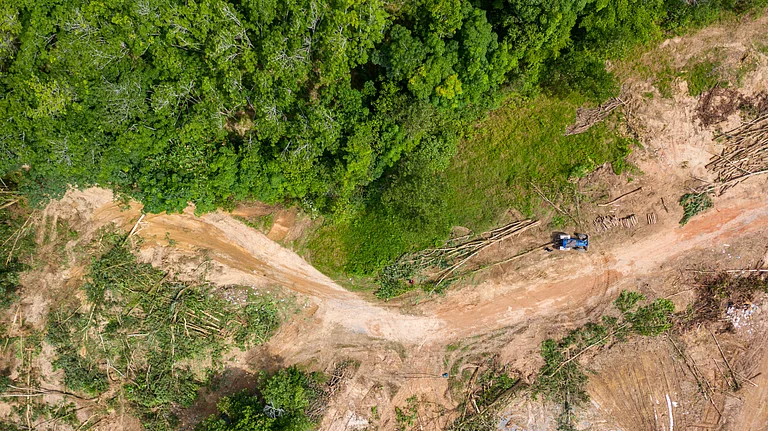
After 2012, a higher percentage of deforestation (74.88%) was observed in mines targeting minerals required for renewable energy production, compared to those for non-renewable energy production (25.11%). For instance, the mining of nickel—used in batteries for electric vehicles and energy storage systems—often involves large-scale changes to land use, including deforestation in regions rich in biodiversity.
Led by Xiaoxin Zhang from the University of Hong Kong, the research overlaid the global high-resolution forest loss and loss year layers with mining areas during 2001-2023 and compared deforestation rates between recorded and unrecorded mines.
The study encompasses 236,028 mining locations worldwide, including a substantial number of unrecorded mining operation sites and found significant deforestation linked to global mining activities in the 21st century.
The findings indicated that mining-related deforestation is approximately twice as high as the estimates reported in recent studies, largely due to the omission of the unrecorded mining activities.
Advertisement
Throughout the 21st century (2001-2023), 175 countries worldwide experienced deforestation in mining areas — mining has led to a total loss of 19,765 sq km of deforestation, contributing to 0.75 Pg CO2 emissions from 2001 to 2023.
Tropical forests were seriously affected, with 10,824 sq km of mining-driven deforestation accounting for 0.56 Pg CO2 in forest carbon emissions, making them visible as hotspots. Cold and temperate regions also faced considerable deforestation, with 5,162 sq km and 3,470 sq km of mining-driven deforestation, respectively.

Balancing Climate Trade-offs
The International Energy Agency (IEA) in its report published in June 2025 warned that to ensure that the tripling of renewable energy capacity by 2030 aligns with the goal of protecting 30% of the planet’s land and water by the same date, robust mechanisms that direct solar and wind projects away from the world’s most biodiverse areas are needed.
Advertisement
At the 28th United Nations Climate Change conference (COP28) in 2023, nearly 200 countries set a target to triple renewable energy capacity by 2030. Based on an assessment by the International Energy Agency (IEA), tripling the capacity of renewables globally requires allocating up to an additional 600 000 km² of land – an area the size of France – to utility-scale solar PV and onshore wind power by 2030, and 2mn km² by 2050.
The IEA report recommended that integrating land-use considerations into energy system planning can reduce negative biodiversity impacts and enhance co‑ordination across land-use priorities.