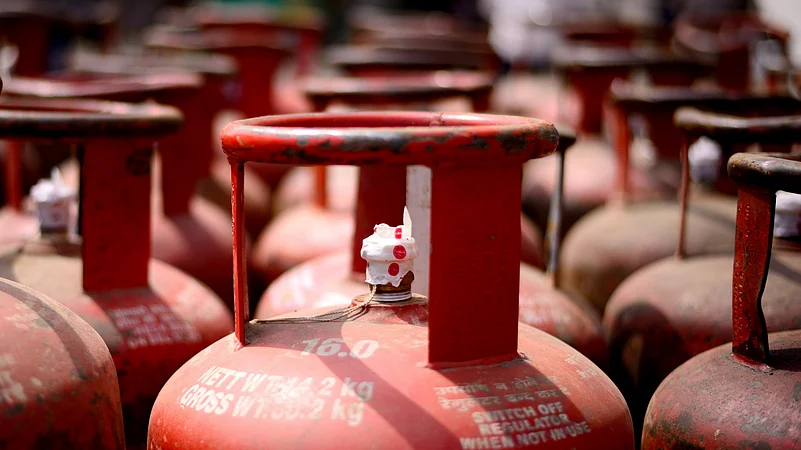

The Petroleum Ministry has set combined LPG production targets for 21 companies, with Reliance Industries receiving the largest individual target of 18,000 tonnes per day.
India consumed 33.2 million tonnes of LPG in FY26 but produced only 13.1 million tonnes domestically, leaving more than 64% of consumption dependent on imports.
Companies have been directed to develop storage and transport infrastructure and explore upgrades such as naphtha-to-LPG conversion to increase output during supply disruptions.
The Petroleum and Natural Gas Ministry issued an order on August 13 setting maximum cooking gas (LPG) production targets for 21 refineries and upstream companies.
The mandate establishes a combined production potential of 63,810 tonnes a day, the publication reported. This figure is more than double the domestic LPG output in FY26 and accounts for about 70 per cent of the country's daily consumption.

1 October 2026
Get the latest issue of Outlook Business

The policy aims to create a domestic supply buffer. This follows the recent West Asia conflict, which revealed the nation's susceptibility to imported LPG supply shocks. The new limits will activate during periods of supply shortages.


Refinery Production Targets
Reliance Industries holds the largest share of the planned output. The company's 33 million tonnes a year domestic-tariff-area (DTA) refinery at Jamnagar, Gujarat, received a target of 18,000 tonnes a day.
No target was set for Reliance's separate 35.2 million tonnes a year export-only refinery at the same location. Meanwhile, 18 refineries owned by public sector companies have been directed to produce a combined 31,470 tonnes a day.
Advertisement
Russia's Rosneft-backed Nayara Energy must produce 4,480 tonnes a day from its 20 million tonnes a year Vadinar refinery. Upstream gas processors, including ONGC and GAIL, received a combined target of 6,460 tonnes a day.
Mitigating Import Vulnerabilities
India consumed 33.2 million tonnes of LPG in FY26, equating to about 91,000 tonnes a day. Of this, 13.1 million tonnes a year (about 35,900 tonnes a day) was produced locally. The remaining 21.3 million tonnes a year (about 58,400 tonnes a day)—representing over 64 per cent of total consumption—was imported.
This high import reliance left India exposed when the Iran war effectively shut the Strait of Hormuz. The narrow sea lane facilitated 90 per cent of India's LPG imports from nations such as Saudi Arabia.
Advertisement
In March 2026, the government ordered refineries to redirect petrochemical streams to boost LPG production and halted sales to industrial and commercial users. Authorities also increased household refill booking periodicity and encouraged consumers to shift to piped natural gas, whose supplies were less affected by the conflict. Domestic production ramped up to 55,000 tonnes a day at the height of the crisis before the emergency orders were withdrawn in mid-June.
Mandated Technical Upgrades
Companies must develop and maintain adequate infrastructure for LPG storage, evacuation and transport. The mandate requires these arrangements to be managed either independently or through entities such as railways or road tankers.
Refiners are directed to implement viable technical and economic enhancements to optimise production. The order specifies measures such as naphtha-to-LPG conversion and upgrading from gasoline-based to petro-fluid catalytic cracking units. Refiners must notify the Centre for High Technology or other authorised agencies when they undertake these upgrades.
The government has empowered itself to mandate production scale-ups for specified quantities during crises to ensure equitable distribution and fair pricing. This includes enforcing compliance with restrictions on alternative uses of the input streams required to produce LPG. The Central Government will update these facility-wise production schedules bi-annually on January 1 and July 1, factoring in output from new refineries and technology upgrades.