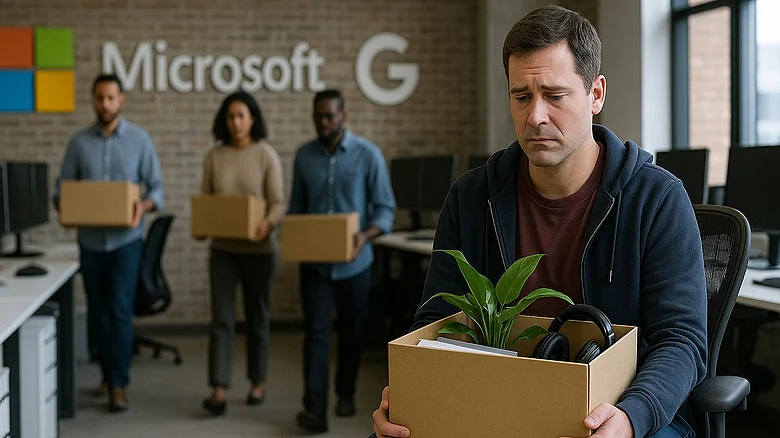

Microsoft is cutting around 2.1% of its global workforce, with approximately 3,200 roles set to be eliminated from its Xbox gaming division through fiscal 2027.
The company says the layoffs are part of a broader organisational overhaul to adapt to changing work patterns in the AI era, while maintaining that AI is not directly replacing affected employees.
Microsoft is spinning off or divesting several game studios as it streamlines its gaming portfolio, even as investors continue to scrutinise its AI strategy and slowing performance in some business segments.
Microsoft on Monday announced the immediate elimination of 4,800 jobs, or around 2.1% of its global workforce, as the technology giant continues to streamline operations amid the rapid evolution of artificial intelligence. The latest round of layoffs is part of a broader restructuring aimed at reducing costs and sharpening the company's focus on long-term growth.
The biggest impact will be felt within the Xbox gaming division, where nearly 3,200 employees—about 20% of the workforce—are expected to leave. Around 1,600 jobs are being cut immediately, while the remaining reductions will take place gradually through fiscal year 2027.

1 October 2026
Get the latest issue of Outlook Business

Xbox Restructuring Underway
In a message to employees, Xbox CEO Asha Sharma said the phased approach would make the restructuring more manageable, although it would extend uncertainty for employees. The company expects the gaming business to return to growth by 2027.
As part of the overhaul, Microsoft will also reshape its gaming portfolio. Studios including Compulsion Games and Double Fine Productions will become independent once again, while Ninja Theory and Undead Labs are set to move under new ownership.
Advertisement
Meanwhile, France-based Arkane Studios is evaluating strategic alternatives following consultations with its employee representatives.
The restructuring will also affect Microsoft's commercial sales business, where additional job cuts are planned.
AI Reshapes Microsoft's Workforce
Chief People Officer Amy Coleman said the pace at which technology is evolving has made organisational changes necessary.
While artificial intelligence is transforming how employees work, she clarified that AI is not directly replacing those whose jobs are being eliminated.
Instead, she said automation is reducing the need for certain routine tasks, requiring employees to continuously develop new skills as workflows evolve. Microsoft believes adapting its own workforce is essential to helping customers navigate similar AI-driven changes.
Advertisement
Earlier this year, the company also introduced its first-ever voluntary retirement programme for eligible U.S. employees, with more than one-third of those offered the scheme opting to participate.

Financial Pressure and Strategic Shift
The layoffs come during a challenging year for Microsoft. The company's shares have fallen 19% in 2026, making it the weakest performer among major technology firms, as investors question whether generative AI could disrupt traditional enterprise software while awaiting stronger commercial success from Microsoft's own AI offerings.
Although Microsoft's cloud computing and LinkedIn businesses have continued to post solid growth, weaker performance in Windows licensing, Surface devices and Xbox has weighed on overall results.
Industry analysts have also questioned Microsoft's long-term commitment to the gaming business, with some suggesting the company could eventually spin off Xbox as it sharpens its focus on artificial intelligence and enterprise software.