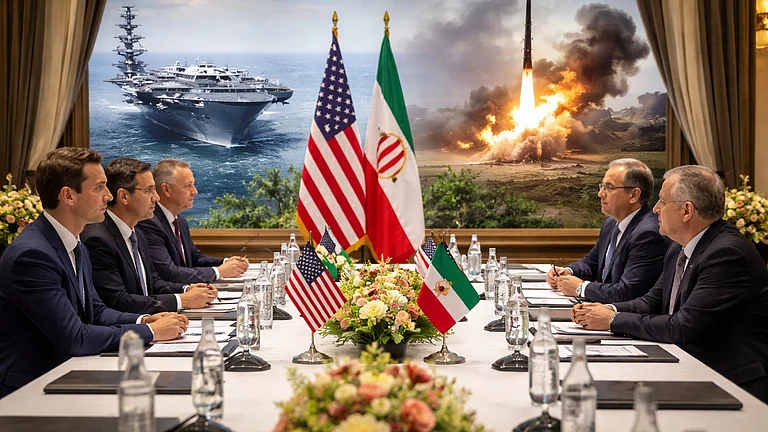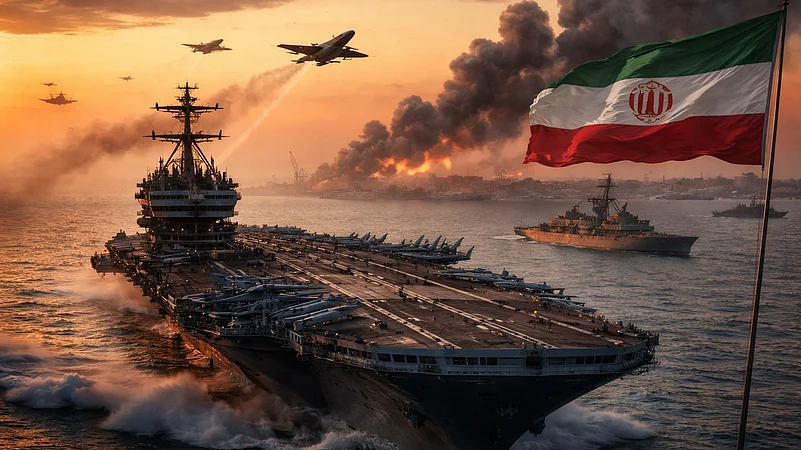

Iran said the Strait of Hormuz remains open but vessels linked to the US and Israel will not be allowed to pass after US strikes on Kharg Island.
The conflict that began on February 28 has killed over 2,000 people, with US and Iranian forces exchanging strikes across the region.
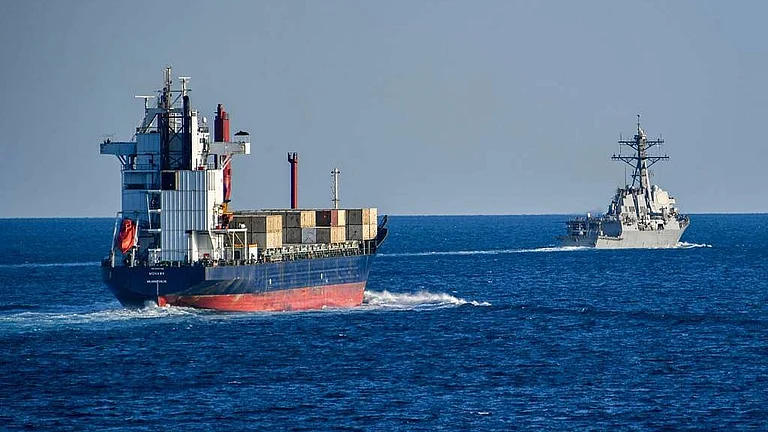
At least 16 vessels have been attacked around the Gulf and Strait of Hormuz since the war began, raising concerns over global energy supply disruptions.
With fresh threats from US President Donald Trump and no signs of a conflict resolution, the Iran war in West Asia is intensifying in its third week. Iranian Foreign Minister Abbas Araghchi said on Saturday that the Strait of Hormuz remains open to most countries but is closed to vessels associated with the US and Israel following recent air strikes on Kharg Island, Iran’s key oil export hub.
On Saturday, Trump signalled more attacks on Kharg Island and urged allies to send warships to secure the Strait.
1 September 2026
Get the latest issue of Outlook Business

“As a matter of fact, the Strait of Hormuz is open,” Araghchi said. “It is only closed to the tankers and ships belonging to our enemies, to those who are attacking us and their allies. Others are free to pass. I can say that the Strait is not closed, but it is closed to American and Israeli ships and tankers, and not to others.”
He added that some shipments were avoiding the route due to security reasons rather than restrictions imposed by Iran. According to a report by Moneycontrol, citing UK Maritime Trade Operations, at least 16 vessels operating in the Gulf region and around the Strait of Hormuz have been attacked since the war erupted.
Advertisement

The conflict, which began on February 28, has taken the lives of over 2,000 people and led to the assassination of Iran’s supremo, Ali Khamenei. Araghchi’s remarks come a day after the US military struck military facilities on Kharg Island. Tehran retaliated with strikes across the region targeting US military bases, disrupting aviation operations and sending shockwaves across global energy markets.
Araghchi also responded to claims made by US Defence Secretary Pete Hegseth that Iran’s new supreme leader, Mojtaba Khamenei, was wounded and likely disfigured, saying that “there is no problem with the supreme leader.”
Advertisement
In a post on social media, Trump asked countries affected by the closure of the Strait to send warships and expressed hope that China, France, Japan, South Korea, Britain, and others would deploy ships to the area. Despite rising tensions, Reuters reported that two Indian-flagged tankers carrying liquefied petroleum gas (LPG) crossed the Strait.