





The US and Iran have reportedly agreed to halt attacks after recent clashes around the Strait of Hormuz, with commercial vessels expected to resume normal transit through the strategic waterway.
Fresh negotiations are expected in Qatar to address disputes over navigation, preserve the fragile ceasefire and prevent another military escalation.
Despite the reported breakthrough, tensions remain high across West Asia, with uncertainty surrounding Iran's role in Hormuz, the Israel-Lebanon ceasefire and ongoing conflicts in Gaza and Syria.
The United States and Iran have agreed to suspend military operations following several days of escalating attacks around the Strait of Hormuz, according to media reports citing a US official. The development is expected to ease tensions along one of the world's most critical maritime trade routes and revive diplomatic efforts to preserve the fragile ceasefire reached earlier this month.
According to a BBC report citing its US partner CBS News, both sides have agreed to "stand down," allowing commercial vessels to resume normal transit through the Strait of Hormuz. The official also said negotiations aimed at ending the conflict would continue, with fresh talks reportedly scheduled in Doha, Qatar.

1 September 2026
Get the latest issue of Outlook Business

Iran has not officially confirmed the reported agreement.
Ceasefire Came Under Pressure
The latest understanding follows several days of military exchanges that threatened to derail a ceasefire signed on June 17, when Washington and Tehran agreed to a 14-point Memorandum of Understanding (MoU).
The agreement called for an immediate and permanent cessation of hostilities and included an Iranian commitment to facilitate the safe passage of commercial vessels through the Strait of Hormuz for 60 days.
Advertisement
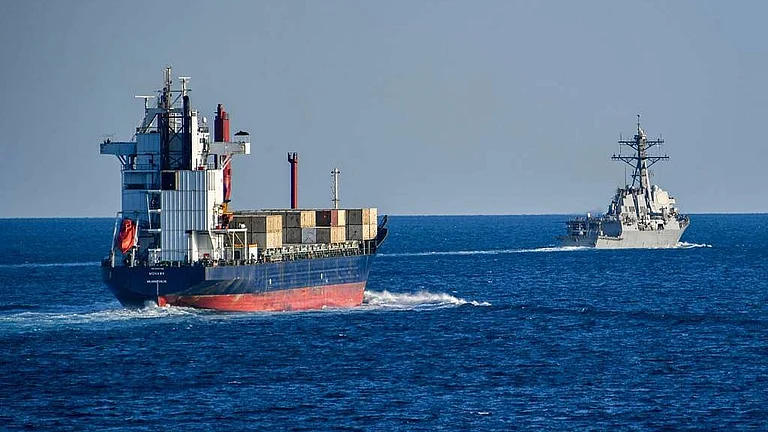
However, tensions resurfaced after an Iranian projectile struck a commercial cargo ship transiting the strategic waterway. The United States responded with airstrikes targeting Iranian military sites, describing the operation as a response to attacks on commercial shipping.
Iran later launched strikes against US military bases in Kuwait and Bahrain. Washington said the attacks caused no casualties or damage.
Hormuz Remains at the Centre of Dispute
The Strait of Hormuz continues to be the central point of disagreement between the two countries.
The waterway, which carries a significant share of the world's oil and liquefied natural gas exports, has remained under heightened security since Iran imposed restrictions on maritime traffic following the outbreak of hostilities earlier this year.
Advertisement
According to Axios, the United States and Iran have now agreed to meet in Doha on Tuesday to address disputes surrounding navigation through the strait and explore ways to prevent further escalation.
Iranian Foreign Minister Abbas Araghchi reiterated that Tehran considers itself solely responsible for managing the Strait of Hormuz and warned that attempts to bypass Iran's preferred shipping arrangements could lead to renewed tensions.

Regional Tensions Persist
Despite the apparent de-escalation between Washington and Tehran, instability elsewhere in the region continues to pose challenges.
The United States recently brokered a framework agreement between Israel and Lebanon aimed at reducing cross-border hostilities. However, the proposal has already faced resistance.
Lebanese Parliament Speaker Nabih Berri rejected the framework, saying it failed to safeguard Lebanon's interests and would not be implemented. Separately, Hezbollah also criticised the agreement, accusing the Lebanese government of compromising national sovereignty.

Meanwhile, the Israeli military said it had destroyed a large Hezbollah tunnel in southern Lebanon that allegedly contained hundreds of weapons. Israeli officials said Washington had been informed before the operation.
Elsewhere in the region, violence continued in Gaza, where Israeli operations reportedly killed four Palestinians, while Syria condemned Israeli military incursions into the southern provinces of Quneitra and Deraa, warning that continued attacks risk further destabilising the region.
While the reported US-Iran understanding has reduced immediate fears of a wider conflict around the Strait of Hormuz, the broader security situation across West Asia remains fragile as multiple flashpoints continue to threaten regional stability.









