

Jewellery stocks erased ₹60,000 crore after gold import duty shock.
Titan, Kalyan and Senco plunged as gold demand fears intensified.
Experts expect organised jewellery players to gain from industry formalisation.
Jewellery stocks have witnessed a brutal selloff this week, with investors dumping shares after Prime Minister Narendra Modi's appeal to defer gold purchases and the government’s sharp increase in import duties triggered concerns around demand, profitability and consumer sentiment.
In just three trading sessions, major jewellery counters have plunged as much as 20%, wiping out nearly ₹60,000 crore in investor wealth. Kalyan Jewellers emerged as one of the biggest losers, tumbling nearly 20%, while Thangamayil Jewellery and Sky Gold declined around 18% each. Senco Gold dropped 14%, while Tata Group-backed Titan Company slipped nearly 11%.

1 September 2026
Get the latest issue of Outlook Business

The correction followed a double policy shock. First, Modi urged citizens to postpone non-essential gold purchases and reduce foreign exchange outflows amid growing economic pressure from the prolonged West Asia crisis. Days later, the government raised effective import duties on gold and silver to 15% from 6%, seeking to reduce imports and protect India's weakening currency and forex reserves.

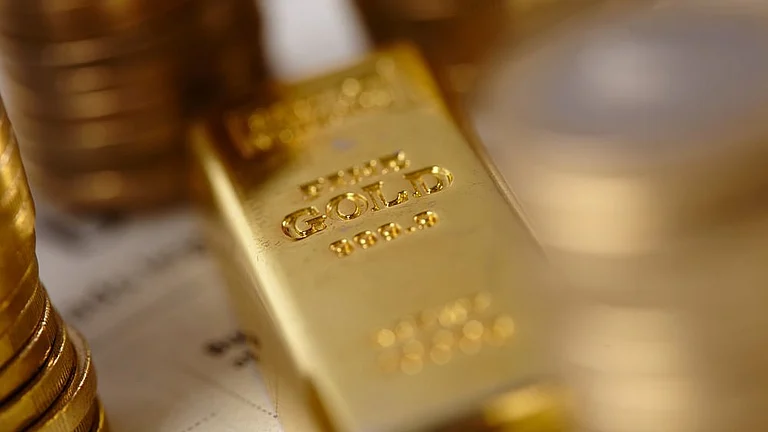
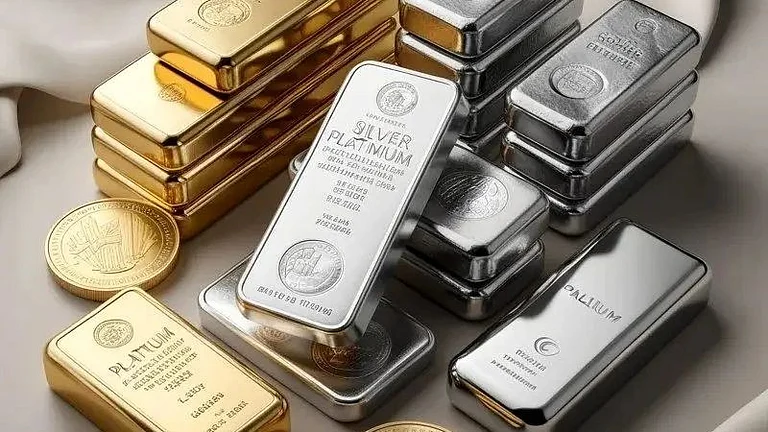

Viewed from a broader perspective, the Prime Minister's comments appear less like an attempt to discourage gold ownership and more like a signal aimed at preserving India's macroeconomic stability. India imports almost all the gold it consumes, making every surge in demand a significant source of dollar outflow and additional pressure on the rupee.
Advertisement

Why Markets Reacted
For jewellery companies, the implications of higher import duties are immediate and complex. Higher tariffs translate into increased domestic gold prices, potentially making jewellery purchases more expensive and forcing consumers to postpone discretionary buying.
At the same time, gold prices have surged to record levels. Gold recently crossed ₹1.62 lakh per 10 grams as global uncertainty, central bank buying and expectations of US Federal Reserve rate cuts strengthened bullion demand.
Mayank Jain, Market Analyst at Share.Market by PhonePe, said global uncertainty had once again turned gold into a preferred safe-haven asset.
Advertisement
"This massive rally is fueled by a combination of international factors: the US Federal Reserve’s anticipated interest rate cuts, heavy central bank buying and escalating geopolitical conflicts," Jain said.
He noted that while organised players may face near-term demand pressure, Titan appears relatively stronger because of its diversified business model and premium positioning, while several other counters have slipped below long-term technical levels.
Demand Shift Underway
Experts believe consumer demand is unlikely to disappear but may change form. As gold prices remain elevated, investors could increasingly shift towards bars, coins, ETFs and digital gold products rather than traditional jewellery purchases.
Navy Vijay Ramavat, Managing Director at Indira Securities, said the near-term impact of higher duties could create pressure in physical demand, but participation in the broader gold ecosystem remains strong.
He pointed out that investors should also monitor segments beyond jewellers, including gold financiers, commodity exchanges and fund houses benefiting from rising ETF flows.
Amit Suri, Founder of AUM Wealth, said gold demand was becoming increasingly bifurcated, with investment demand strengthening while discretionary jewellery purchases faced pressure.
According to Suri, higher import duties may ultimately support organised players because stronger brands generally gain market share during periods of industry consolidation and pricing disruptions.

Long-Term Story Intact
Despite the sharp correction, market participants believe the long-term fundamentals of organised jewellery companies remain intact due to India's deep cultural connection with gold and increasing formalisation within the industry.
Prasanna Pathak, Deputy CEO at The Wealth Company Mutual Fund, said elevated gold prices continued reinforcing the metal's role as a hedge against inflation, geopolitical uncertainty and currency volatility.
He added that organised jewellers with strong balance sheets, transparent sourcing and scalable retail networks remain better positioned to benefit from industry consolidation.
Pravesh Gour, Senior Technical Analyst at Swastika Investmart, said higher gold prices may support billing values and revenue growth in the near term, although prolonged price inflation could weigh on volume growth, particularly in rural and entry-level segments.
Analysts said investors should closely monitor rural demand recovery, import duties, rupee movement and global macro developments, as these factors could influence both sector sentiment and profitability.
Forex Risks Remain
The government's concerns over gold imports stem from a broader macroeconomic challenge rather than demand alone. India consumes around 700–800 tonnes of gold annually while domestic production remains negligible.
Gold imports surged to a record $72 billion in FY26, accounting for nearly 9% of India's total import bill and becoming one of the country's largest sources of foreign exchange outflow after crude oil.
Higher gold imports increase demand for dollars, widening the current account deficit and exerting additional pressure on the rupee during periods of elevated oil prices and geopolitical stress.
Experts said while the recent measures may temporarily slow imports and pressure jewellery demand, they should be viewed primarily as macroeconomic interventions designed to protect external balances rather than as a structural negative for the sector.
What Investors Should Watch
For investors, the focus now shifts beyond the immediate stock price correction towards broader demand and macro indicators. Analysts said factors such as gold price volatility, rupee movement, import duty changes and global geopolitical developments will continue to influence sentiment across jewellery counters in the near term.
Experts also highlighted that while elevated gold prices may temporarily impact affordability and physical jewellery demand, particularly in rural and price-sensitive markets, organised players with stronger brands and efficient inventory management remain better placed to navigate volatility. Industry formalisation and rising preference for trusted brands could continue supporting long-term market share gains.
At the same time, consumption patterns appear to be evolving. Analysts are increasingly seeing a shift towards digital gold, ETFs, gold financiers and investment-led products as consumers look for alternative ways to participate in the gold ecosystem. While near-term volatility may persist, experts advised investors against panic reactions, saying staggered investment approaches and focus on quality businesses may remain the preferred strategy.