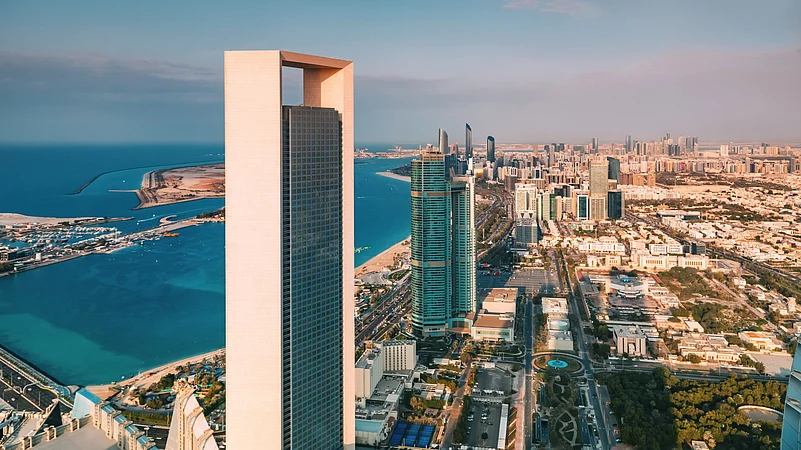

Abu Dhabi has imposed a temporary rent freeze on all residential, commercial and industrial tenancy renewals, mandating a 0% increase for previously occupied units.
The measure suspends the usual 5% annual cap, compelling landlords to renew leases at the same rate.
It aims to shield tenants from rising living costs, fuel constraints, job losses and economic uncertainty linked to the ongoing West Asia conflict.
The Abu Dhabi Real Estate Centre has announced a rent freeze across the capital city of the United Arab Emirates. "Your rent stays the same," announced the real estate body through a post on 'X' from their official account on Tuesday.
In simple words, there will be no increase in property rent for residential, commercial and industrial tenancy contract renewals for the duration of the measure. The new rule requires landlords to renew leases on previously occupied units at the same rent.

1 September 2026
Get the latest issue of Outlook Business

"A temporary measure is in effect across Abu Dhabi. All residential, commercial, and industrial tenancy contract renewals will be processed at a 0% increase for the duration of the measure. Any new tenancy contract on a previously rented unit will be offered at the same rental value as the preceding contract," the post read.
The rent freeze is described as a "temporary measure." Currently, under the state law, property owners can increase the rent up to 5% annually during contract renewals on previously rented units. The rent cap was introduced to keep landlords from increasing property rents beyond limits.
Advertisement
The announcement comes as a relief amid the current price hike, fuel constraints, job losses and pay cuts due to the ongoing West Asia conflict.
While the region continues to bear the prolonged effects of the US-Iran conflict. Iran has threatened that it may target the economic and financial infrastructure in the West Asian countries that harbour US military assets, which puts the UAE among the targets.

UAE's Realty Market Shift Post War
For decades, Dubai has enjoyed the “safe haven” status as the Gulf nation became a preferred land for global investors, especially Indians. In 2025, Indians were the largest group of foreign buyers in Dubai’s residential property market. They purchased homes worth an estimated ₹85,000 crore to ₹95,000 crore, according to Anarock Property Consultants data.
Advertisement
However, Iran war-driven volatility rattled oil, currencies and investors’ confidence. Property sales in Dubai have come down by 44% year-on-year since February end across the emirate’s home, villa, office and commercial markets, the data from Dubai Land Department revealed.
Bloomberg had also reported that residential prices in Dubai have slipped for the first time after a post-pandemic boom, falling around 5-6%. However, overall sales volumes have also cooled sharply from peak levels.
Currently, Dubai’s recent wobble in property sentiment shows how quickly its long-touted safe-haven appeal can come under pressure when geopolitical risk escalates. After a post-pandemic surge that pushed home prices up more than 70% since 2020, the emirate’s real estate market is now seeing its first meaningful correction phase.


Yet, even this slowdown comes after an exceptionally strong cycle, with Dubai still recording around $250 billion in property transactions last year, underlining its deep liquidity and global investor base.