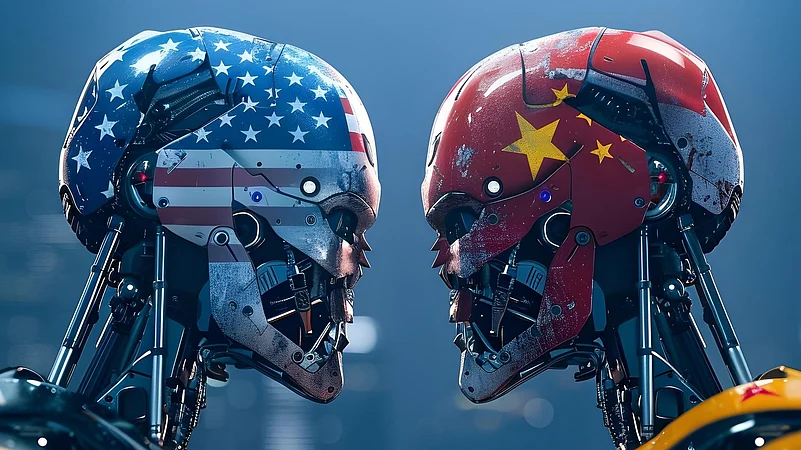

US leads in frontier AI research, semiconductors and cloud infrastructure
China dominates robotics deployments, while pursuing self-reliance goals
DeepSeek's release served as wake-up call, showing China can build elite AI models
2025 was an inflection year in the US-China tech rivalry, with competition intensifying across multiple fronts simultaneously.
While the US leads in core technology development, AI frameworks, cloud infrastructure and quantum computing, and continues to attract global technical talent, China leads or is closing the gap rapidly in practical physical AI and robotics deployments such as drone deliveries, uncrewed taxis and large-scale factory automation; in building and installing digital infrastructure worldwide, particularly across the Global South; and in advancing technological self-sufficiency through aggressive industrial policy and state-backed incentives.

1 September 2026
Get the latest issue of Outlook Business

2025 was also one of the most active years for new technology launches, major investments and cross-industry collaborations. Beyond innovation and capital flows, the rivalry increasingly extended into geopolitics, with export controls, supply-chain strategy and industrial policy shaping where and how technologies were developed, deployed and commercialised in the race for long-term tech advantage.




US vs China: Head to Head Comparison
Goldman Sachs’ Top of Mind: The US-China Tech Race report argues that the US has maintained an advantage over China in frontier research and platform-level capabilities. This includes advanced semiconductor design and manufacturing know-how, foundational AI research and frameworks, large-scale cloud and datacentre infrastructure and early-stage quantum technologies. This lead is reinforced by a strong talent ecosystem that the US is able to attract.
Advertisement
On the other hand, China is described as moving ahead in large-scale, practical deployment and downstream application. The report highlights rapid rollouts of robotics and autonomous systems such as drones, delivery robots and uncrewed taxis, fast expansion of digital infrastructure at home and across parts of the Global South and a coordinated push for industrial self-reliance backed by state finance, procurement policies and local incentives.
The report notes that US export controls have slowed China’s access to advanced tools (like Nvidia’s H100 chips) but have not stopped technological progress. Instead, restrictions have accelerated domestic substitution efforts, including closer software–hardware co-design, experimentation with alternative chip architectures, indigenous tool development and more efficient use of slightly older semiconductor nodes.
Advertisement
China’s dominance in critical supply-chain segments, particularly rare-earth processing and magnet production, combined with access to abundant, low-cost power for large industrial projects, creates vulnerabilities for the US and complicates efforts by either country to achieve full technological self-sufficiency.

US Approach To Maintain Lead
Policy choices shaped much of the year. Washington combined Cold War style industrial mobilisation with market incentives. This included continued deployment of CHIPS Act grants, with roughly $50 billion allocated, an expanded Advanced Manufacturing Investment Credit under OBBBA raised to 35 percent, preservation of IRA production credits with tighter rules on Chinese-linked content, and a growing use of direct government equity and loan support, with about $10 billion announced, nearly $9 billion of it tied to Intel.
OBBBA also added a $1.5 billion appropriation that enables up to $200 billion in lending through the DoD’s Office of Strategic Capital, along with targeted funding such as $2 billion for the Defense Innovation Unit and $10 billion for an Industrial Base Fund.
To reduce commercial risk for emerging domestic supply chains, the US increasingly relied on offtake agreements, floor price mechanisms and procurement guarantees, particularly for rare earth downstream processing and magnet production, while signalling faster permitting for data centres and semiconductor fabs. At the same time, export controls, a widening Entity List, Section 232 investigations and outbound investment rules remained core tools to limit the transfer of cutting edge capabilities to China.
China’s Playbook
Beijing’s playbook is highly state-led and coordinated. China has clustered priorities into “chokehold” technologies (integrated circuits, machine tools, basic software, advanced materials, biomanufacturing), “emerging industries” for rapid scale-up (new-energy tech, aerospace, drones, robotics), and “future industries” that receive strategic R&D focus (quantum, brain–computer interfaces, embodied intelligence, 6G).
Local and central incentives, large funds, tax breaks, subsidised land and power, fast-track permitting and talent programmes, have driven fast scale-up but also frequent overcapacity and duplication at the regional level.

Major Moves of 2025
According to Stanford’s AI Index report, 2025 saw the technology race sharpen around inference, infrastructure and industrial policy.
Nvidia doubled down on inference-focused partnerships and licensing strategies to reinforce its advantage in AI compute, while large corporates such as Disney made billion-dollar investments that accelerated the commercial adoption of AI at scale. In China, hyperscalers including ByteDance announced aggressive AI capital-expenditure plans and pursued more compute-efficient model strategies in response to US export restrictions.
At the same time, semiconductor onshoring gathered pace amid record global investment in chipmaking equipment, with China leading in overall investment volume even as US export controls tightened further.
Quantum technologies also moved closer to commercial viability, supported by technical milestones and rising private funding. Across the broader ecosystem, AI-driven mergers, acquisitions and mega funding rounds increasingly concentrated talent and intellectual property among a small number of platform owners, reinforcing scale advantages at the top of the market.
Who’s Leading at the End of 2025?
By the end of 2025 the picture was nuanced rather than binary. The US maintained a lead in top-tier foundation models, cloud-scale AI, and cutting-edge training GPUs, while China gained ground in open-source momentum, domestic-scale deployment, and depth in select supply-chain segments.
On hardware, the US-Taiwan–Korea ecosystem continued to dominate the most advanced nodes and inference stacks, whereas China invested heavily in alternative accelerators and large-scale capacity, but lagged on EUV-dependent toolchains.