
A new Supreme Court-backed definition of the Aravalli Hills leaves over 90% of the ancient range outside legal protection.
The Centre argues the redefinition enables regulated, sustainable extraction of critical minerals vital for energy transition and national security.
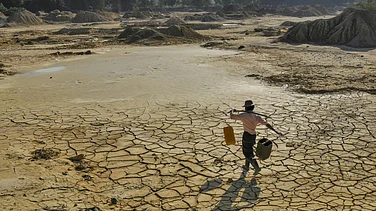
Environmentalists warn the move could worsen groundwater depletion, desertification and air pollution.
Spanning nearly 700 km across four states, the Aravalli Hills are not only the oldest mountain range in India but also serve as a critical ecological barrier and the green lungs of northern India. Predating the Alps, the Andes and even the Himalayas, the ancient range has now become the centre of a debate following a narrow legal definition accepted by the Supreme Court last month.
On November 20, the apex court accepted a redefinition of the Aravalli Hills that leaves only 8.7% of the range under protection. The remainder is now vulnerable to mining and infrastructure activity, raising concerns over long-term ecological damage and risks to both human and wildlife habitats.

1 September 2026
Get the latest issue of Outlook Business

The Aravalli Range
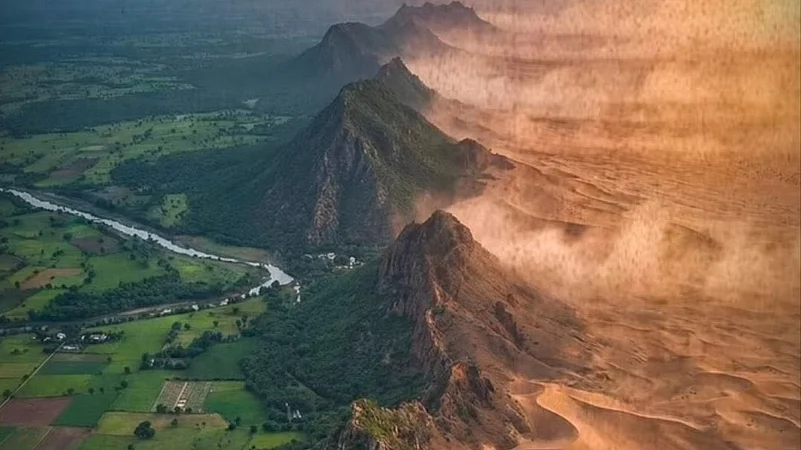
The Aravallis are a long stretch of low- and mid-elevation hills spanning Rajasthan, Gujarat, Haryana, Delhi and western Uttar Pradesh. The range provides vital ecological services across these regions, including limiting eastward dust movement from the Thar Desert, acting as a natural water aquifer, sustaining diverse wildlife habitats, and preventing soil erosion.
Advertisement
Redefining the Aravallis
Under the new legal definition, a landform qualifies as an ‘Aravalli Hill’ only if it rises at least 100 metres above the local terrain. A cluster of hills within a 500-metre radius is classified as an ‘Aravalli range’.
According to official data, of the 12,081 hills mapped in Rajasthan—where the Aravallis are most prominent—only 1,048 hills, or 8.7%, meet the revised criteria. This leaves more than 90% of the ancient range outside legal protection, exposing it to potential mining and land-use exploitation.
For decades, large parts of the Aravallis were legally protected from large-scale commercial activity.
Advertisement
Why the Redefinition Now
For years, states have sought mining and quarrying permissions in the Aravalli region. However, ambiguities in earlier definitions led to inconsistent interpretations across states.
In May 2024, the Union Environment Ministry constituted a committee to formulate a uniform definition of the Aravalli Hills and ranges. The panel submitted its final report in October 2025, following which the Supreme Court ruled in November that only hills rising over 100 metres would qualify for protection.
What the Centre Says
The Aravalli range contains several minerals, including lithium, tungsten, gold and lead. According to a report by The Wire, the Centre has argued that the presence of precious and strategic minerals offers “substantial potential for future exploration.”
The range is also said to hold “significant potential” for the extraction of critical minerals such as graphite and rare earths—resources seen as vital for the energy transition, high-technology manufacturing and national security.
“In this context, the Committee was of the considered opinion that while the ecological and environmental integrity of the Aravalli Hills and Ranges must remain the foremost priority, it is equally necessary to evolve a framework that enables systematic, scientific, and environmentally sustainable exploitation of critical, strategic, and atomic minerals located within the region,” the report said, citing an affidavit filed on behalf of the Union Environment Ministry.
The Centre has also said that “regulated, sustainable” mining would be permitted only after detailed mapping, while core ecological and groundwater recharge zones would be preserved. Restoration efforts, including projects under the Aravalli Green Wall initiative, are expected to be scaled up.
What the Supreme Court Says
While accepting the redefinition of the Aravalli Hills and ranges, the Supreme Court directed that scientific mapping and a sustainable mining plan be prepared. The court also restrained the grant of new mining leases until the mapping exercise is completed.
The Ecological Costs
Environmentalists and conservationists argue that removing protection from over 90% of the Aravalli range—including low-elevation ridges, knolls and rocky outcrops—undermines a critical natural barrier and ecosystem. Many of these formations fall below the revised 100-metre threshold.
Critics warn that the redefinition could pave the way for mining, highway construction, real estate development and quarrying—activities already prevalent illegally in states such as Rajasthan and Haryana—triggering a cascade of climate and environmental risks.
Beyond acting as green lungs, the structure of the Aravalli range allows rainwater to percolate deep into underground reservoirs. Congress MP Ajay Maken has said in Parliament that the range enables groundwater recharge of nearly 20 lakh litres per hectare annually. A loss of this function could accelerate groundwater depletion in cities such as Gurugram and Faridabad, which rely heavily on Aravalli aquifers, and may worsen water stress across the National Capital Region. Northern India already ranks among the world’s fastest-depleting groundwater zones.
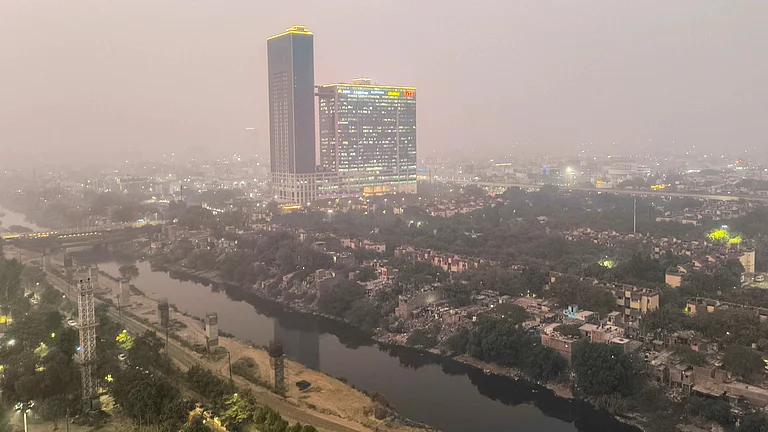
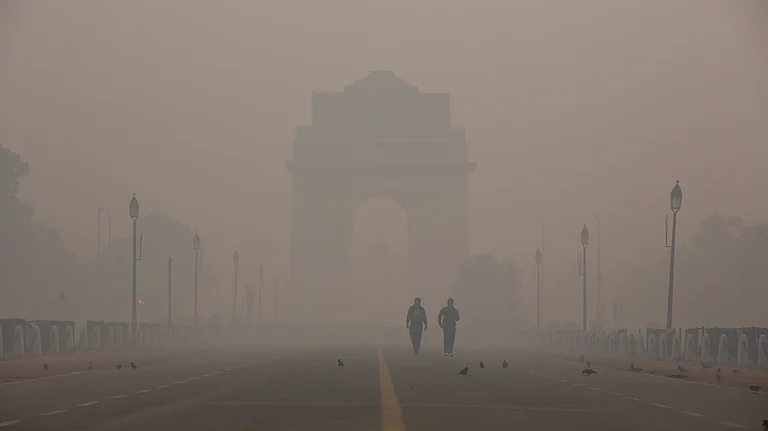
The adverse effects of a weakening Aravalli range extend beyond groundwater depletion. The hills act as a natural barrier, disrupting hot, dust-laden winds from the Thar Desert into the National Capital Region and the Gangetic plains. If this barrier is compromised, adjoining states and the national capital are likely to experience higher levels of particulate pollution, including PM10, exacerbating already hazardous air quality conditions.
Critics argue that declassifying a critical ecosystem—followed by intensified mining and real estate activity—could cause irreversible damage to the climate and physical geography of northern India.
Parliamentary debates have also seen Congress MP Ranjeet Ranjan draw parallels with landslides in Uttarakhand and indiscriminate mountain cutting during the Char Dham road project in the Himalayas.
Ecological systems, critics argue, cannot be compromised blindly for economic development, as natural buffers cannot be rebuilt once quarried away.