
Maharashtra has introduced its first comprehensive housing policy since 2007
It aims to achieve 'Housing for All' by 2030 through affordable housing, redevelopment and sustainable urban planning
The policy expands its focus to include rental housing, redevelopment of ageing buildings and slums, digital governance through the State Housing Information Portal (SHIP), and housing for students, migrant workers, senior citizens and working women
Nearly two decades after introducing its previous housing policy, Maharashtra has unveiled a new roadmap aimed at addressing one of the state's biggest development challenges—providing affordable, sustainable and inclusive housing in an increasingly urbanised economy.
The Maharashtra State Housing Policy 2025 came at a time when rapid migration, rising property prices, ageing housing stock and climate risks are reshaping cities across the state.

1 September 2026
Get the latest issue of Outlook Business

According to the policy, the government's vision is to create a housing ecosystem that is affordable, technologically driven and environmentally sustainable while ensuring that every citizen has access to adequate housing.
Unlike the 2007 policy, which primarily focused on increasing housing supply, the new framework broadens its scope to include redevelopment, rental housing, digital governance, green construction and housing for groups that have traditionally received limited policy attention, including students, industrial workers, working women and senior citizens.
Why Was a New Policy Needed?
Maharashtra's housing needs have changed significantly over the past two decades. Urbanisation has accelerated, household incomes have evolved and cities have expanded rapidly. While economic growth has created opportunities, it has also widened the gap between housing demand and affordability.
Advertisement
According to the policy document, nearly 45% of Maharashtra's population now lives in urban areas, placing enormous pressure on housing, civic infrastructure and public services.
Mumbai alone continues to have one of the country's largest slum populations, highlighting the persistent shortage of affordable formal housing.
The government also notes that rising land prices, higher construction costs and lengthy project approvals have made affordable housing increasingly difficult to deliver.
The experience of the Covid-19 pandemic further underscored the importance of housing located closer to workplaces, particularly for migrant workers and lower-income households.
Housing for All by 2030
At the heart of the policy is the government's ambition to achieve "Housing for All" by 2030. The objective is not merely to build more houses but to ensure that housing is affordable, accessible, safe and supported by adequate infrastructure.
Advertisement
The policy proposes a comprehensive approach that combines new housing construction with redevelopment, rental housing, financial support, improved planning and better coordination between government agencies. Rather than treating housing purely as a welfare measure, it positions the sector as a key driver of economic growth, employment and urban development.
Planning Housing Through Better Data
One of the biggest departures from previous policies is the emphasis on data-driven planning.
The government intends to undertake a statewide assessment of housing demand and create a State Housing Information Portal (SHIP), which will consolidate housing-related information on a single digital platform.
The portal is expected to help policymakers identify housing shortages, monitor project implementation and improve coordination among departments responsible for land, planning and housing development.
Officials believe that better data will allow investments to be directed towards regions with the greatest need instead of relying on fragmented estimates.
Affordable Housing Beyond Traditional Beneficiaries
The policy significantly expands the definition of affordable housing.
While economically weaker sections and low-income households remain central to the government's strategy, the policy also recognises the growing housing needs of students, working women, industrial workers, migrant labourers, senior citizens and government employees.
Rental housing also receives greater attention than before. Recognising that not every household seeks immediate home ownership, the government plans to promote affordable rental accommodation, particularly in employment centres experiencing rapid migration.
The policy also promotes the concept of "Walk to Work" by encouraging residential development closer to industrial clusters and commercial hubs. The objective is to reduce travel time, lower transport costs and improve the overall quality of urban living.
Redevelopment Becomes a Priority
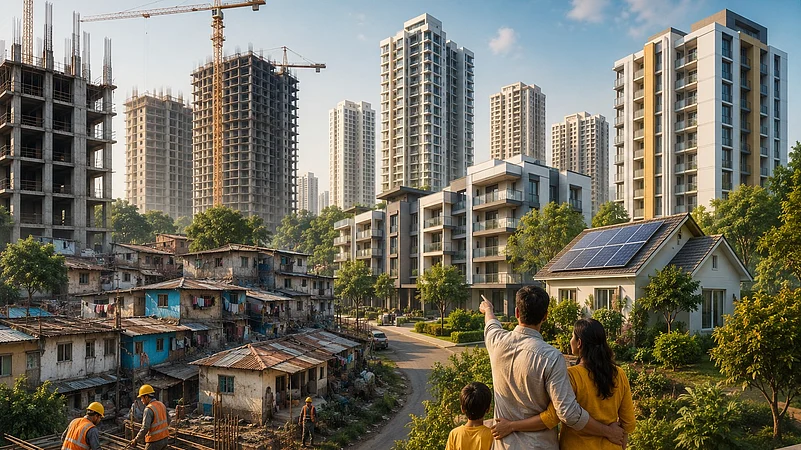
With land becoming increasingly scarce in cities like Mumbai, redevelopment has emerged as a central pillar of the new housing strategy.
Instead of relying solely on new housing projects, the government plans to accelerate the redevelopment of ageing buildings, housing societies and slum settlements. The policy seeks to simplify redevelopment processes while protecting the interests of existing residents and improving the pace of project execution.
The government believes redevelopment can create additional housing supply without placing further pressure on limited urban land.

A Push Towards Sustainable Housing
The new policy also aligns housing with Maharashtra's broader environmental goals.
It promotes green building practices, energy-efficient construction materials and modern building technologies that can reduce both construction costs and environmental impact. Climate resilience has also been incorporated into future planning, reflecting the growing frequency of extreme weather events affecting urban areas.
Making It Easier to Build Homes
Apart from supporting homebuyers, the policy also attempts to improve the environment for developers.
It proposes measures to simplify approvals, improve access to housing finance, strengthen construction quality, encourage technology adoption and improve skill development within the construction sector. By reducing procedural delays and improving institutional coordination, the government hopes to accelerate project delivery while maintaining quality standards.