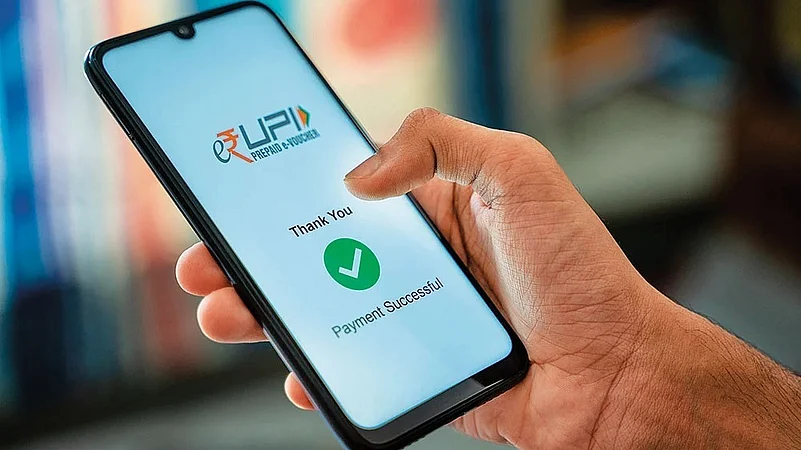

The government removed MDR on UPI and RuPay debit card transactions from January 2020
Under the existing system, a part of the costs is supported through government incentives instead of merchant charges
The proposed amendment does not itself impose MDR. Instead, it removes the statutory restriction that currently prevents the levy
For years, Unified Payments Interface (UPI) has become synonymous with free digital payments. Consumers do not pay to transfer money, and since 2020, merchants have also not paid Merchant Discount Rate (MDR) on UPI and RuPay debit card transactions.
That arrangement may now be up for review.

1 September 2026
Get the latest issue of Outlook Business

The government has proposed amendments to the Payment and Settlement Systems (PSS) Act that would remove the legal provision preventing the levy of MDR on specified digital payment modes.



The proposal does not automatically restore MDR but would create the legal framework to introduce such charges in future.
Why Is MDR Back In Talks?
The debate has resurfaced as banks and payment service providers argue that operating a digital payments network involves costs.
Speaking after the RBI's monetary policy announcement on Wednesday, RBI Governor Sanjay Malhotra said, "Someone has to pay the cost," adding that the decision on MDR rests with the government, not the Reserve Bank, as per a report by India Today.
Industry bodies have argued that the zero-MDR regime has left payment companies without a direct source of revenue from UPI transactions, even as volumes continue to grow.
Advertisement
According to NPCI data, UPI processed 23.6 billion transactions worth ₹29.9 trillion in July.
Why Was MDR Removed In 2020?
The government removed MDR on UPI and RuPay debit card transactions through the Finance Act, 2019, with the policy taking effect from January 2020.
The move was intended to encourage digital payments by ensuring that merchants and consumers did not incur additional charges while using UPI. To offset the impact on the payments ecosystem, the government later introduced an incentive scheme for banks and payment service providers.
A Press Information Bureau (PIB) release issued in December 2021 said "there is no MDR charged on RuPay Debit Card and BHIM-UPI transactions" and announced an incentive scheme to promote digital payments.
Advertisement
Who Bears The Cost Of 'Free' UPI?
Although UPI is free for users, processing digital payments is not.
Banks maintain payment infrastructure, payment service providers invest in technology and cybersecurity, and payment applications operate and expand the network.
Under the existing system, a part of these costs is supported through government incentives instead of merchant charges.
The proposal has revived the debate over whether the current funding model remains viable as UPI transaction volumes continue to rise.
Will Consumers Have To Pay?
As of now, there is no proposal to charge consumers for making UPI payments.
The discussion centres on MDR, a fee that merchants pay to banks or payment service providers for processing digital transactions. Similar charges already apply to several debit and credit card transactions, as per Mint.
However, if MDR is reintroduced for merchants, businesses may choose either to absorb the cost or factor it into their pricing.
No decision has been taken on whether merchants would be allowed to pass on the charges to customers.
Which Merchants Could Be Affected?
The proposal under discussion is not meant for all merchants.
One option reportedly being considered is to levy MDR only on merchants with an annual turnover above ₹1.5 crore and for UPI transactions exceeding ₹2,000.
Another proposal links MDR to merchant turnover. The government has not taken a final decision.
Transactions above ₹2,000 account for around 4% of UPI transaction volume but nearly 67% of the total transaction value, making them the focus of the proposal, as per Reuters.
What happens next?
The proposed amendment does not itself impose MDR. Instead, it removes the statutory restriction that currently prevents the levy of MDR on specified digital payment modes.
If the amendment is enacted, the government would have the option of introducing merchant charges through a separate notification.
The debate is centred on whether the digital payments ecosystem can continue under a zero-MDR model or whether larger merchants should begin bearing part of the cost of operating it.
For now, UPI payments remain free for consumers.