India and the US have signed a Critical Minerals Cooperation Framework aimed at strengthening supply chains for rare earths, lithium, and cobalt.
The partnership could focus on joint processing infrastructure, recovery of minerals from mining waste, and regulatory coordination.
Experts say workforce development, technology transfer, and industrial investment will determine whether the agreement delivers long-term strategic impact.
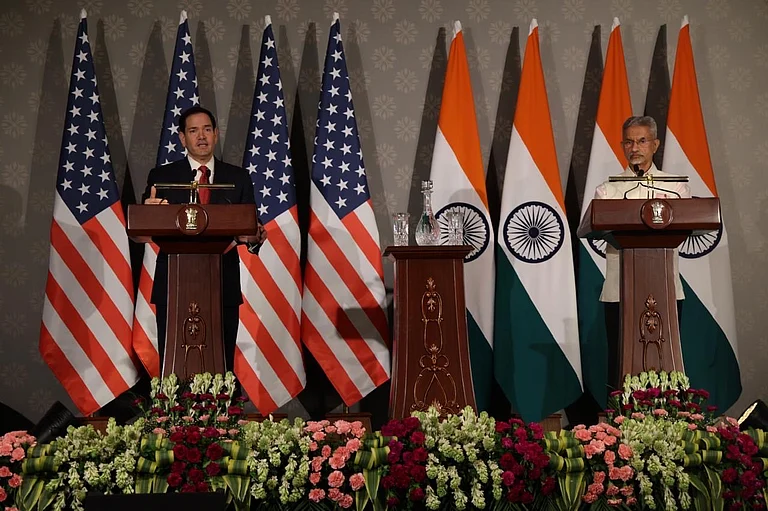
On May 26, 2026, at Hyderabad House in New Delhi, The United States (US) Secretary of State Marco Rubio and Indian External Affairs Minister S. Jaishankar signed a bilateral Critical Minerals Cooperation Framework, building on the Forum on Resource Geostrategic Engagement launched earlier this year in Washington.
The signing builds on US’s recognition that India is emerging as a serious player in critical minerals and downstream processing. Critical minerals such as rare earths, lithium, cobalt are foundational minerals for energy, manufacturing and defense technologies.

1 October 2026
Get the latest issue of Outlook Business

This new agreement itself is brief. But its implications could be substantial if both countries move decisively to translate diplomatic intent into industrial partnerships, joint research, and long-term investment.
The US and India can translate this diplomatic language into tangible and durable cooperation by focusing on four areas.
Joint Development of Processing Capacity
Both governments have explicitly framed this agreement around reducing dependence on “single-source monopolies.”
Advertisement
While China has a commanding position on lithium, cobalt, and other mineral processing that are critical to economic and national security, China’s dominance in rare earth processing, which extends to over 85 percent of global refining capacity is a key concern for both the US and India.
But this is where the US-India partnership can punch above its weight.
India has significant deposits of rare earth minerals, particularly in the monazite sands from its coastline. However, its downstream processing capabilities remain limited. Indian firms are scouting for processing technologies oversees.
The US, meanwhile, has expanded funding for rare earth processing research, pilot facilities, and domestic supply-chain development, though commercial-scale capability faces a long ramp-up period.
Advertisement
This creates a natural basis for industrial cooperation. A practical next step would be joint investment in processing infrastructure either in India or the US, pairing American technology and offtake commitments with Indian feedstock, industrial scale, and a growing technical workforce.
For example, Vulcan Elements, a North Carolina-based rare earth magnet manufacturer backed by a $1.4 billion US government partnership, is building toward 10,000 metric tonnes of annual magnet capacity—enough to make it one of the largest magnet manufacturing efforts outside China.
Partnerships between companies like Vulcan and India's state-run IREL (India) Limited (formerly Indian Rare Earths Limited) could help accelerate an integrated rare earth processing ecosystem spanning both countries.
Such collaboration would strengthen supply security for both nations while establishing a diversified critical minerals supply chain for the broader Indo-Pacific region.
From Coal Waste to Critical Minerals
India sits atop one of the world's largest coal economies. State-owned companies including Coal India Limited, Singareni Collieries Company Limited and NLC India Limited collectively produce over 10% of global coal output annually.
In the process, they generate enormous volumes of mining waste, discarded coal material, and polluted water from mining operations. These can be costly long-term liabilities for both companies and communities.
For nearly two decades, US universities, national laboratories, and private firms have been advancing technologies to recover rare earth elements and other critical minerals from coal ash, mine waste, and related byproducts.
The Department of Energy’s (DOE) National Energy Technology Laboratory, for instance, has supported pilot-scale projects focused on extracting rare earth elements from coal ash and other waste streams.
More recently, the DOE announced up to $135 million in funding opportunities to support projects demonstrating the commercial viability of recovering rare earth elements and critical minerals from mine tailings and related waste materials.
India is now moving in a similar direction. In January 2026, India’s Ministry of Mines announced for the first time a tailings policy, setting guidelines for the exploration and recovery of critical minerals from mine dumps and legacy waste streams. India’s mining sector is now clamoring to build the capacity to be able to comply with this mandate.
Collaboration is already beginning at the ground level. US scientists and Indian institutions have initiated joint work on sample analysis, collection protocols, and beneficiation methods aimed at assessing the commercial potential of waste streams.
This is exactly the kind of university-industry collaboration the new partnership should accelerate. The US brings deep technical expertise and research capacity; India brings industrial scale, untapped feedstock, and mining infrastructure.
A formal technology transfer and co-research mechanism within the FORGE umbrella could transform what has historically been treated as a waste problem into a strategic industrial opportunity.
Aligning Standards, Certification, and Transparency
One of the less glamorous but greatest needs is regulatory convergence. The US and Indian mining, environmental, and permitting systems differ considerably, creating friction for companies seeking to operate across both jurisdictions and complicating joint ventures and cross-border investment.
The goal should not be to dilute or harmonize environmental protections through a race to the bottom.
The legal, political, and ecological contexts of the two countries are too different for simplistic regulatory coverage to be either realistic or desirable. Instead, the partnership should focus on transparency, predictability, technical coordination, and shared systems of verification with respect to critical minerals development and processing.
In practice, this could include mutually recognized geological surveys, shared certification frameworks for mineral quality and traceability, and common reporting standards.
It should clarify mechanisms for coordination among agencies, laboratories, universities, and industry partners. Most importantly, implementation should be transparent and broad-based, drawing on the full technical and institutional capabilities of both countries rather than relying on political networks of engagement.
This kind of institutional alignment is the plumbing that makes investment and industrial cooperation to scale. Without it, even well-intentioned partnerships can stall in the gap between ambition and execution.
Build the Human Capital
Neither country can benefit from a critical minerals partnership if it lacks the human capital to execute it. Both India and the US face shortages of specialized talent needed to build critical mineral value chains.
India’s engineering and scientific workforce is among the world’s largest, but specialized expertise in mineral processing, beneficiation technology, and mine-site remediation remains thin.
The US, through programs at institutions like Duke, MIT, and Colorado School of Mines, has decades of accumulated expertise that could support joint training, research, and workforce development initiatives.
A formal bilateral education and training initiative, possibly housed within the broader framework, could help scale this effort through joint degree programs, exchange fellowships for mining engineers and geologists, shared research centers, and co-authored technical standards.



Workforce cooperation of this kind has a long tail: it builds institutional familiarity, shared professional cultures, and human networks that outlast any single administration.
The US-India Critical Minerals Cooperation Framework is an important signal of long-term strategic intent. But China’s dominance in processing, the long lead times required to develop new supply chains, and the sheer capital intensity of the sector will not be overcome though a signing ceremony at Hyderabad House alone.
What matters now is whether the framework is backed by resources and institutional follow-through. The real measure of success will be whether the partnership produces the refineries, processing capacity, research eco systems, and skilled workforce needed to build resilient supply chains over the next decade.
The window to act is open. Both countries should walk through it together.
Disclaimer: This is an authored article. The views expressed are personal and do not necessarily reflect those of the publisher or the editorial team.
About the Authors: Sandeep Pai is Senior Lead, International Energy Transitions at the Nicholas Institute for Energy, Environment & Sustainability, Duke University
Jonathan Phillips is the Director of the James E. Rogers Energy Access Project at the Nicholas Institute for Energy, Environment & Sustainability, Duke University