
White House says India-US trade framework prioritises reciprocal market access, tariff cuts and stricter rules of origin
Negotiations to continue on non-tariff barriers, services, IP, labour, environment and government procurement
Trade talks also aligned with broader economic and national security cooperation between New Delhi and Washington
In a White House fact sheet released on Monday, the United States said its proposed trade framework with India would be structured to ensure that “the agreed benefits accrue predominantly to the United States and India,” underlining the need for reciprocal market access, tariff reductions, and stricter rules of origin between the two countries.
The fact sheet also emphasised that the India–US arrangement would go beyond trade and commerce, aligning with broader goals of converging economic and national security priorities.

1 October 2026
Get the latest issue of Outlook Business

According to the document, negotiations between the two sides will continue to address remaining tariff barriers as well as a wide range of non-tariff issues.
These include technical barriers to trade, customs and trade facilitation, regulatory practices, trade remedies, services and investment, intellectual property rights, labour and environmental standards, government procurement, and trade-distorting or unfair practices involving state-owned enterprises.
The statement follows a joint declaration issued by New Delhi and Washington on Friday. Union Commerce and Industry Minister Piyush Goyal said the first tranche of the India–US trade arrangement had been concluded with the announcement of the pact, with formalisation of the agreement expected by mid-March.
Advertisement
On February 2, US President Donald Trump announced that India and the US had sealed the initial framework, with reciprocal tariffs on Indian goods reduced to 18% from 50%. Both countries have also committed to advancing negotiations towards a broader Bilateral Trade Agreement (BTA).

According to a report by The Economic Times, the framework signals a potential shift in tariff policy. Trump has claimed that Washington agreed to roll back a 25% punitive tariff after India committed to halting purchases of Russian oil. However, New Delhi has not confirmed these claims regarding its energy imports from Moscow.
Advertisement
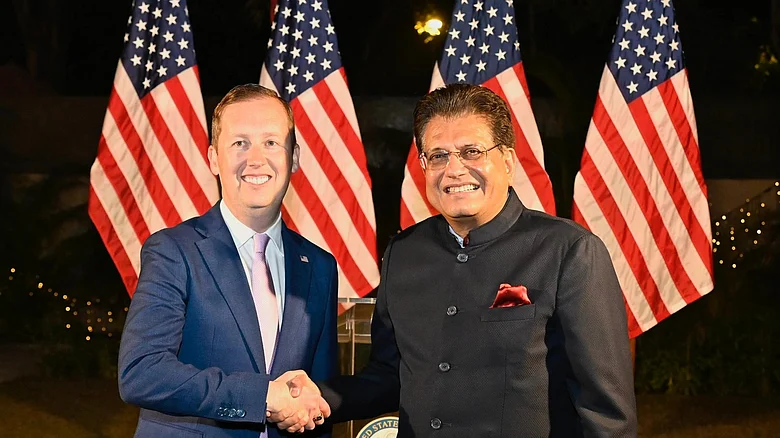
On Tuesday, Goyal and US Ambassador to India Sergio Gor expressed optimism about the future of the bilateral relationship. “Delighted to attend the welcome reception of @USAmbIndia Sergio Gor at the US Embassy in India. Confident that the India–US partnership will reach newer heights with the #IndiaUSTradeDeal,” Goyal said in a post on X.