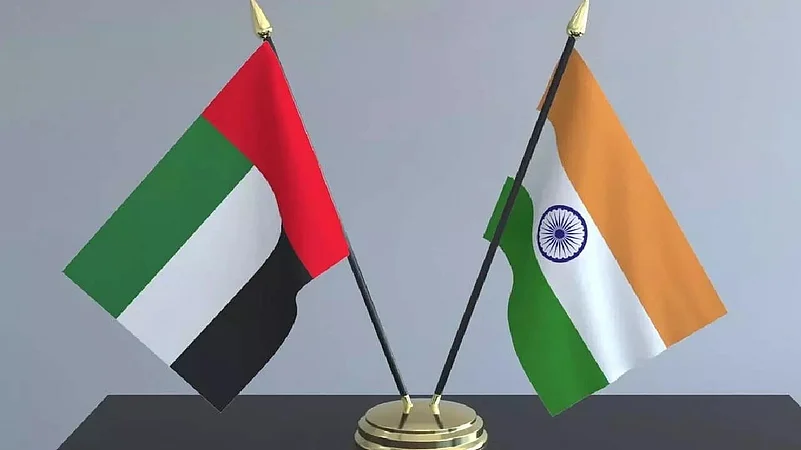

India and the UAE plan to scale bilateral trade to $200 billion by 2032 under the CEPA framework.
Imports, driven largely by energy purchases, continue to outpace exports, widening the trade deficit.
Meeting the target will require faster export growth and diversification into high-value sectors.
On Monday, India and the United Arab Emirates officially announced plans to double bilateral trade to $200 billion by 2032, a move that could help India diversify and accelerate its export base while addressing a widening trade deficit of nearly $27 billion, Moneycontrol reported.
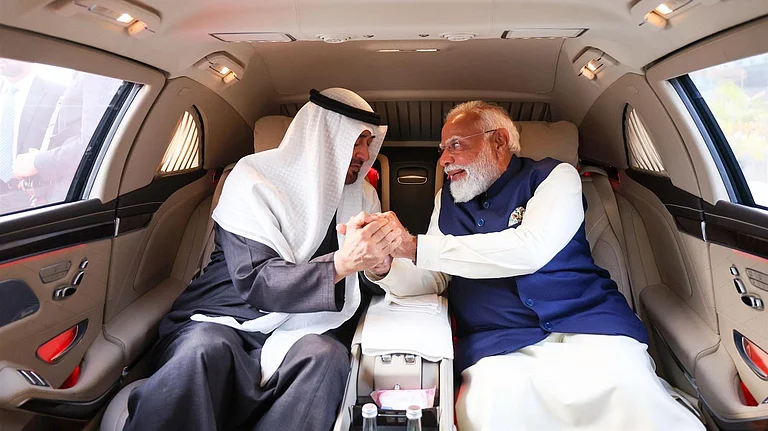
UAE President Sheikh Mohamed bin Zayed Al Nahyan visited New Delhi for a one-day official trip on Monday, holding a three-hour meeting with Prime Minister Narendra Modi. Despite the short duration, the visit provided fresh momentum to the Comprehensive Economic Partnership Agreement (CEPA) that has been in force between the two countries since 2022.

1 September 2026
Get the latest issue of Outlook Business

The meeting reaffirmed commitments to deepen defence and security cooperation, alongside efforts to build soft-power influence beyond trade and commerce. Since the signing of CEPA, India’s exports to the UAE have risen to $36.6 billion, but imports have climbed faster to $63.4 billion, widening New Delhi’s trade deficit with Abu Dhabi to $26.8 billion.
Indian exports have continued to lag imports despite total bilateral trade crossing $100 billion, the report noted. In FY25, India’s export growth slowed to 2.8%, while imports surged 32%, largely driven by energy purchases. To meet the $200 billion trade target without further worsening the deficit, Indian exports will need to grow at a significantly faster pace, with total trade requiring an annual growth rate of about 10.4%, according to the report.
Advertisement
During April–November, Indian exports rose 6.7%, while imports increased 8.8% over the same period. The trade deficit widened to $19.1 billion, from $17.1 billion a year earlier.
Several traditional export segments recorded sharp declines. Petroleum product exports fell 11% year-on-year during April–November, while iron and steel exports also declined 11%. Residual chemical and allied products dropped 26%, buffalo meat exports fell 35%, and auto component exports plunged 46%.
However, the Moneycontrol report noted that certain high-value and emerging sectors are gaining traction, signalling a shift in demand within the UAE market. Strong growth was recorded in telecom instruments, pearls and precious stones, gold and other precious metals, as well as iron and steel products. Demand for electrical machinery and equipment and ready-made garments also rose.
Advertisement
Against the backdrop of rising global uncertainty and tariff threats, the India–UAE trade corridor offers New Delhi a critical opportunity to diversify its export basket. However, sustaining the momentum will depend on India’s ability to expand exports while containing trade imbalances and deficits.