India’s real GDP grew 7.8% in Q1FY27, while nominal GDP growth stood at 10.3%, surprising economists
Former Finance Secretary Subhash Chandra Garg argued that GDP growth would have been 2.6% without the downward revision to the previous year’s GDP
The remarks have triggered a wider debate over the government’s estimates with several economists backing and opposing Garg's claims
India’s former Finance and Economic Affairs Secretary Subhash Chandra Garg has stirred a debate over the country’s GDP estimates, arguing that actual GDP growth in the first quarter of financial year 2027 was 2.6%, rather than the 7.8% reported by the government.
On Monday, the government released its quarterly estimates of GDP for Q1FY27, according to which, real GDP, or GDP at constant prices, grew 7.8% in the April-June quarter. According to the estimates, real GDP stood at ₹81.36 lakh crore, compared with ₹75.46 lakh crore in Q1FY26, representing a growth rate of 7.8%.

1 October 2026
Get the latest issue of Outlook Business

Nominal GDP, or GDP at current prices, was estimated at ₹88.27 lakh crore in Q1FY27, compared with ₹80.00 lakh crore in the same quarter a year earlier, registering a growth rate of 10.3%.


Importantly, the 7.8% figure came as a surprise, beating the expectations of economists as well as the Reserve Bank of India (RBI). The number also came at a politically and economically sensitive juncture, when the Centre has been facing criticism over concerns around unemployment and the quality of economic growth.
Prime Minister Narendra Modi hailed the growth figure, calling it a “herculean feat” and taking a dig at the “doomsayers”, critics and Opposition leaders who have blamed the government for economic mismanagement.
Advertisement
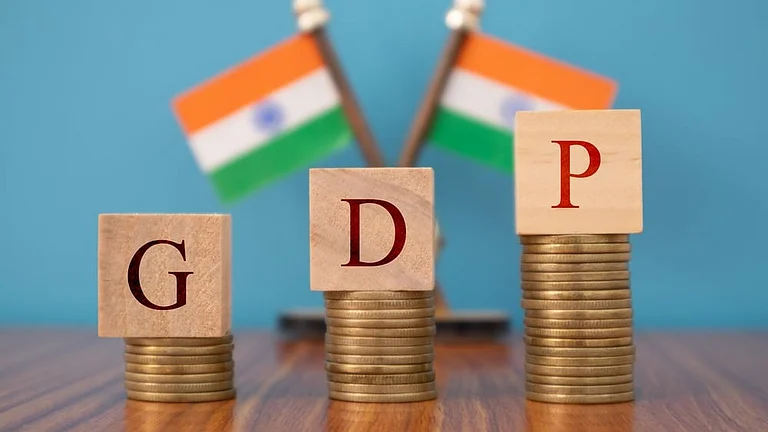
"India’s exemplary GDP growth of 7.8% during Q1 of FY 2026-27 is a herculean feat. The collective strength of our people ensured India delivered such growth despite oil price shocks and supply chain issues in the midst of global uncertainties. Doomsayers were doomed and India bloomed…yet again!” Modi wrote in a post on X (formerly Twitter).
Garg Claims Manipulation In GDP Figures
However, as has often been the case, India’s official growth figures have not received unanimous acceptance. Garg, a former senior bureaucrat in India's Finance Ministry who left the government following differences with Finance Minister Nirmala Sitharaman, has questioned the latest estimate.
Advertisement
In an interview with NDTV, Garg claimed that growth at current prices would have been only 2.6% if the government had not revised down last year’s GDP.
“See, 7.8% looks impressive on the face of it, but we should get into the reality of it. Last year’s GDP growth in the first quarter was also 7.8%, which is claimed for the current year as well. Last year’s GDP has been revised down to 6.9%. So, if you revise last year’s GDP down from what was claimed last year, this year goes up. But that doesn’t explain the whole of it...” Garg said in the interview.
"The current price's GDP last year was 86 trillion rupees. This has been revised down to 80 trillion rupees. I am saying that by revising last year's GDP by as much as 6 trillion rupees, the current year's GDP in the first quarter has gone up by about 10.3%. If you had not revised last year's GDP, the growth in current prices would have been only 2.6%," Garg added.
Govt's Revised Series For Estimates
It is important to note that the government released a new series of annual and quarterly GDP estimates, with 2022-23 as the base year, on February 2. Subsequently, it released the provisional estimates of GDP for 2025-26 on June 5, 2026.
According to the government, the quarterly GDP estimates under the new 2022-23 base year largely follow the guidelines and standards laid out in the International Monetary Fund’s (IMF) 2017 Quarterly National Accounts Manual.
The methodology and data sources used to compile the GDP estimates will be presented comprehensively in the publication Sources and Methods, which MoSPI has said is scheduled to be released by September 2026.
Garg's Claims Trigger Debate
Garg’s remarks triggered a flurry of reactions, both political and economic, as the video began circulating widely on social media. While some agreed with his argument, others dismissed it as an economic error.
Kaushik Basu, Professor of Economics at Cornell University and former Chief Economic Adviser (CEA), backed Garg’s argument. Writing on X, Basu said: “There has been a lot of discussion on India’s recent growth data. I have not studied the numbers in sufficient depth to take a stance but the best analysis I have heard is that of Subhash Garg, who, as former Finance Secretary, GOI, knows these statistics extremely well.”
Congress MP Pawan Khera also supported Garg's remarks, stating, "Subhash Garg has punctured the government’s tall claims of 7.8% GDP growth, arguing that India’s real GDP growth is closer to 2.6%. His contention is even more damning: the previous year’s GDP growth was revised downward, making this year’s growth rate look stronger by comparison. His assessment seems far closer to the lived reality of ordinary Indians — rising prices, falling purchasing power, shrinking disposable incomes and savings, stagnant job opportunities, and rising household debt."
"These claims cannot simply be dismissed. They come from someone who served as Finance and Economic Affairs Secretary of the Government of India under Modi between 2017 and 2019. The government now owes the country a clear explanation: Why were last year’s GDP numbers revised downward? Why is it fudging numbers? What is the real GDP growth?" he added.
Another camp, including Garg’s former colleague and former CEA Krishnamurthy V Subramanian, has dismissed his claims. Subramanian described Garg’s assertion of a 2.6% real growth rate as a “hilarious demonstration of economic ignorance on National TV.”
In a post on X, Subramanian listed what he described as “errors” in Garg’s claims, alongside what he said were the relevant facts.
“Error 1: Take a nominal GDP number from the old series and compare it with a nominal GDP number from the new series. Divide one by the other and proclaim 2.6% ‘growth.’ That is comparing apples with oranges,” he said.
He added: “Fact: When GDP series are revised, historical numbers are re-estimated using the same methodology to ensure an apples-to-apples comparison. Such an ECON 101 error!”
According to Subramanian, Garg’s second error was using nominal GDP figures to challenge the 7.8% real GDP growth rate while ignoring the government’s adoption of double deflation and the constant-price estimates. His third was treating routine revisions based on improved data and methodology as “manipulation”. The fourth, he said, was claiming negative consumption growth when official data showed real private consumption growing 7.1%.
Subramanian concluded that Garg’s “true GDP growth rate” was based on comparing incompatible numbers, calling it a “hilarious demonstration of economic ignorance on National TV.”
Govt's Economists Defend Methodology
Before Subramanian, Sanjeev Sanyal, Prime Minister’s Economic Adviser, had also defended the government against allegations of manipulating GDP data.
In an interview with India Today, Sanyal said the GDP methodology was updated in line with recommendations from the IMF and other international institutions. He said the revision had been delayed because the Covid-19 pandemic made the early years of the decade unsuitable for use as a base year.
“We did have a problem with methodology till last year because the base year had not been updated. Every decade, we update the base year at the beginning of the decade. We could not have done it in this decade for the simplest reason. Those were Covid years,” Sanyal said.
“Once we got [a typical year], we of course updated the base year. I don't think anybody should complain. We did exactly what the IMF and others were asking us to do. No serious economist is going to complain about this,” Sanyal added.
This is not the first time a government economist has defended the credibility of India’s GDP estimates. In June, CEA V Anantha Nageswaran said the government was not using methodological changes to inflate GDP figures.
“If they had said Indian GDP was no longer ₹354 lakh crore but ₹384 lakh crore, people would have accepted that. That is what many countries do. In fact, we are the only country which brought it down,” Nageswaran said in an interview with news agency ANI.
“We produce reliable statistics. We follow internationally accepted methods and we don't use the GDP methodological revisions to bump up numbers artificially. Our philosophy is to let the statistics speak for themselves,” he added.
On the criticism of the estimates, Nageswaran said, “The problem with some of these critiques is that if the number doesn't meet their expectations, then they are willing to call it, ‘I don't have trust in that number’.”
While Garg’s remarks have led to a debate around India’s GDP figures, now it would be significant to see how the economy fares in FY27.