



India’s economic transformation has always been a slightly unusual one. As countries become richer, workers typically move out of agriculture and into factories, construction and eventually services. India has moved too, but not quite in the way development textbooks would have predicted.
A recent paper, titled Structural Transformation in Agricultural Employment: Gender Disparities, by researchers Aamir Ahmad Teeli and Ch Sankar Rao, published in the Economic & Political Weekly, explains one major complication to this story.
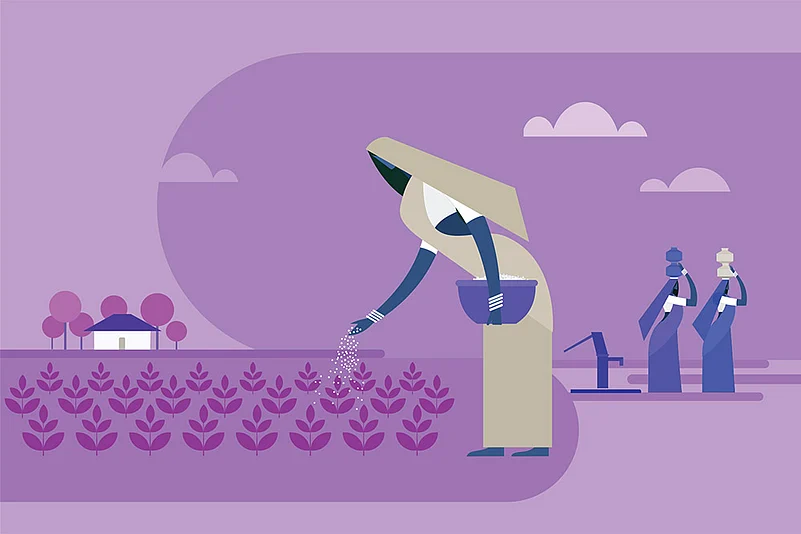
The research paper finds that the people leaving agriculture are not leaving at the same pace, where men are getting out faster while women are getting left behind.

1 October 2026
Get the latest issue of Outlook Business

That is a deceptively simple finding, but it goes to the heart of one of India's oldest economic problems. After liberalisation, the country has spent three decades growing and shifting towards higher-productivity activities.
Yet in 2022, agriculture still employed 42.9% of India's workforce even though it contributed only 16.6% of GDP. In 1991, the corresponding figures were 63.4% and 27.7%.
The gap between where people work and where economic value is generated remains enormous.
Yet it is the gender numbers that make the story more revealing. In 1991, 58.66% of male workers were in agriculture. By 2022, that had fallen to 37.09%.
Meanwhile, for women, agricultural employment fell from 77.75% to just 59.24%, suggesting a much slower pace of upward mobility.
That difference is important because it challenges the comforting idea that economic growth automatically creates mobility. It does not.
Growth creates opportunities; whether people can take them depends on where they live, what skills they have, whether they can migrate, who looks after their children and, in India's case, whether they are men or women.
Advantage Men
The authors put numbers on this difference using what economists call growth semi-elasticity: essentially, how strongly agricultural employment responds when GDP per capita rises. Their long-run estimate gives a good idea.
A 1% rise in GDP per capita is associated with a 0.93% fall in the male share of agricultural employment, but only a 0.58% fall in the female share. The short-run estimates show the same pattern.
These numbers capture something that should be visible beyond economics. Men have traditionally had far greater freedom to leave villages and take up jobs in construction, manufacturing, transport, retail or services.
Women, on the other hand, face a different labour market.
Their ability to migrate is more constrained, their unpaid care responsibilities are heavier, and their access to skills and formal employment is weaker.
If the economy does not create enough accessible and productive jobs, women are likely to be the ones who remain behind
Similarly, between 1991 and 2022, the share of male workers employed in industry rose from 16.05% to 29.63%, compared with an increase from around 10% to 16.14% for women.
The shift towards services offers some comfort, with women’s share rising from 12.15% to 24.62%, compared with an increase from 25.30% to 33.27% among men.
Although the female movement into services is, in fact, substantial, quantity is only one part of the story. The authors note that women remain concentrated in lower-skilled and lower-paid jobs and are under-represented in the better-paying end of the service economy.
In other words, even when women move, they do not necessarily move into the same economic space as men, observes the paper.
This is where the paper becomes more interesting than a conventional account of structural transformation.
Limited Industrial Growth
There is then another uncomfortable feature of the Indian story. Industry itself has not played the role that it has played in many other developing economies. The authors note that industry's share of GDP was 26.44% in 1991 and 25.28% in 2022, while services rose from 37.79% to 49.58%. This means that employment in industry did rise, but the sector's output share remained broadly flat.
This is the problem often described as premature deindustrialisation, whereby India has moved towards services without first building a sufficiently large manufacturing base. For a country with a huge young workforce, such a problem has long-term consequences. A sophisticated services economy can generate enormous output without necessarily creating enough jobs for workers leaving low-productivity agriculture.
The paper's gender finding sits neatly inside this larger problem.
If the economy does not create enough accessible, productive jobs, the people with fewer resources and less mobility are likely to be the ones who remain behind.
In India, that disproportionately means women.
The next phase of India's growth therefore cannot be judged simply by how quickly agriculture's share of GDP falls or how fast services expand. The more consequential question is whether people trapped in low-productivity work can actually move into better jobs.
For women, that means more than training programmes. It means making migration and urban employment possible, creating workplaces that accommodate care responsibilities, expanding childcare and making employers more willing to hire and retain women.
The authors point towards many of these interventions, including skills programmes, flexible work, maternity benefits, equal pay and affordable childcare.
India's growth story has often been told through GDP, rise of technology and services. This paper asks us to look at it from the other end, from the farm worker who is supposed to move when the economy grows.
And that is where the story becomes less triumphant. The economy has been moving. But for millions of women, it has not been moving fast enough.



