Budget 2026 announces a ₹10,000 crore MSME Growth Fund to create future champions.
Government to revive 2,000 clusters and expand the Self-Reliant India Fund.
Focus spans old-economy sectors like textiles and engineering and new-economy areas like semiconductors.
Equity and liquidity support expected to strengthen supply chains and boost localisation.
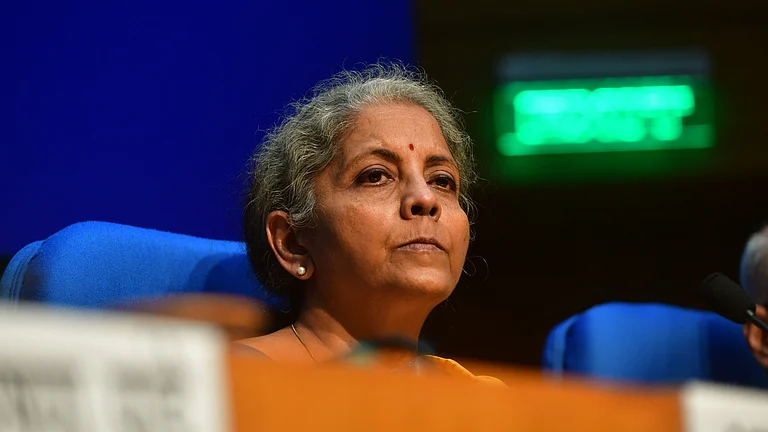
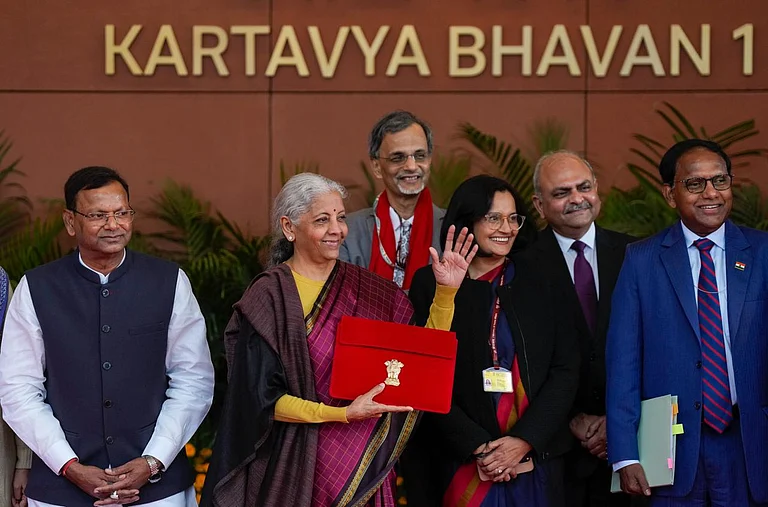
Finance Minister Nirmala Sitharaman today announced a ₹10,000 crore MSME Growth Fund as part of her Union Budget speech, aimed at strengthening Micro, Small and Medium Enterprises. She also proposed the revival of 2,000 industry clusters across the country.
She stated that the government recognises MSMEs as a vital engine of growth, and proposes a three-pronged approach to help them grow as champions.

1 September 2026
Get the latest issue of Outlook Business

"I propose to introduce a dedicated 10,000 crores SME growth fund to create future champions, incentivising enterprises based on select criteria. I also propose to top up the self-reliant India fund set up in 2021 with 2,000 crores to continue support to micro-enterprises and maintain their access to risk capital," she said.
Outlining the government’s framework to “accelerate and sustain economic growth”, Sitharaman said interventions would focus on six key areas: scaling up manufacturing across seven strategic sectors; rejuvenating legacy industrial sectors; creating champion MSMEs; accelerating infrastructure development; ensuring long-term security and stability; and developing city-based economic regions.
Notably, the government will also develop a cadre of "corporate mitras" in Tier-II and Tier-III cities. It is aimed to help MSMEs to meet their compliance requirements at affordable costs.
Advertisement
Additionally, Sitharaman proposed that the Self-Reliant India Fund will be topped up by Rs 4,000 crore in 2026-27 to support the sector.
“Great support is offered under the budget for the MSME sector, both for old-economy and new-economy industries. Old-economy sectors targeted include textiles, engineering, handloom and handicrafts, khadi and sports goods. New-economy sectors include bio-pharma, semiconductors and rare earths,” said Padmanand V, Partner – MSME at Grant Thornton Bharat.
He added that cluster development and challenge-mode PPP interventions had been given strong emphasis. “Notably, an SME Growth Fund of ₹10,000 crore is also envisaged. In the new-economy sector, semiconductor R&D and electronics manufacturing capability is to be developed through a massive allocation of ₹40,000 crore. In old-economy segments, particularly textiles, mega technical-textile parks are to be developed on challenge mode.”
Advertisement
"For many MSMEs in our ecosystem, equity support and day-to-day liquidity are serious bottlenecks. If this fund translates into easier access to growth capital, especially for cluster-level suppliers, tool rooms and component makers, it will lift the entire value chain and give manufacturers a lot more confidence to invest in capacity and localisation,” said Jasraaj S Kalra, managing director at Noble Group.
[With agency inputs]