China has approved sales of Nvidia’s H200 AI chips, removing a key barrier that had blocked access to one of its largest tech markets for months.
The approval reopens a market that previously contributed about 13% of Nvidia's revenue, with confirmed purchase orders from multiple Chinese firms.
China’s earlier reluctance, despite US export clearance, had been the main bottleneck, making this decision a significant breakthrough for Nvidia’s global AI chip business.
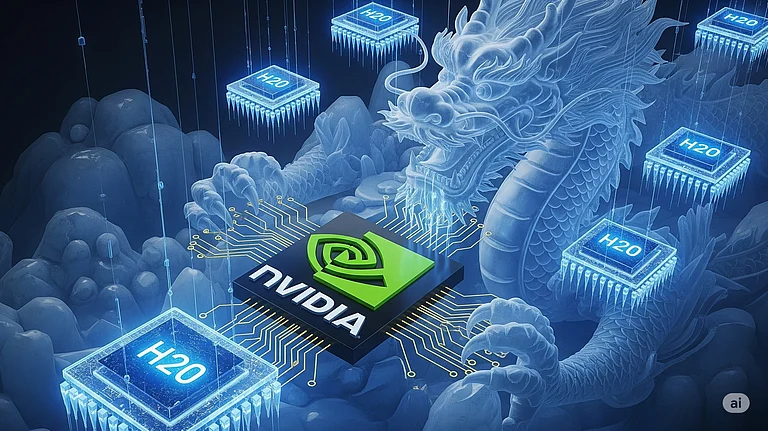
In a major breakthrough for the American chipmaker, China has approved the sale of Nvidia's H200 artificial intelligence chips. This marks the clearance of a key hurdle that had kept one of Nvidia's most powerful offerings out of one of the world's largest technology markets.
Beijing's green light paves the way for Nvidia to resume sales in a market that once accounted for 13% of its total revenue, according to a Reuters report.

1 September 2026
Get the latest issue of Outlook Business

Despite strong demand from Chinese companies and the US having already approved exports, China's reluctance to allow imports had been the main roadblock to H200 shipments reaching Chinese buyers.



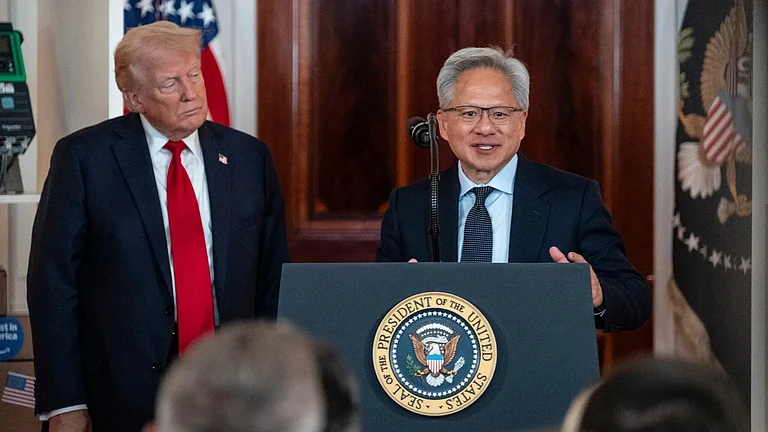
Nvidia CEO Jensen Huang confirmed the development at the company's annual GTC developer conference in San Jose on Tuesday, saying the chipmaker had received purchase orders from "many" companies in China and was now cleared to resume production of the chip. Nvidia had halted H200 production last year amid mounting regulatory pressure from both Washington and Beijing.
Advertisement
Why Beijing Had Been Saying No
China's reluctance to approve the H200 chips was not simply a case of bureaucratic delay, it was a deliberate policy stance. Beijing had been pressing domestic companies to buy Chinese-made chips instead, as part of a broader push to build up its homegrown semiconductor industry, led by Huawei.
White House AI adviser David Sacks had earlier said that this desire to protect and subsidise Huawei was a key reason China was holding back. Reports also suggested that Chinese government officials had actively instructed domestic tech firms not to purchase H200 chips unless absolutely necessary.
Advertisement
Compounding matters, while the US did approve the sale of H200 chips in China, it also sought a 25% cut of Nvidia's revenue from those sales, a condition that reportedly soured Beijing's mood further and contributed to its clampdown on imports. Additionally, the Trump administration also made clear that China cannot receive more than 50% of the total amount of chips sold to American customers.
Adding to this, broader US-China tensions played a role, with some Chinese commentators linking the import curbs to America's interception of a Venezuelan oil tanker bound for China in late 2025. Beijing's approval on Tuesday, therefore, marks a notable softening of that position

A New Chip for the Chinese Market
Alongside the new update on H200, Nvidia is also developing a version of the Groq AI chip that can be sold in China. This chip is used for what is called "inference", where AI systems answer questions, write code, or carry out tasks. The chip is expected to be available as early as May.
Crucially, it is not a downgraded or China-specific product, but a variant that can be adapted to work with other systems. Nvidia plans to pair it with its upcoming Vera Rubin chips for markets outside China, as those chips are not cleared for sale to Chinese buyers.
The inference market, where Nvidia's new China-ready Groq chip will compete, is, however, a more contested space.
Several major Chinese technology firms, including Baidu, already produce their own inference chips, meaning Nvidia will face stiff local competition even as it re-enters the market.
A Trillion-Dollar Bet
The China re-entry comes at a time when Nvidia is riding an extraordinary wave of growth. Speaking at the GTC conference, Huang said the company now expects purchase orders for its next-generation chip platforms to reach $1 trillion by 2027, which is double its earlier estimate of $500 billion.
Nvidia currently holds a market capitalisation of roughly $4.5 trillion, making it the most valuable publicly traded company in the world, and anticipates revenue growth of roughly 77% year-on-year to approximately $78 billion this quarter.