On Pre-IPO Round: Have Already Raised $200 Million Out of $500 Million Pre-IPO Round, Says Gupta
About Listing in the USA: Nothing Stops Me from Going There. I Can Raise in India and in the USA as Well.
On India: India Is One of the Pockets in the World That Everybody Believes Is Among the Safest Places to Do Business
A soft nudge from the government, along with the fact that Mumbai-based data centre start-up Yotta’s entire business, story, and narrative are in India, led the company to decide to list in India instead of the USA, as pre the company's top executive.
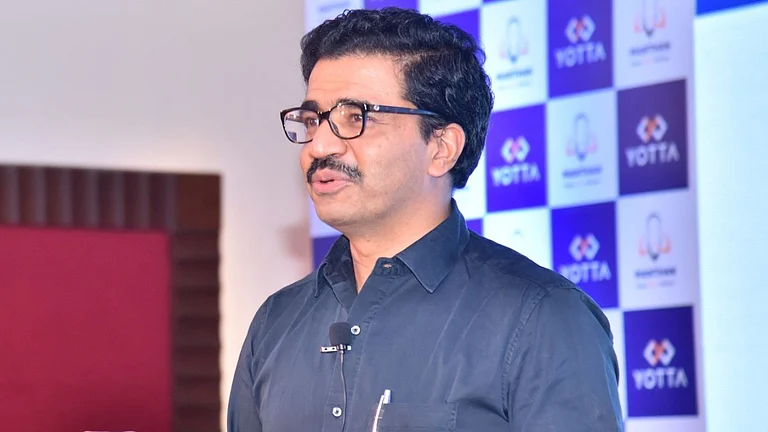
“First is that the company’s entire business, story, and narrative are in India. It’s all sovereign. Then comes a soft push from the government. And we are working so closely with the Government of India. So, there was definitely a nudge that, you know, why are we not doing it in India? I mean, it was like a soft nudge,” says Sunil Gupta, Co-founder, Managing Director & CEO at Yotta.

1 September 2026
Get the latest issue of Outlook Business

Another reason that was on the top executive’s mind was the current geopolitical scenario in the world. When asked about the ongoing atmosphere in the USA, Gupta adds, “Possibly you are also answering, in one of the ways, why I decided to first start with the India IPO and raising of funds in India, because all these things were back on our mind, right?”
Advertisement
“But the great part is that, yes, these relations have followed a sine wave—coming down, going up, and all these things,” he adds.
Gupta talks to Outlook Business about why investors are interested to invest in AI infrastructure, why he doesn’t repent not listing in the USA, what made him take a bet on GPUs and AI infrastructure at a time when it wasn’t even cool and more.
Edited Excerpts
Why did you decide to list in India and not the USA?
Actually, I was preparing myself to ring the bell on NASDAQ. I think there were a couple of factors that made us shift from the USA to India for public listing. See, as you know, my entire business, my entire story, my entire narrative is in India. It's all sovereign. And we are working so closely with the Government of India. So, there was definitely a nudge that, you know, why are we not doing it in India? I mean, it was like a soft nudge.
The good part is that on our own, we actually saw the type of response and the level of enthusiasm we are getting in India. See, let's understand that when you are going to global private equity, they are exposed to different markets in the world. They are exposed to a saturated and mature market like the USA also, and India is one of the options for them. While everybody will praise, oh, Yotta, you are doing great and all these things, fine. But suddenly they say, oh, we have to factor in the India risk also. Suddenly, how they perceive things starts changing.
So, we were going through that. There were a lot of commitments and all these things. Nothing stops me from going to the USA again. And that is my plan for sure, that I can raise in India, I can raise in the USA also. But I thought, since all my conditions are in India, my customers are in India, people know me, and are giving me a fantastic response here, why don’t I first raise in India and then go to the USA? So, it was just a matter of sequencing, not stopping that path altogether. And I can tell you that ever since we decided that, and then we immediately, you know, put in the fund, the managers did a good job. The last two to three months have been maybe validating what we thought about it.
Advertisement
Did you ever repent not listing in the USA?
I am feeling validated that we took this decision because within the last few months, I mean, we are targeting, like, from between the pre-IPO round with funds and family offices and HNIs, and then obviously raising a public float. We are hoping that we will be raising around $1.2 billion dollars by this financial year.
If everything goes well this financial year, I would rather like to be in the market by July, August itself. So, right now, what has happened is that I have consolidated all my Indian business into one single company, which will get listed, so that the entire value, investors, you know, get benefit from the entire value. So, all my—there were different entities that were holding the assets and doing the business. So, everything is getting consolidated into a single entity.
That entity will be listed. And what we are doing now in the first round, I have, instead of going to the funds, large institutional funds directly, we have gone to HNIs, we have gone to family offices. Out of my targeted about $500 million dollars, which is to be raised privately before I go to IPO, we have already raised $200 million, which is already the money in the bank with us.
So much enthusiasm—people who are not connected to the IT industry completely, such types of family offices, want to have a pie of this whole growth cycle. Not at the AI use case level, but at the AI infrastructure level. Because everybody feels that use cases may come and go, maybe they will not. But the infrastructure you build for this story will always sustain, and you will have a much longer life cycle.
This is surprising because when we talk about family offices, the general notion is that they don't want to invest in deep tech because of the gestation period.
So, I think that is where, of course, it has required us to explain the whole story and the whole stack. I must have spent countless meetings. Once you start, see, most of the people are seeing this industry sitting on a fence.
And most of the time you are getting exposed to the use cases of AI. But when you start explaining what is the raw brass stack which is going behind this whole thing, and see, I correlate that to the dot-com time.
You know, when the dot-com boom was there in the late 90s and early 2000s and that dot-com boom got busted, everybody thought that everything is doomed, everything is down, right? But what people didn't realize was that only the use case, that you are creating a website with some HTML, and you thought that that is the internet economy. It was not. People realized there is supposed to be a strong brick-and-mortar economy behind that. Those use cases may have gone. But the infrastructure which got built to support the internet at that time, the data center, the network—that infrastructure actually got used to support the internet of today.
The undersea optic fiber cables and the data centers. Same thing I talk about AI in today's environment. The use cases of AI may come and go. People may say, oh, it's a hype, whether AI will do this or not, whether people adopt it or not, and all that stuff. Some use cases may become very successful. Some use cases may die.
But whatever may be the case, use cases will keep on evolving. Fundamentally, this is a fact that if you have to go through the training life cycle of models—whether it will be a small model, large model, medium model—and later on when you are trying to put those models for inferencing for billions of people, you will require GPUs in both cycles. So, the infrastructure you will be building in terms of GPU stack, the software platform stack on the top, the underlying data center stack—they'll be here to stay.

You started working on GPUs before AI became mainstream. Even today, India has very few growth-stage AI startups, and founders say it’s still hard to convince investors or family offices. What was it like three years ago?
It was a chicken-and-egg story. Three years back, the narrative across the industry, and technical circles was whether GPUs should come first and demand would follow, or whether AI demand should come first and then GPUs would follow. Someone had to break that cycle. What people were not realizing, and I’m glad we did, was that you don’t always go by visible demand, you go by latent demand. You go by fundamentals.
My fundamentals were clear. First, India has 1.4 billion people, with nearly a billion on smartphones, constantly creating and consuming content. We’ve seen mass adoption through DPI, UPI, Aadhaar. Give people useful technology at the right price, and India will adopt it at scale.
Second, can we build AI for India? AI doesn’t need traditional coding; with enough data, machines can learn and build themselves. India already has the data, the startup ecosystem, and the skill set. The only missing piece was compute.
So for me, it was simple—solve for compute, and everything else falls into place.

Yotta was among the early Indian companies to partner with Nvidia to partner with Nvidia. What was your conversation with the Nvidia CEO (Jensen Huang) like?
You know, just a few months after ChatGPT got launched, Jensen was in India. It was then Vishal Dhupar (Managing Director for South Asia at Nvidia) actually said, why don’t you come and meet Jensen? This is the biggest opportunity of a lifetime for you.
And I spent more than an hour with Jensen. And he said the same thing: “Sunil, I’m coming to India almost every year for the last four or five years. People send MOUs with me, they do press releases with me, but nobody is actually taking the first step of investing in my chips. And I’m promising them that if you invest in my chips and create a cloud and make it available to people, it’s going to create a revolution, given the, you know, again, the Indian penchant for adoption of any technology.”
And the second point he said about why he was choosing me instead of anybody else, besides the Indian market, was that I am already carrying an integrated stack of data centers. I’m not going to any third party to run my GPUs. I own land parcels. I build my own buildings.
I do design, engineering, and operations in my own data centers. I’ve solved the power problem. In my Mumbai campus, I can scale to 2 gigawatts of power. In my Greater Noida campus, I can scale to 250 megawatts.
My substations are there. My power lines are there. My fiber is there. These are the fundamental building blocks which I created six years back. At that time, GPUs were not popular, but cloud was there and overall digital adoption was happening.
You have a significant presence in the USA. Do you see any challenges for India as a country, or for your company, amid the current geopolitical environment?
Possibly you are also answering, in one of the ways, why I decided to first start with the India IPO and raising of funds in India, because all these things were back on our mind, right? But the great part is that, yes, these relations have followed a sine wave—coming down, going up, and all these things.
So, right now, all my business, all my market is India. Even when I'm serving global customers like NVIDIA itself, which is a huge customer for me, serving the global market for their European customers and all. But all my base, all my GPUs, all my data centers, my compute, everything is in India only. The USA vehicle was only for the purpose of raising money.
Can we say it's safe, given the geopolitical scenario, it's safe for you to be listed in India?
Absolutely. I think nobody should have a doubt about India. I mean, India is one of the pockets in the world which everybody believes is one of the safest places to do business. You are not in any of the extremes, you are able to hold your ground and still be respected by everybody, including the USA and all the economies of the world.