
The Vivobook 16 packs an Intel Core Ultra 5 325 processor, 16GB RAM and a 512GB SSD.
It handles everyday work smoothly and delivers more than eight hours of screen-on time.
The 60Hz display, bottom-firing speakers and weak gaming performance are its biggest drawbacks.
Asus, reliability and dependability go hand-in-hand. With the Vivobook 16 (X1607AA), I felt no difference. These days, Asus is the go to brand for any Windows laptops. I’ve recommended countless of them to my family members and numerous friends.
With the Vivobook 16, I’ll just say that while Asus has done a fine job with regards to the laptop, they haven’t tried to push the boundaries. Once you hear the specifications, you’ll also probably agree. It comes with an Intel Core Ultra 5 325 (Series 3) chipset, and is paired with 16GB of RAM, a 512GB SSD, Intel graphics, and a 16-inch FHD+ (1920x1200) display with a 16:10 aspect ratio and a 60Hz refresh rate. The brightness is rated at 300 nits. This exact configuration is currently priced at Rs 96,990 on the Asus website.

1 October 2026
Get the latest issue of Outlook Business

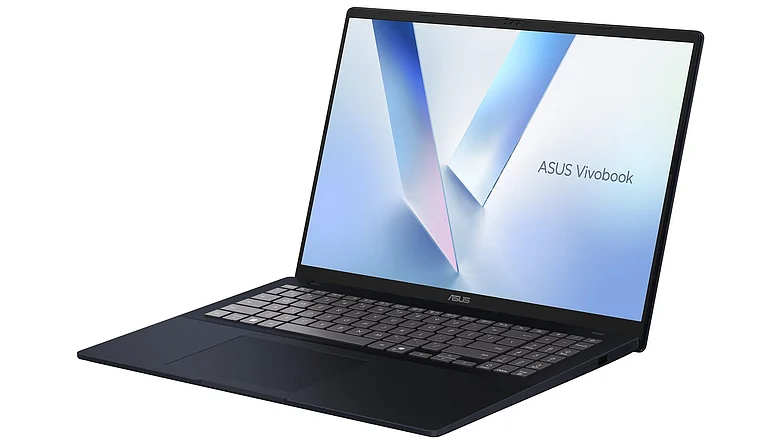
Design wise, I really don’t have much to say. It’s minimal, sleek, feels good, and is slightly hefty. Then again, which 16-inch laptop isn’t (read: The LG Gram series is the one and only true exception). The entire chassis is made of plastic, but it isn’t the cheap kind. It’s as solid as it can be built. Yes, I have knocked it against the wall, once or twice, and it survived without any damage.
The laptop can be opened one-handed, and the display can up to a 180-agree angle. The one design choice I did not like at all is that the stereo speakers are placed at the bottom. The sound sometimes gets muffled, they aren’t very loud, and they are not at all tuned. The vocals are clear, so you can use them for podcasts, but that’s about it.
Advertisement
What you interact with most is the display, and for a Rs 1,00,000 laptop, it’s very disappointing to see a 60Hz refresh rate. Thanks to the matte coating, reflections aren’t an issue, and the bezels are also thin enough that you don’t notice them. It’s just about an okay display. The colours are good, but they aren’t popping like they do on my Xiaomi Pad 8.
Again, for daily use, it’s fine, but don’t expect to be wowed while watching movies. What’s good is that the laptop can get sufficiently bright for indoor uses, and even outdoors, for the most part, it’ll be readable. Under the harsh rays of the Delhi summers, readability was a big issue for me.
Advertisement

Something that is crucial for me, while testing out a laptop, is the keyboard. I’m a journalist, and so I create and populate a lot of documents daily. The key travel is good, and the spacing between keys is good. There’s a dedicated numpad, so those who work with a lot of numbers, will be satisfied. The highlight is the backlighting, with three brightness levels.
Something I’ve complained about is the lack of palm rest (besides the touchpad) on various laptops. I’m happy to report that accidental touches are down to a minimum thanks to a large palm rest area. The touchpad is satisfactory as the tactile feedback is good.

Day-To-Day Usage
The Vivobook 16 gets the Intel Core Ultra 5 325 (Series 3) chipset. With 16GB of RAM (LPDDR5) and a 512 GB SSD (M.2 NVMe PCIe 4.0), the laptop chugs along without stuttering or lagging. For my daily workload that mostly includes researching on Google Chrome, typing on Google Docs, and watching YouTube videos along with some photo editing on Adobe Photoshop, the laptop didn’t prove to be a hurdle.
I was genuinely thinking even the most basic of tasks would get caught up in the lack of power. But the choice of chipset surprised me the more and more I used the laptop.
The thing is, just don’t try and push the laptop to its limits. You’ll be hitting it quite soon. Gaming proves to be a hurdle, and even multiple Google Chrome apps can throw the laptop in to a tizzy. Basic games like TrackMania Nations Forever work fine, but any modern AAA game and you’ll be seeing lots of frame drops.
The one thing that I’m thankful for is that the laptop never got uncomfortably hot. I did notice a slight warming when pushing the laptop, but nothing to worry about.
Before I conclude, there is one last thing to touch upon: battery life. The Vivobook 16 comes with a 42Wh battery and a 68W USB-C charger in the box. With the usage pattern as mentioned above, I was easily getting a full days of usage out of this laptop. I was consistently hitting over eight hours of screen-on-time. On the days I was pushing it, I did manage to kill the battery in much lesser time, but that’s not the norm at all.

Good Laptop?
I’d say the Vivobook 16 is a slightly expensive, yet dependable laptop. I understand the price, because of the geopolitical concerns, but even then, it should have been pushed a little more aggressively. It’s a good laptop for college students or office goers, but for creative professionals, or gamers, they must look elsewhere.
Just wait for any discount to arrive, and if you’re in the market for a 16-inch laptop, buy it!