
Gen AI is changing brand discovery, shifting power from traditional search to AI-driven answers
OptimizeGEO CEO Kirthiga Reddy argues: if a brand is absent in AI search, it is invisible to modern buyers
She details how AI visibility exposes gaps in content, positioning and trust, turning discovery into a core business KPI
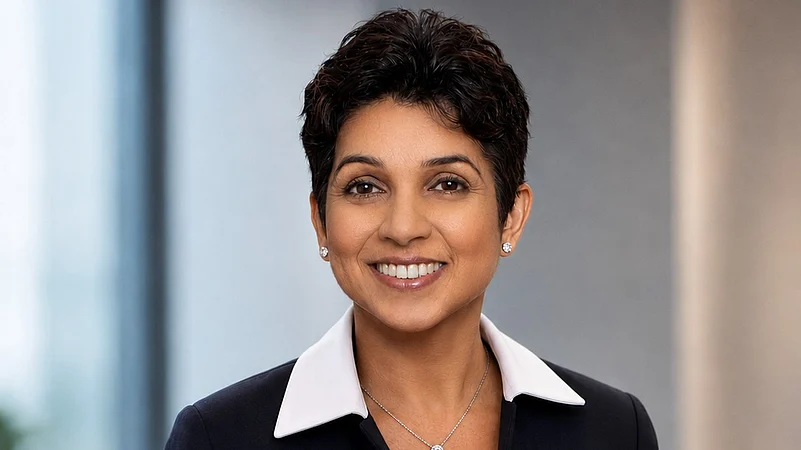
The age of blue links is giving way to the age of AI answers, and with it, a new race for visibility is reshaping how brands are discovered. In this conversation with Outlook Business, Kirthiga Reddy, CEO of OptimizeGEO, explains why generative AI is no longer a distant trend but a commercial turning point, one that is already moving consumer attention, marketing budgets and even business priorities.
You’ve witnessed multiple technology inflection points within your career, from the rise of social media to mobile-first platforms and now AI-driven discovery. Looking back, what specific signal convinced you that generative AI would fundamentally reshape how businesses are discovered online?
1 August 2026
Get the latest issue of Outlook Business

The first signal was the consumer shift. ChatGPT had over a billion users globally, and in India it reached 100 million across platforms like ChatGPT and Perplexity almost overnight, with 300% to 700% year-on-year growth and people using it 13 to 17 times a day. The second signal was the shift across industries in leads and clicks coming from traditional Google search. Those two signals made it clear that there was a major shift ahead.
With 75% of both B2C and B2B decisions estimated to be driven by AI search discovery, brands that are not present there are essentially forgotten by the modern consumer.
Advertisement
Was there a particular moment when you realized this was not merely an evolution of search, but an entirely new paradigm?
Yes. Our own search volumes on the enterprise business dropped before the geo transition, and that was the aha moment. We realized this would become a hair-on-fire problem for CEOs and CMOs across industries and stages.
We then validated it by reaching out to Fortune 1000 CMOs and agency leaders, getting inputs from over 60% of the Fortune 1000 either directly or through channel partners. That confirmed for us that this was the next thing to build.
For nearly two decades brands have optimized for Google rankings. Today you’re asking them to optimize for AI-generated answers. What do you think is the most important shift in mindset that business leaders still haven’t grasped?
Advertisement
The big shift is that AI search is not just about optimizing for AI search. It is exposing what the brand is conveying about itself across content, media, pricing, positioning and partnerships.
AI search is taking all that information and turning it into answers. So it gives companies a window into what is happening across the marketing mix and where they need to improve. It helps increase the ROI of investments across the marketing mix, whether or not AI search exists.
Can you give an example of what that looks like in practice?
For a Fortune 50 baby product brand, overall AI visibility was high, but there was almost a 40% zero-visibility gap across the questions that mattered most to the brand. In that case, they were not showing up in safety-related questions. That told them they needed to improve content strategy, media strategy and partner messaging.
In another case, a competitor was surfacing because it had a certification the client did not have, or because another product had a money-back guarantee. These are the kinds of data points that help influence content, media, partnerships and pricing.
Is it fair to say that how a company is portrayed in AI search reveals a lot about its positioning and can help it distribute investment more effectively?
Absolutely. Leading marketers are beginning to see that. It also matters who is driving the change. If it is delegated too far down the organization, the ability to make changes is limited. The most success happens when a CEO-CMO leadership initiative is driving it, because then the insights can be used to change the organization more broadly.


If a CEO says they have already invested heavily in SEO, why is that no longer enough?
They should go and do the kind of search that users are doing for their brand. Better still, they should do it in a statistically significant way, because search results vary depending on how the query is framed. What they will find are visibility gaps. If you are not appearing there, you are essentially forgotten by the modern consumer.
In a recent CMO roundtable, about 30% said they were shifting their complete SEO budgets to geo, and another 30% were looking to move 30% to 50% of their budgets. This is a major disruption, and challenger brands can use it to make their mark.
When you started OptimizeGEO, what was harder: convincing customers that the problem existed, or proving that it could actually be measured?
That is typical of any technology transformation. During the social media transition, people asked why they should move beyond television, print and early social. But once the value became clear, adoption followed.
In any transformation, there are early adopters. We saw the same sectors leading then, and we see many of the same sectors leading now. We now have proof points, including work with the Business Intelligence Group, where we helped grow visibility by 3x, AI-attributable traffic by 151%, and revenue from AI-attributable traffic by 2x. Fifty-eight percent of that revenue came from new customers who had never seen the brand before.
What were the first metrics that gave you confidence that AI visibility could become a business KPI?
What makes us different is that we do not just show where a brand stands. We help understand what people are asking in LLM platforms across different personas. So if you are a healthcare or baby-care brand, your consumer, your dermatologist and another stakeholder may each have different concerns.
We focus on the “so what” too: how changes in AI visibility connect to brand and revenue metrics. A fintech client in India told me 40% of their leads are now coming from AI-attributable traffic. At that point, it is impossible for CMOs and CEOs to ignore.
What separates a company that understands geo strategically from one that is simply chasing another marketing trend?
Trend-chasing is about vanity metrics like AI visibility alone. Strategic companies use the data as evidence tied to brand and business outcomes.
We can show what sources drove a visibility score, whether it came from YouTube, Instagram, TikTok, Reddit or user forums, and even break it down further into brand-generated, user-generated and creator-driven content.
The real work is rolling up your sleeves and using that data to shape strategy.
Traditional search rewarded authority and relevance. What does AI search reward?
It rewards structured data that the system can understand and parse. It also rewards authority, but authority over media spend is not enough. You need a complementary AI strategy.
We saw that in our IPL report: two brands in the same category could have the same media spend, but the one with an AI visibility strategy would score higher. Another key point is diversification across LLMs. Brands optimizing across platforms saw a lower overall dip than brands optimizing for just one platform when a major Google update changed how visibility worked there.
Do different AI models rank or choose content differently?
Very differently. For example, YouTube citations are picked up more heavily by Google AI Overviews, but not as heavily by OpenAI. So you need to optimize by LLM and use the right partners to do that.
You also mentioned tools that close the loop. What does that mean?
We have a recommendations agent that watches how a brand performs versus competitors and suggests fixes, such as poor content coverage or missing certifications. We also have a content agent that can generate content automatically based on what people are asking, integrate with a content management system and push it out.
We also monitor what citations are contributing to answers and how that split works between earned and paid media. The goal is an autonomous growth loop.
Are we entering a world where businesses must optimize for machines before they optimize for humans?
No. You always optimize for humans first. AI is just another intermediary, like retail stores have been intermediaries between brands and consumers. The human comes first, and the machine is a way to reach the consumer.
When it comes to GEO, which industries are moving the fastest, and which are at risk of being caught off guard?
Adoption is happening across industries, but the fastest are CPG, tech and e-commerce. After that come fintech, health tech and transportation tech. The main difference is speed. Some sectors are moving much faster than others.
Regulated industries are being more cautious, which is why accuracy and trust scores matter.
CPG (Consumer Packaged Goods) and tech are also adopting agentic AI execution layers faster, while fintech and health tech have more checks to clear before they can fully use them.
One of the promises of AI is democratization—that smaller brands can compete with larger incumbents. In reality, is AI discovery leveling the playing field or reinforcing existing advantages?
It creates an opportunity for market share to be won or lost. Challenger brands can leapfrog, and dominant brands should act like challenger brands.
We have already seen new companies born in the Facebook and Instagram eras become billion-dollar businesses, and I expect the same in AI discovery. Even local dentists have signed up because they want to appear when someone searches for the best dentist nearby.
How has building OptimizeGEO challenged assumptions you previously held about scaling tech businesses?
AI changes everything. It changes the number of people needed to build large-scale businesses. It changes how every team works, including HR and finance, which are essentially building software to become more efficient. It also changes pace.
Trillion-dollar companies may be rare, but companies getting to $10 million or $100 million with teams in the tens is now possible. Everything has accelerated, and the need to unlearn and relearn has never been higher.
What will discovery look like five years from now?
Consumer understanding will be much richer. Instead of a short keyword like “baby face wash,” people will ask for a skincare product for a two-year-old with sensitive skin that is recommended by a dermatologist. That means more personalized and more precise information.
We will also see more agentic e-commerce, where consumers allow agents to do more on their behalf. People may not let an agent buy a car, but they may let it buy a book or a movie. And I hope we build all of this responsibly, so that AI does not widen the divide and instead remains transparent and fair.
What aspects of marketing, search or consumer behavior do you think are most likely to disappear altogether?
Content, media planning and measurement will still exist, but how they are done will change completely.
We already see workflows splitting between machine-readable content and human-readable content. Functions will also have to work together much more closely. Companies that break silos and align different teams will leapfrog. That is especially true in large organizations, where information must move quickly between the global center and regional teams.
As AI systems become increasingly influential in shaping decisions, what responsibilities do companies like OptimizeGEO have in ensuring transparency, fairness and trust?
We have to think through all the ways those aspects can break and build mechanisms proactively. We do regular reviews, and much depends on where the training data comes from and whether it is representative.
We also support AI Kiran with the Government of India, which is focused on inclusive AI. That is another way we contribute to ethical, fair and transparent AI.