Reliance Group has denied Subhash Chandra's allegations against its media businesses, calling them baseless.
Chandra alleged a deliberate campaign to damage his reputation and directly named Mukesh Ambani in his statement.
NCLT has approved a ₹6.5 crore settlement plan against admitted claims of ₹22,006 crore, a move Chandra disputes on claim size.
Reliance Group on Friday dismissed allegations made by Essel Group chairman Subhash Chandra against its media businesses, calling them "baseless." The rebuttal came amid a growing controversy over Chandra's personal insolvency proceedings, with reports suggesting creditors could face a 99.97% haircut on claims exceeding ₹22,000 crore.
In its statement, Reliance Group said it was disappointed by Chandra's remarks. "We strongly deny the allegations and insinuations against the media entities that are a part of the Reliance Group. Our media brands have never been used to attack anyone, nor will they ever be. We hold Shri Subhash Chandra in high regard as a businessman and entrepreneur. We wish him well," the company said.

1 October 2026
Get the latest issue of Outlook Business

The statement followed an unusually direct public outburst from Chandra, in which he named Mukesh Ambani and his media networks, including TV18, CNBC and News18, accusing them of running a "fake narrative" and what he called a "witch-hunt" against him. Chandra alleged that a deliberate effort was underway to damage his reputation by circulating an inflated debt figure of ₹22,000 crore.


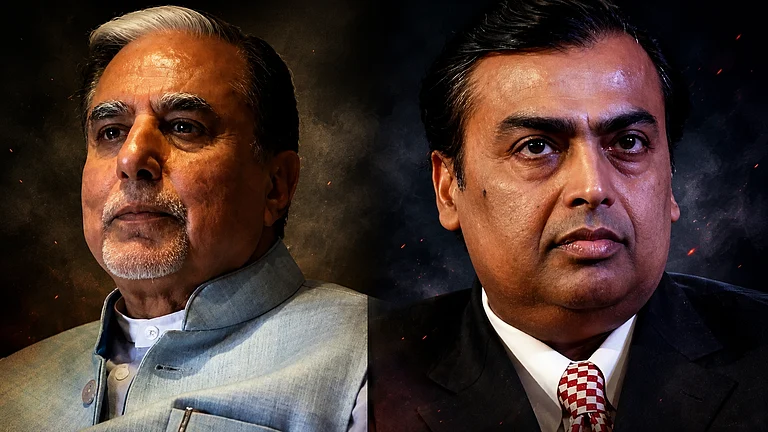

Chandra Alleges Pressure On Media, Recalls 2019 Crisis
According to Chandra, he attempted to reach Mukesh Ambani directly over the phone after the ₹22,000 crore figure began doing the rounds in the media, and also wrote him a letter on the matter. He further claimed that when a mutual acquaintance raised the issue with Network18's editor-in-chief over the loss of credibility involved, the editor responded that he had "instructions from above" and was "compelled" to act on them. Chandra said he decided to speak out publicly because he felt it was important for the truth to reach people.
Advertisement
In his statement, Chandra also revisited the events of January 2019, when Zee Entertainment Enterprises Limited (ZEEL) shares fell nearly 40% in a single trading day, a crash he attributed indirectly to shell companies. He said that when he approached Ambani with a proposal to sell Zee in order to clear his debts, Ambani advised him against repaying banks in full, telling him, "Subhash ji, why are you paying back the banks' money, including interest? No one does."
Chandra also alleged that a later attempt was made to acquire Zee in partnership with foreign investor Invesco, under terms that would have benefited his family but not minority shareholders. He said this was the reason the offer was turned down, with the company eventually opting to merge with Sony instead.
Advertisement
'Nothing Left To Lose,' Says Chandra
Describing himself as a proud corporate citizen who did not flee during a crisis, Chandra said his group had built up total debt of ₹45,000 crore, of which ₹43,000 crore had already been repaid by liquidating Zee shares and personal assets. He added that over his career, he had paid ₹60,000 to ₹70,000 crore in interest alone to India's banking system, and that only two lender accounts now remained unsettled, both backed by adequate collateral.
Addressing Ambani directly, Chandra said, "I have learnt a lot from your father Dhirubhai Ambani, but it seems you have not adopted his principles. You are trying to kill a person who has nothing left to lose." He further warned that if the alleged campaign against him, which he linked to associates such as Manoj Modi, did not stop, he would not stay silent. "You have a lot to lose and you also have many skeletons in your closet. So stop this dirty game," he said.
Chandra also responded to questions raised by Congress and Shiv Sena lawmakers over his political ties, pointing out that Zee News had backed Narendra Modi in 2014 but that he had never sought government help or bank intervention despite his financial troubles. He alleged that certain lawmakers were raising the issue at the instance of rival financial interests. He ended his statement by urging Ambani to pursue global financial dominance instead of playing "corporate games" within India.
NCLT Clears ₹6.5 Crore Settlement Plan
Notably, the National Company Law Tribunal (NCLT) approved a resolution plan under which Chandra will pay close to ₹6.5 crore towards admitted creditor claims. NCLT judicial member Nilesh Sharma, who was appointed as the third member to break a deadlock between the tribunal's original two-member bench, cleared the plan on August 25. Under the plan, Chandra is required to pay ₹6.25 crore against admitted claims of ₹22,006 crore, a shortfall widely described as a 99.97% haircut for lenders.
Government sources have called that characterisation inaccurate, while dissenting lenders have argued the payout is too low. Chandra, for his part, disputes the size of the claims altogether.
Sharma's appointment followed a split verdict from the tribunal's original two-member bench. He was brought in by the tribunal's president to resolve the disagreement and subsequently rejected objections filed by a group of dissenting creditors led by LIC Housing Finance, who had called the settlement "unviable and unlawful."
These creditors had argued that the resolution plan offered only ₹6.25 crore against admitted claims of roughly ₹22,006.57 crore, along with an additional ₹25 lakh earmarked to cover insolvency process costs. If implemented, the plan would mean creditors recover only a small fraction of their admitted claims.
Chandra Disputes Claim Amount
On August 27, Chandra stated disputing media reports that placed the total claims against him at more than ₹22,000 crore. He said the actual aggregate claim was ₹3,992 crore, and clarified that he was involved in the matter as a personal guarantor rather than as the original borrower on the underlying loans.
The dispute over the exact scale of liabilities attributed to Chandra remains unresolved, running alongside the broader disagreement over the settlement amount itself. The matter will now go back to the original two-member bench, which will issue a formal order based on Sharma's majority opinion, in line with the procedure laid out under Section 419(5) of the Companies Act, 2013.