




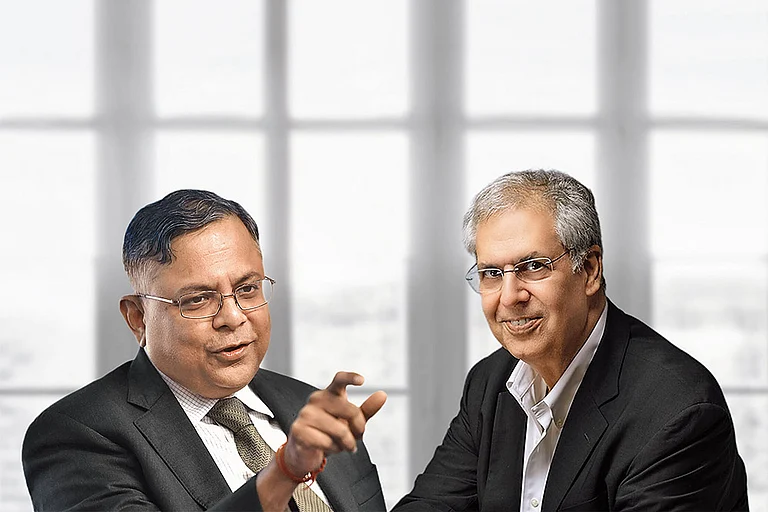
N Chandrasekaran's decision to step down as Tata Sons chairman has turned attention to what kind of company his successor will take charge of, a group with a stronger balance sheet than a decade ago but also carrying a set of capital-heavy businesses yet to turn a corner.
Chandrasekaran will stay on until February 2027 as the group works through the process of naming its next chief. Air India, Tata Electronics and Tata Digital together posted losses of nearly ₹29,000 crore in the last financial year, according to a Times of India report. These three businesses are set to dominate the incoming leadership's attention, as per ET.
An Airline Still Finding Its Feet
Of the three, Air India carries the most visibility. Tata Group took operational control of the airline in 2022 and has since pushed through a restructuring plan covering fleet expansion, integration of its aviation units and upgrades to customer-facing services.

1 September 2026
Get the latest issue of Outlook Business

Progress on profitability, however, has been slower than anticipated. The airline's losses more than doubled to ₹22,238 crore in 2025-26, per the latest available figures cited in the report.

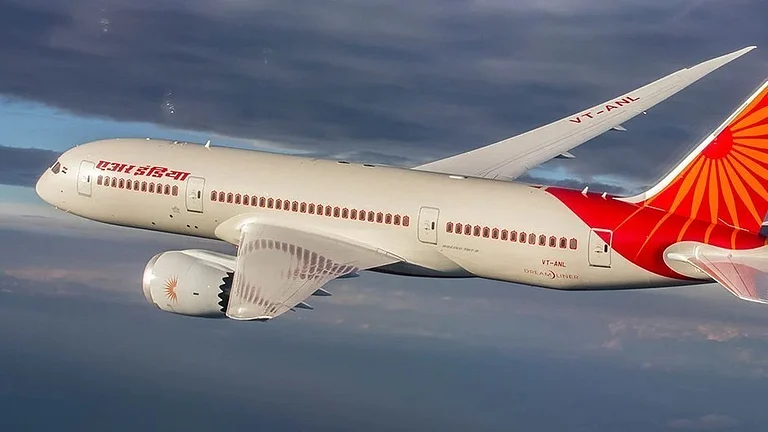

There is also a dimension beyond the numbers. The government has positioned Tata Group as a central private-sector partner in scaling up India's aviation sector, adding pressure on the new chairman to show the airline can be turned around credibly rather than simply kept afloat with fresh capital.
Advertisement
A Semiconductor Bet Built For The Long Haul
Tata Electronics sits in a different category altogether. The business has become central to the group's role in India's semiconductor and electronics manufacturing push, an area the government has actively courted private investment into, with Tata emerging as one of its most significant players.
The scale is already evident, revenue has crossed ₹1.3 lakh crore, making it the group's fourth-largest company. What is not yet evident is profitability. Semiconductor manufacturing typically demands large upfront spending, long timelines before returns show up, and considerable execution risk, meaning the new chairman inherits a business that will need patience rather than quick fixes. Tata's ambitions in this space also extend into defence, with group companies working on military aircraft and drones, deepening its footprint in strategic manufacturing.
Advertisement
Tata Digital Yet To Find Its Winning Bet
Tata Digital poses arguably the toughest question, not of scale but of strategy. Revenue rose to ₹35,990 crore last year, yet losses widened too, to ₹4,974 crore from ₹4,610 crore in FY25.
Much of that strain traces back to BigBasket, acquired in 2021 for an estimated $1.5 to 2 billion. The grocery platform entered quick commerce after rivals had already gained ground, and now holds roughly 4-5% of the market against Blinkit's over 40 percent share, with Amazon and Flipkart also pushing harder into rapid delivery.
The Tata Neu super app has run into a different problem; convincing users that bundling several Tata services into one app is reason enough to keep coming back. Three leadership changes since the platform's 2019 launch point to a business still searching for a workable model, the report added.









