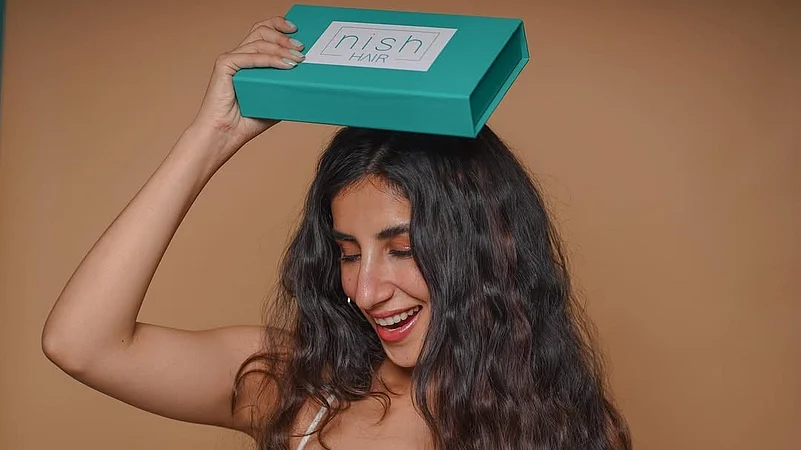

Nish Hair provides premium human-hair extensions designed to last 3 to 7 years
Parul Gulati transitioned Nish Hair from D2C to retail stores in six cities
After Shark Tank India, the brand expanded its reach and integrated strategic mentorship
The company utilizes personalized consultations and AI tech for modern hair wellness solutions
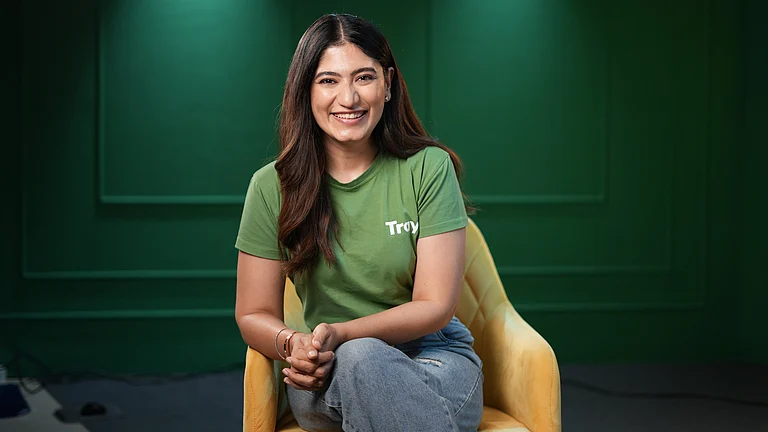
On the occasion of International Women’s Day, Outlook Business, in an exclusive interview, features actor-entrepreneur Parul Gulati, who explains how she built Nish Hair by first addressing a personal problem: the lack of natural, easy-to-use human hair extensions that would not damage real hair.
What began as a solution to her own styling challenges quickly evolved into a consumer-focused brand aimed at making high-quality hair solutions affordable and accessible.
1 September 2026
Get the latest issue of Outlook Business

Starting with hair extensions priced for everyday buyers, the company initially recorded modest sales of about ₹6,000 in its first month. However, gradual validation from customers encouraged Gulati to expand the product line, introducing coloured extensions and later clip-on bangs designed for temporary style changes.
Over time, the brand evolved from being fashion-led to addressing deeper consumer concerns, including hair loss and confidence-related issues among women.
When you were founding Nish Hair, how did you decide which product problems to solve first, was it product quality, stigma, distribution, or something else, and how did those priorities evolve as you began to scale?
Advertisement
As an actor, you are always needed to pull off new hairstyles; some days it would be braids, other days maybe curls or beach waves. Somewhere between all this constant styling, my hair was suffering, and that made me turn to hair extensions. I was on the lookout for natural human hair extensions that would be hassle-free and easy to wear and take off without damaging my actual hair. That’s how the idea for Nish Hair was born.
At the back of my mind, I was also thinking about the pricing; it needed to be fair, so every woman out there facing a similar problem didn’t have to think twice about her purchase. That's how I ended up starting with hair extensions. In my first month, I sold products worth six thousand, which was enough to let me know I was on the right track.
Once we completed all the trials and errors and perfected the extensions, we realised it's time to solve a newer problem. That’s when I realised why don’t we try developing different coloured hair extensions? After all, that could be a fun and fashionable statement piece in every woman's wardrobe. Once we realised the demand existed, our next step was to meet that demand.
As a kid, almost every girl has cut up her bangs, realised she hated the way it looked, but then just had to live with it. So the next product in line had to solve that problem. I, myself, loved bangs, but on certain days I just would not, and I’m sure we all have those phases.
My clip-on bangs were for exactly those phases. Soon, I realised I’m not the only one. After all, we are a country of over 1.4 billion people, almost half of whom are women. If even a very small percentage of this demographic is seeking such a product, I realised I could bring them happiness without burning a hole in their pockets.
That’s how Nish Hair started, and now it just continues to grow. Of course, since we started scaling, my decisions are now backed by more consumer opinions and demand in the market. We started by listening to what problems our consumers faced and discovered gaps where we could fill in. Soon, Nish Hair went from a brand that sells fashion to a brand that solves real problems, including something as personal as hair loss.
Advertisement

Your products centre on premium human-hair extensions: can you walk us through the key quality and sourcing decisions you made early on? For example, where you source hair, what quality controls you insist on and how those choices shape your brand promise?
I still remember when I was just starting, I had a difficult time finding vendors who could match the standards and quality of hair I was looking for. During that time, I had reached out to multiple vendors, and in that group of countless people, I found a few that truly met a few items on the checklist that I had in mind.
For the first couple of years, I wouldn't even sell 1 Kg of hair I purchased, but soon I met a few more vendors, and two of them hit all the marks on my checklist. Now the rest is history. I’ve been with those vendors ever since, and that ensured consistent quality as we scaled. Apart from having fixed vendors, we also have a few processes and procedures in place for quality assurance. The thing with real hair is that it comes with a lot of challenges. So we have to ensure and test it for daily usage without falling apart.
Also, every product has a different type of testing and a life span. With clip-ins and extensions, our products can last a good 3 to 7 years. When it comes to wigs and hair toppers, our testing is slightly different because they are made using thin hair for women who have naturally thin hair. At the end of the day, for us, it is about delivering beyond expectations and more than fulfilling our brand promise.
How does creative risk-taking, like the Cannes look fit into your broader communications strategy for the brand, especially when some people read stunts as publicity and others see them as storytelling?
Cannes is a place for storytellers, and I just happen to be one. At the time, I didn't have a movie to promote, but I did have a story of my own. And that’s how I put out my story in the most bold, creative and ingenious way possible.
A dress of braided hair, completely made out of human hair - you see, it sounds a bit insane. But then this one idea sparked with the team as well, and we thought, what is stopping us from doing it? That’s how it then grew into this big brand story and a powerful way to communicate what Nish Hair stands for.
I know a few people might view it as a publicity stunt, but for me, it was a once-in-a-lifetime opportunity. It was like a little girl's dream come true. I wore my story and walked the red carpet at the world’s biggest film festival. It was a big risk, but a little risk sometimes is all the push you need for your business to reach a global audience.
Retail is a different beast from D2C, You’ve been expanding offline into cities such as Hyderabad and beyond. What changes when you move from an online-first model to a physical retail footprint and how do you keep the brand experience consistent?
When we started Nish Hair, it was the only online company in the hair extensions space and the first of its kind in the country. But even during that time, we would set up offline pop-up stores, and those showed great results. Since hair is such a personal thing, a lot of people love to actually touch, feel and try products before buying. So, naturally, people started loving the offline experience as well.
So yes, while retail is very different from D2C, if we maintain a balance when building a category up like this, it just works. While we try to ensure a similar customer experience across both offline and online channels, a physical store offers something different, and I want to give more of that to my customers. We have expanded into Hyderabad and five other Indian cities. We’ve also launched a store in Dubai. Now, I plan to keep growing and mark our presence in all cities in India and beyond.

Walk me through the operational side of scaling retail: what did you have to change in supply chain, inventory planning or staff training to support faster store rollouts while preserving product quality?
We started as a digital-first brand, and prepared an order only when it got placed. It was a short-term strategy to make more of what little we had. Our turnaround time was about a day or two, which still stands the same. Now, we just plan better. Our inventory is stocked, labelled, and segregated.
Every team member at Nish Hair is trained by just one person. It all started with that one person training 10 people, and it has only grown in numbers ever since. That same person now goes to different locations to train our people. So, even with staff training, we’re ensuring that our values, processes, and ways of working remain consistent. Our staff is well-trained to drive product quality, and things are a lot more streamlined to drive faster roll-outs.
Another interesting thing is that when you visit our stores, especially our flagship store, you will find a consultation-based business. We work with every client to understand their needs and suggest the best products to them, so they don’t have to buy products off the rack. To ensure all of this stays on track, we need to maintain high standards when it comes to our staff and our training, so that every customer has an experience worth sharing.
After raising investment following the Shark Tank lift, what were the biggest strategic shifts you made with fresh capital and what pressure, if any, did outside investors introduce?
While I did raise investments, appearing on Shark Tank brought me a lot of reach and exposure. I transitioned from a sole proprietor to a private limited company, which was one of the major milestones in my career and for Nish Hair.
The funding took almost two years to get through, but the growth momentum worked in my favour. Although I was introduced to new investors after Shark Tank, raising funds was never a goal for me. My focus was and will always be on delivering well and doing justice to the one person from whom I raised money. And I could do that, thanks to some luck and a lot of hard work and maybe even some tears, both happy and sad.
So, on Shark Tank, my goal was purely to seek the right mentorship. Amit Jain is someone I still look up to, and in a way, he is my Guru. And while I don't intend on raising any funds right now, I do plan on sticking with him to keep getting better with Nish Hair.
How has your leadership style changed as the team has grown from a small founding group to the larger organisation you have today and what rituals or hires helped you create the culture you wanted?
I must say, leadership humbles you.
In the beginning, I had a “go with the flow” and “we’ll figure it out” approach to every challenge that came our way. But I soon realised that businesses don’t sustain on just winging it. Over the years, I honed my leadership skills through the mentoring of a fantastic business coach, who is helping me be a better leader in every sense.
I love to admit that I am not the sole custodian of my company culture, a few team members and I are building a culture we all love, together. We are building a culture where everyone, including me, is accessible and approachable. I’m still as involved in the day-to-day shenanigans as I was on day one, just maybe now a bit more strategically.
Customers usually might just see me on social media when the content goes out, but I’m just as involved behind the scenes. A lot of the firefighting, quick decision-making, and pushing ourselves to do better is driven by me. I like being challenged, and so does my team. We are a team of hungry people, waiting for any and every moment to live up to our full potential. We get things done, and we do it very passionately.
Looking at competition and category evolution, what do you see as the next big product or service adjacencies for a company like yours and how are you preparing for them?
A brand like Nish is all about understanding that everyone’s hair journey is different. No two people want the exact same thing, so personalisation and customisation are a huge part of what we do and something I’m really excited to keep building on.
When I started out, hair extensions and wigs were almost a hush-hush topic in India. People were curious, but they were also hesitant to talk about it openly. Seeing how comfortable women are with it today makes me really happy. It feels like we’ve all collectively helped normalise the conversation around it.
Looking ahead, I’m also really interested in exploring the hair wellness space. There’s so much untapped potential there, and I genuinely feel like there’s a lot more we can do for people beyond just styling. At the same time, we’re also looking at integrating better tech, like AI and virtual try-ons, so people can actually see what works for them before they even try it.
And honestly, I love that more people are entering this space now. It means there’s more awareness, more conversations, and more demand. When I started, I was one of the very few people on social media talking about human hair extensions, explaining how they work and how natural they can look. So it’s really nice to see how much the industry has evolved since then.
Finally, if you could write a short note to the next generation of female entrepreneurs, one line of advice and one specific resource or habit you recommend, what would that note say?
For future female entrepreneurs, I’d say, stop procrastinating on your idea and take action now. All you need is an idea. And if you have it, what you need next is action. Then keep learning, evolving, and growing from there.
Once you take that step and start building your business, keep tracking your numbers weekly. Build a habit out of it. Because once you understand your numbers, you have the power to do anything and everything with your own business. It will ensure that no one takes advantage of you and no one has the guts to take you lightly as a woman founder. This one thing alone can put you ahead of the competition.