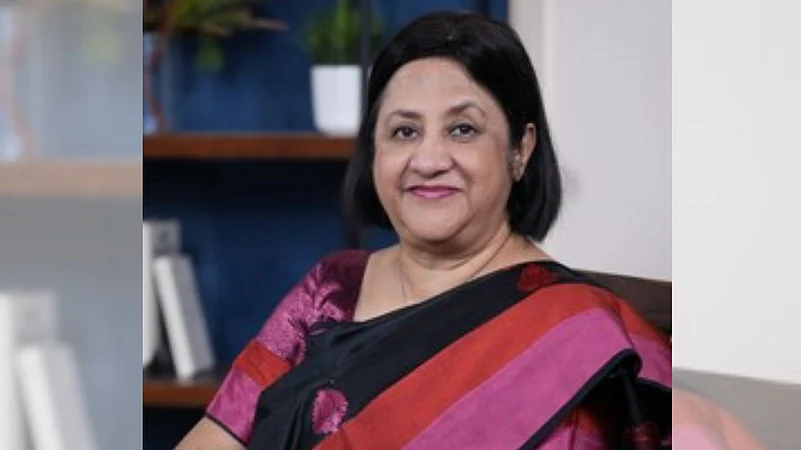

Arundhati Bhattacharya said formal workplace structures may be gender-neutral, but social barriers—such as housing discrimination and remote postings—continue to affect women’s career mobility.
Drawing from her experience at SBI and Salesforce, she noted that global firms rely more on structured processes to address bias and ensure equality.
Bhattacharya said AI can deepen human relationships in banking by freeing employees from routine tasks and enabling better customer engagement.
With over four decades in banking and finance, Arundhati Bhattacharya is one of India’s most prominent business leaders. A career banker who rose through the ranks to become the first woman chairperson of the State Bank of India and later led Salesforce South Asia, she has been recognised among Forbes’ most powerful women globally.
Speaking to Outlook Business on the occasion of International Women’s Day, Bhattacharya draws on her experience across public sector banking and global technology firms. She discusses the evolution of women’s leadership, the hidden barriers that still shape careers, and how artificial intelligence could transform the future of banking and work. Edited Excerpts:
1 September 2026
Get the latest issue of Outlook Business

You have led a PSU like SBI and now lead a global tech firm. In your experience, how do opportunities and barriers for women leaders differ between traditional institutions and global firms?
If you talk about legacy institutions, as far as SBI is concerned, SBI is really a meritocracy. To that extent, it is not as though there is any lack of opportunities for women.
Having said that, there are definitely issues regarding the logistics that women have to manage in order to be able to stay the course in SBI. For instance, you can get transferred to very remote places. Women who have a lot of responsibilities at home, or who are single mothers, find it very difficult.
The company often does take these things into consideration. But I also know of cases where these things have not been kept in consideration. So it is more person-driven rather than system-driven to ensure that this consideration is given.
In the private sector, especially in companies like Salesforce, these things are process-driven. They are not person-driven. On top of that, there is the issue of unconscious bias. We do not quite realize it unless we really dig into it, and that is something that companies like Salesforce make you do.
We are required to take unconscious bias training before we interview a single person. A person like me, who thought I was wasting my time taking such training, actually found that I did have unconscious bias.
You do not realize that you are asking an entirely different set of questions to a male candidate and to a female candidate. That should not be the case. It should not be gender-specific. Multinational companies give you better awareness of these things.
The processes here are meant to ensure equality.
In the private sector there is often gender pay disparity as well, this does not happen in the public sector, where women get paid less. There is a lot for our private companies to learn regarding the way equality can be maintained in companies such as the one that I am working in right now.
Advertisement
You mentioned unconscious bias. Could you elaborate on some of the structural barriers that still persist in different forms in both private and public sectors?
There is no structural barrier as such, but hidden barriers persist such as housing discrimination against single women and transfers to remote locations, which can force long commutes and make it difficult for women to stay in the workforce.
There are issues that we need to take care of, and there is definitely a long way to go before we can make sure that women are not leaving.
Another structural barrier, if you call it that, is the inflexibility regarding the fact that people are expected to come in at a particular time and leave at a particular time.
Flexibility in timings and flexibility in placements are important. If companies are a little more sensitive to these needs, it can make a woman’s life much easier.
Advertisement
While the digital economy is expanding rapidly, the gender gap in AI and deep tech remains stark. How inclusive is the AI ecosystem today?
As far as engineers are concerned, at least in our country we have a lot of STEM graduates. We see no dearth of women engineers.
The question of maintaining those women engineers in service is the result of other factors. It is not because they are not being allowed in. It may be because they do not feel appreciated, or because they have primary caregiving duties that need to be prioritized, and because of that they leave.
For people using AI, it is also a question of the availability of phones in the hands of women. If the phone itself is not available, their usage of AI or even digital technology will be lower.
Over time, we are finding that this is improving as more women gain possession of smartphones.
Whether that access extends to AI is yet to be seen. Moreover, in order to use AI even today, you need more or less a working knowledge of English. It does not work so well in the mother tongue yet, but efforts are being made.
Once it starts working in the mother tongue, you will see far more inclusion. AI democratizes access because it gives access to knowledge and information that people did not have before.
The question then is how to increase usage. One is that you should have the instrument, and the second is that you should have the ability to communicate with the device.
If you have these two, then there is no question of a divide. This is not dependent only on gender. It depends on how the technology evolves. Going forward, we will see more inclusion rather than the other way around.
As banking tasks become increasingly automated, does the next generation of banks risk losing the human relationships that you helped build at SBI, or does AI actually deepen trust?
AI should actually deepen relationships.
Today the workload is such that the person at the counter does not really get a chance to say hi. AI gives humans more time. If we use that time intelligently, the time given back to us can improve human interaction.
But if we do not use that time well and instead open more screens and continue working mechanically, then nobody can help.
What does real enterprise adoption of AI agents look like today, and how realistically do you see scaling happening over the next couple of years?
In the next one year, scaling should happen. There are two ways in which agents can be used well: internal use and external use.
Internal use is already quite common. This includes searching for knowledge, summarization, improving communication, and preparing for meetings.
What has not scaled yet is external use because there is still a trust issue. People are still wondering whether it is the right thing to do, or what happens if the agent gives a wrong message.
But even human beings can give wrong advice. When an agent gives a recommendation, there is a clear audit trail. It shows the sources or articles on which the recommendation is based.
If something is wrong, the organization can correct the mistake and ensure it is not repeated.
Using agents for customer-facing interactions can actually be more error-free and may lead to better customer satisfaction.
What we will see in the next year is scaling of customer-facing agents, while internal usage will continue to grow.